Canary islands. Graphic - M. HersherScience; Data - Ancient World Mapping Center, University of North Carolina at Chapel Hill.
I have
written about lithophones, as well as music and rock art, in previous columns (please
check the cloud index at the bottom of the blog to see those articles). In this
column I am going to discuss the relationship of lithophones to rock art panels
on the Canary Islands.
El Hierro Petroglyphs ,Rock Art on the Canary Islands, Spain.
In a study
of the rock art and lithophones of the Canary Islands, lead author Marco
Merlini explained “Rock carvings are one of the most significant
expressions of Guanches, the aboriginal stone age population that disembarked
at the Canary archipelago during the first millennium BCE. It was formed by
Paleo-Berbers with roots in the Mediterranean North African koine and with
close links to the Libyan-Punic milieu.” (Merlini 2019:1) In linguistics, a koine or koine
language or dialect is a standard or common dialect that has arisen as a result
of the contact, mixing, and often simplification of two or more mutually
intelligible varieties of the same language. (Wikipedia) Lithophones have been
found all over the world and from a great many cultures, both ancient and
modern. These musical rocks consist of many different minerals from limestone, lavas
and granites to jade and stalactites.
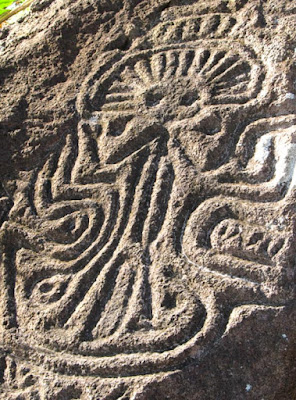
Petroglyph rock on the Canary Islands. Online image, public domain.
In
the Canary Islands “lithophones are
located alongside petroglyphs, drawings and inscriptions incised into rocks of
archaeological sites that are often astronomically significant. The sound rock
sites and their use from prehistorical
times until recent times are recalled by oral tradition too. In several instances, we know only the toponyms of the
lithophonic sites, their location, and a generic oral memory emphasizing their
special (and sometimes reputed magic) sonorous effects. The collective,
although feeble, reminiscence maintained in the Canary Islands generation after
generation represents the fundamental base of the investigation on the music of
the stones. It includes: explication of toponyms; association of the
lithophones with the ancestral meaning of rock carvings, channels, cup-marks,
and other types of rock art in the surrounding
areas; their relationship with engraved texts; connections of the ringing
stones with legends and related traditions as places of worship, and/or of
performing special rituals, and/or of supernatural
interest and consecration.” (Merlini 2019:246) The authors included no actual
factual evidence of astronomic significance of either petroglyphs or
lithophones, but the possibility is not out of the question.
“Canary Archipelago
possesses an atout (asset) for our chances to
understand the pre-historical exploitation of rock art sites for music-making.
If we get to know that a natural “rock gong” produces sounds on a musical
scale, then the subsequent question is to understand how it was used in the
past, and even if it was actually in use. Association with musical instruments,
petroglyphs, cave paintings and archaeological remains give only partial hints.
The lithophones of the Canary Islands were alive in the troglodyte pre-Hispanic
period and sometimes even after it. Part of the question concerning their
exploitation is therefore solvable thanks to oral traditions or legends about
their role in ceremonies or in creating an alert. The Canary Islanders,
descendants from the Guanches, keep memory about certain stones and rock
surfaces that were in use even in historical times to produce a peculiar
metallic sound when being struck, and their peculiar association with rock art
engravings.” (Merlini 2019)
Petroglyph rock on the Canary Islands. Online image, public domain.
Robert
Bednarik (2010) wrote about lithophones being useful for long distance communication.
“Judging from
the few recorded instances it seems the utilitarian role of lithophones or rock
gongs relates primarily to the communicating or carrying ability of the
produced sound, and the metallic sound of effective lithophones can carry over
distances of several kilometres. as mentioned above, in one report it serves to
communicate with ancestors.” (Bednarik
2010:117)
Rocking lithophone on Canary Islands, Image from tenerifeweekly.com.
The government has sponsored a study of Canary Island
lithophones. “Through the work promoted
by the General Directorage of Cultural Heritage in Tenerife, La Gomera and El
Hierro, three types of lithophones have been documented: percussion, aerophones
and rocking. The latter has only been found on the island of El Hierro and, as
its name suggests, the sound is produced by rocking.” (Europa Press 2022)
Someone standing on the top stone with one foot on each side can, by shifting
weight, start a rocking motion on the top stone. The friction between the
shifting top stone and the rock beneath causes the vibration that makes the
sound. I wonder if the top stone would also ring if just struck like the other
lithophones?
Canary island lithophones showing striking points. Online image, public domain.
“Sometimes Guanches
shaped the acoustic space. In certain cases, they arranged the stone blocks to
empower their sonority. For example, lithophones have been oriented to empower
the sounding board effect of the surrounding space. In other cases, the natural
sound of the rocks was accentuated by artificial layout and configuration of
the place (Ulbrich 2003).
Lithophones
are located alongside petroglyphs, drawings and inscriptions incised into rocks
of archaeological sites that are often astronomically significant. The sound
rock sites and their use from prehistorical times until recent times are
recalled by oral tradition too. In several instances, we
know only the toponyms of the lithophonic sites, their location, and a generic
oral memory emphasizing their special (and sometimes reputed magic) sonorous
effects. The collective, although feeble, reminiscence maintained in the Canary
Islands generation after generation represents the fundamental base of the
investigation on the music of the stones. It
includes: explication of toponyms; association of the lithophones with the
ancestral meaning of rock carvings, channels, cup-marks, and other types of
rock art in the surrounding areas; their relationship with engraved texts;
connections of the ringing stones with legends and related traditions as places
of worship, and/or of performing special rituals, and/or of supernatural
interest and consecration. However, still nowadays the ancestral sonorous rocks
are affected by suspicions that chains them to "pagan culture and
spirituality". Lithophones have a diversity of forms, structures,
geological frames and sounds, but they share a gloomy common denominator: most
of them have been vandalized, plundered, but never Christianized,
i.e. reformulated and taken under control by the Catholic Church and its
liturgy. Contrariwise, the lithophones had a social and cultural solid place in
the Canary native world.” (Merlini 2019)

Lithophone playing in the Canary Islands. Online image, public domain.
In the statement by Bednarik above (2010) he
speculates that the primary utilization of lithophones is for communication.
This generalization seems based on the fact that any form of sound produced and
then heard is, in some sense, communication. “Most likely, their ancient function was multiple, taking advantage of
their sonority and the exceptional loudness that benefit the sites in which
they are embedded. Prehistoric and protohistoric manifestations firstly
inserted the lithophones among the natural sites that anchored animism and
attested the magic-ritual features of the sound of the volcanic stones. Music
had not only a playful character, but also ceremonial in association with
crops, cures, and offerings to divinities and deceased. Spanish conquerors and
their chroniclers inform about rites of the ancient Canarians, mainly hinged on
the request for rain. They included fasting of the entire village, processions
with their livestock to certain elevated places or to the ocean, lamenting
invocations by humans and even cattle and flocks (that Europeans misunderstood
as yelling and barking), round dances, beating the ocean with sticks, sink
palms and branches into the sea to make them weep, etc. Lithophones offered support
for rhythmic or a-rhythmic sound production within the proscenium for the
sacred acts aimed to gain the divinities’ pity (Ulbrich 2003).” (Merlini
2019) Again, the purpose is assumed to be communication, in this case with the
divinities.
Of course tapping or pounding a boulder with another rock will
eventually make marks, especially since reportedly many of the lithophonic
boulders make different notes what struck in different locations. The question
then should be are these marks also petroglyphs although they are a result of
making a sound, not an image? Unfortunately, Merlini’s paper (2019) neglects to
establish any relationship between the lithophones and certain petroglyphs,
although a few may be discerned from illustrations.
NOTE: Some images in this
posting were retrieved from the internet with a search for public domain
photographs. If any of these images are not intended to be public domain, I
apologize, and will happily provide the picture credits if the owner will
contact me with them. For further information on these reports you should read the
original reports at the sites listed below.
REFERENCES:
Bednarik, R. G., 2010. About lithophones. In R. Querejazu Lewis and
R. G. Bednarik (eds), Mysterious
cup marks: proceedings of the First International Cupule Conference, pp. 115-118, BAR International Series 2073,
Archaeopress, Oxford. Accessed online 18 June 2024.
Europa Press, 2022, Documented
a new typology of lithophones in El Hierro, 15 June 2022, Tenerife Weekly, https://tenerifeweekly.com. Accessed
online 11 February 2024.
Merlini, Marco, 2019, The Sound of Rock Art: Canary Lithophones, https://www.academia.edu. Accessed online
17 June 2024.
Wikipedia, Koine language, en.wikipedia.org/wiki/koine_language. Accessed
online 16 September 2024.
SECONDARY
REFERENCE:
Ulbrich, H. J., 2003, Frequenzanalyse eines Lithophons auf Lanzarote
(Kanarische Inseln), Almogaren XXXIV,
Wien, p. 331-346.





 Posts
Posts

