Saturday, February 25, 2023

A NEW VIEW ON INCOMPLETE HANDPRINTS IN EUROPEAN CAVES:

Stencilled handprint with missing fingers, Gargas Cave, France. Internet photograph, public domain.

I have previously written a number of columns in RockArtBlog about handprints (see hand print in the cloud index at the bottom of the page with a couple more under gender). Subjects have included determining gender from handprints, handedness from handprints, and handprints as a system of numerical notation. Many handprints (especially in the Paleolithic painted caves of Europe) are incomplete showing apparently missing finger joints of whole fingers. Various reasons for this have been proposed including fingers missing because of injury or fristbite, and counting systems where whole fingers and folded fingers represent differing numbers in a notation.

Stencilled handprint with missing fingers, Cosquer Cave, France. Internet photograph, public domain.

A 2018 paper published online brought out a new proposal for the reason we find hendprints with missing finger joints or fingers. McCauley et al. (2018) studied the phenomenon of phalangeal amputation across a broad range of indigenous cultures and identified seven separate reasons for the removal of finger joints among these peoples.  

Stencilled handprint with missing fingers, Maltravieso Cave, Spain. Internet photograph, public domain.

Sacrifice: the amputation to appeal to a deity for assistance. The most common type of finger amputation, they found thirty-three groups that practiced this: sixteen from North America, ten from Africa, six from Oceania, and one from Asia. More common in females than in males, it was also more common in children than adults. Typically the distal phalanx of the fifth finger would be removed from one hand or the other. (McCauley et al. 2018) An example would be members of the tribes of the Great Plains of North America who would sometimes remove a finger joint during the Sun Dance to appeal to the Great Spirit.

Stencilled handprints with missing fingers, Gargas Cave, France. Internet photograph, public domain.

Mourning: wherein close relatives of a deceased individual would remove finger joints as an actd of extreme grief. Thirty groups displayed this practice: fifteen from North America, six from Africa, six from Oceania, and three from South America. (McCauley et al. 2018)

Identity: finger amputations carried out to mark group membership. Nineteen groups in their sample engaged in this practice: nine from Australia, eight from Africa, and two from North America. (McCauley et al. 2018)

Stencilled handprints with missing fingers, Gargas Cave, France. Internet photograph, public domain.

Medical: in this practice finger amputation was used to resolve a health problem. It not only includes fingers that have been physically damaged (e. g. frosbitten or crushed) but also amputating undamaged fingers to bleed sickness out. Twelve groups engaged in this practice: eight from Africa, two from North America, one from Eurasia, and one from Oceania. (McCauley et al. 2018)

Marriage: This was removal of a phalange prior to the amputee getting married. This was engaged in by two groups; one from Africa, and one from Australia. In both cases it was female specific and involved the removal of the distal phalanx of the left hand. In both of these groups it was carried out by tying a cordd tightly around the finger until the phalange fell off. (McCauley et al. 2018)

Punishment: Twenty three groups practiced finger amputation as a form of punishment: sixteen from Africa, four from Asia, two from North America, and one from Oceania. (McCauley et al. 2018)

Veneration: McCauley et al. found one example of this from North America. In this case and elderly Sioux woman cut off all the fingers of some Chippewa children and strung them on a ritual necklace. (McCauley et al. 2018)

View of the "Panel of Hands," Gargas Cave, France. Illustration from the Wendel Collection, Neanderthal Museum.

McCauley et al. also recorded some instances of the practice of amputating fingers of an individual after death but these would be irrelevant to this practice because we would not expect a dead person to be leaving handprints in a cave.

"We identified 121 groups that engaged in finger amputation at the time they were studied by ethnographers. Among these groups there were ten different reasons for engaging in finger amputation. Of these ten, the one that best fits the available data for the UP (Upper Paleolithic) incomplete hand images is voluntary sacrifice to a deity or supernatural power." (McCauley et al. 2018) So, based on this study, we have a new candidate for the reason some handprints show missing fingers or joints - voluntary sacrifice.

This comprehensive study illustrates the difficulty of interpreting the moteve from just the image. Far from proving either frostbite, or a counting system, a missing finger could represent any of these seven cultural practices, as well as indicating frostbite, or a counting system. It is just not as simple as it looks.

NOTE: Some images in this posting were retrieved from the internet with a search for public domain photographs. If any of these images are not intended to be public domain, I apologize, and will happily provide the picture credits if the owner will contact me with them. For further information on this subject you should read the original report at the site listed below.

REFERENCES:

McCauley, Brea, David Maxwell and Mark Collardi, 2018, A Cross-Cultural Perspective on Upper Palaeolithic Hand Images with Missing Phalanges, published online 21 November 2018, Journal of Palaeolithic Archaeology, Springer Nature Switzerland AG. 


Saturday, February 18, 2023

MORE GAMES IN ROCK ART - STONE SPHERES ARE BELIEVED TO BE ANCIENT GREEK GAME PIECES:

Minoan stone spheres. Internet photograph, public domain. 

Minoan stone spheres from Akrotiri, Thera island, Greece. Photograph from Fernee and Trimmis, 2022.

Among other artifacts from the fascinating Minoan Culture are stone spheres of various sizes. Also found at Minoan sites are stone slabs with pecked cupules or depressions. A 2022 study by Christianne L. Fernee  and Konstantinos P. Trimmis associated these artifacts and postulated that the spheres are pieces in an ancient Minoan board game with the pecked stone slabs representing the boards.


Minoan stone spheres from Akrotiri, Thera island, Greece. Photograph from Fernee and Trimmis, 2022.

“The Minoan civilization was a Bronze Age Aegean civilization on the island of Crete and other Aegean Islands, whose earliest beginnings date to c. 3500 BC, with the complex urban civilization beginning around 2000 BC, and then declining from c. 1450 BC until it ended around 1100 BC.” (Wikipedia)

Akrotiri, Thera island, Greece. Internet photograph, public domain.

Although these artifacts have been found at a number of Minoan sites, by far the greatest number of the spheres have been discovered at the Minoan city of Akrotiri. “The site of Akrotiri on the modern-day island of Thera (Santorini) is a well-known Bronze Age town that was destroyed by the eruption of the island’s volcano during the Middle Bronze Age (possibly during the early 16th century BCE. In Akrotiri, among a wealth of finds, 746 spherical lithic objects have been catalogued, of which 65% were brought to light in the recent excavations for the new shelter. The spheres come in different sizes, colours, and stone materials, and have been found throughout the settlement, in both open and closed spaces. Small numbers of similar objects have been discovered in Cyprus and Crete. Akrotiri, however, is unique due to the large number of spherical objects published to-date. The wealth of spherical objects in Akrotiri, has resulted in different interpretations regarding their use by different researchers. Marinatos (1971) interpreted the spheres as either sling stones or as tossing balls. Later, this interpretation was rejected by Valacy (2022) and Tzachili (2007). They suggest that the spheres are unlikely to have been sling stones as all other examples from this period, and from later periods, are generally heavier than most ot the spheres from Akrotiri and are more ovoid in shape. Valacy and Tzachili suggest they are unlikely to have been used as tossing balls as they could easily harm the players if not caught. They agree, however, that the spheres may have been used as a counting/record-keeping system or as counters/pawns for a type of board game.” (Fernee and Trimmis 2022)

Stone slab with pecked depressions. Phaistos, island of Crete, Greece. Internet photograph, public domain.

What does not seem to have been considered in these studies is the possibility that the stone spheres are weights. Akrotiri was a Minoan city, and the Minoans were traders with their ships known all over the eastern Mediterranean. Weights and measures are vital to traders of commodities. Most known Minoan weights, however, are made of lead, and while stone weights have been found they are generally cone or disc shaped, not spherical. (Alberti 2006) Given the presence of the stone slabs with pecked cupules it would seem more likely that the spheres represent game pieces with the slabs representing the game boards.

Stone slab with pecked depressions. Phaistos, island of Crete, Greece. Internet photograph, public domain.

“It will here be suggested that the Cretan stones with the depressions arranged in a roughly circular shape represent a simplified version of Mehen (an Egyptian board game). This suggestion is strengthened by the fact that stones on which the depressions seem to be arranged in the form of a spiral have been found at Malia as well as in a Middle Minoan context at Dato Zakro, while at Gournia several of the floor slabs in House Aa have a double ring of depressions as does one of the stone from Chrysolakkos.” (Whittaker 2002:77)

Another example of game boards pecked out of the surface of a stone once again emphasizes the importance of game playing in human cultures. I wonder how far back we will eventually be able to trace this phenomenon.

NOTE: Some images in this posting were retrieved from the internet with a search for public domain photographs. If any of these images are not intended to be public domain, I apologize, and will happily provide the picture credits if the owner will contact me with them. For further information on these reports you should read the original reports at the sites listed below.

PRIMARY REFERENCES:

Fernee, Christianne L. and Konstantinos P. Trimmis, 2022, The rolling stones of Bronze Age Aegean: Applying machine learning to explore the use of lithic spheres from Akrotiri, Thera, October 2022, Journal of Archaeological Science: Reports, Volume 45. Accessed online 14 December 2022.

University of Bristol, 2022, Stone spheres could be from Ancient Greek board game, 30 September 2022, https://phys.org/news/2022-09-stone-spheres-ancient-greek-board.html. Accessed online 14 December 2022.

Whittaker, Helene, 2002, Minoan Board Games: The Function and Meaning of Stones with Depressions (so-Called Kernoi) from Bronze Age Crete, pp.73-87, Aegean Archaeology Vol. 6, Studies and Monographs in Mediterranean Archaeology and Civilization, Ser. II, vol. 7, Art and Archaeology, Warsaw.

Wikipedia, Minoan Culture, https://en.wikipedia.org/wiki/Minoan_civilization. Accessed online 4 February 2023.

SECONDARY REFERENCES:

Alberti, M.E., E. Ascalone, and L. Peyronel, (Editors), 2006, Weights in Context: Bronze Age Weighing Systems of the Eastern Mediteerranean Chronology, Typology, Material and Archaeological Contexts, Instituto Italiano di Numismatica, Rome, p. 384, ISBN 88-85914-44-6, Judith Weingarten reviewer. Accessed 2 February 2023.

Marinatos, S., 1971, Excavation at Thera V, Hetaireia, Athens.

Tzachili, I., 2007, Poikila. In: Doumas, C. (Ed.), Akrotiri Thera, Western House, Athens, Archaeological Society of Athens, 256-258.

Valacy, L., 2022, The Small Stone Spheres from Akrotiri, Thera, In: Doumas (Ed), Akrotiri, 40 years of Research, Archaeological Society of Athens, Athens.


Saturday, February 11, 2023

HERE WE GO AGAIN – ANOTHER CLAIM FOR PALEOLITHIC WRITING:

Aurochs with four dots. Illustration from Bacon et al., 2023.

Periodically, claims spring up that some of the imagery in Paleolithic cave painting in Europe represents early forms of writing, or proto-writing. I have addressed that claim more than once in previous columns, which you can visit by clicking on ‘writing’ in the cloud index at the bottom of this blog.

Another aurochs with four dots. Illustration from Bacon et al., 2023.

A lengthy paper by a team of researchers from England has brought this idea up again in a new context. Their lengthy and complicated analysis has led them to the conclusion that the marks associated with prey animals on cave walls represent records of the fertility cycles of the animals in question, their season of reproduction, etc.

Horse with three marks. Illustration from Bacon et al., 2023.

In 1999, Carol Fritz had looked at Magdalenian art and concluded that the markings that accompany animal portrayals represent an artificial/external memory system for the Upper Paleolithic artists. In other words, they were a record of something. "Fritz assembled a database of 90 Magdalenian portable objects from the Dordogne and the Pyrenees, noting considerable consistency in the 'pricipal types [of sign] including linear marks, dashes, angular signs, arc shapes, broken lines . . . dots, various impact marks and combinations and repetitions thereof' with no site- or region-specific difference. She concluded that these were underpinned by a single conceptual scheme that lacked any significant variation in space or time. There is, therefore, little controversy that the use of sequences of dots, lines and other marks, often associated with animal images, reflected a widespread use of cardinal artificial/external memory systems in Upper Palaeolithic space and time. The actual subject of such systems - the information recorded in them - has been, so far, elusive." (Bacon et al. 2023) This seems reasonable, she is saying that whoever made the marks was recording something, perhaps numbering.

Examples of cave art with "Y" signs. Illustration from Bacon et al., 2023.

 Bacon et al. (2023) addressed those symbols in an attempt to understand what was being recorded. “Our interest is in the sequences of dots/lines associated with the depictions of prey animals in Upper Palaeolithic art, and in the <Y> sign that appears in some of these sequences. As we have noted above, it seems justifiable to assume that such sequences were saying something about the specific taxa with which they were associated, rather than forming a part of the depiction. If they depict blood or breath, for example, why would several taxa including aurochs, fish and a cicada be consistently marked with four dots/lines in various anatomical locations (Aujoulat 2005)?” (Bacon et al. 2023) The authors define these associated marks as meaningful to the animal image they accompany. Their conclusion is that they convey information about the reproductive cycles of the animal; the season of fertility, length of pregnancy, etc., and that the Upper Paleolithic hunters needed to have this information recorded for some reason.

Probable horse with three marks. Illustration from Bacon et al., 2023.

“We believe that we have demonstrated the use of abstract marks to convey meaning about the behavior of the animals with which they are associated, on European Upper Palaeolithic material culture spanning the period from ~37,000 to ~13,000 B.P. In our reading, the animals integral to our analytical modules do not depict a specific individual animal, but all animals of that species, at least as experienced by the images’ creators. This synthesis of image, mathematical syntax (the ordinal/linear sequences) and signs functioning as words formed an efficient means for recording and communicating information that has at its heart the core intellectual achievement of abstraction. The ability to assign abstract signs to phenomena in the world – animals, numbers, parturition, cyclical phases of the moon – and subsequently to use these signs as representations of external reality in a material form that could be used to record past events and predict future events was a profound intellectual achievement.” (Bacon et al. 2023).

Cervid with six red dots. Illustration from Bacon et al., 2023.

This goes somewhat farther than I am comfortable with. I certainly agree that the marks in question could be some form of notation, possibly numbers. And, I can accept the concept that the Upper Paleolithic creators of the imagery understood abstraction. What I have trouble with is the authors’ implication that it is a form of communication that, like writing, someone else in the group who had not been coached in its meaning could see it for the first time and appreciate the meaning its creator was attempting to convey. Additionally, way too much of this study relied on statistical analysis for my comfort. I think that, in the end, it comes down to how you define writing. If writing is using imagery to express something, then these might be defined as writing. If, on the other hand, writing is an agreed upon series of symbols that can be combined to express thoughts, etc., then I find it hard to call these notational examples writing, communication in some fashion yes perhaps, but writing - no. Labeling - perhaps. They did find multiple examples of prey animals with the same numbers of dots or lines. For example, more than one aurochs with four dots, and more than one horse with three markings (although one horse has three dots and another has three lines - different dialects perhaps?) I will give them that, noticing these details are something new.

Quadruped (cervid?) with five dots, also seven lines. Illustration from Bacon et al., 2023.

I am also just a little skeptical about the assumption of their focus on the fertility of their pray animals. I agree that these Upper Paleolithic hunters might be somewhat interested in that subject, but I imagine that they, living by hunting, would have probably taken any chance that came along at harvesting an animal (which was their food after all) so I don’t imagine that those marks and symbols affected their behavior at all, whatever their meaning. Then what would have been the point?

NOTE: Images in this posting were retrieved from the internet with a search for public domain photographs. If any of these images are not intended to be public domain, I apologize, and will happily provide the picture credits if the owner will contact me with them. For further information on these reports you should read the original reports at the sites listed below                                                                                

PRIMARY REFERENCE:

Bacon, Bennett, Azadeh Khatiri, James Palmer, Tony Freeth, Paul Pettit and Robert Kentridge, 2023, An Upper Palaeolithic Proto-writing System and Phenological Calendar, 5 January 2023, Cambridge University Press online, Cambridge, England, https://www.cambridge.org. Accessed 5 January 2023.

SECONDARY REFERENCES:

Aujoulat, N., 2005, The Splendour of Lascaux: Rediscovering the greatest treasure of prehistoric art, London, Thames and Hudson.

 Fritz, C., 1999, Towards the reconstruction of Magdalenian artistic techniques: the contribution of microscopic analysis of mobiliary art, Cambridge Archaeological Journal 9 (2) 189-208, cited by Bacon et al., 2023.                                                                                                                                                                                                                                                                                                                                                                                                                                                                                                                                                                                                                                                                                                                                                                                                                                                                                                                                                                                                                                                                                                                                                                                                                                                                                                                                                                                                                                                           


Saturday, February 4, 2023

12,000 YEAR OLD ROCK ART DATES IN NORTH AMERICA:

Team member taking a pXRF reading at Rochester Creek site, Utah.

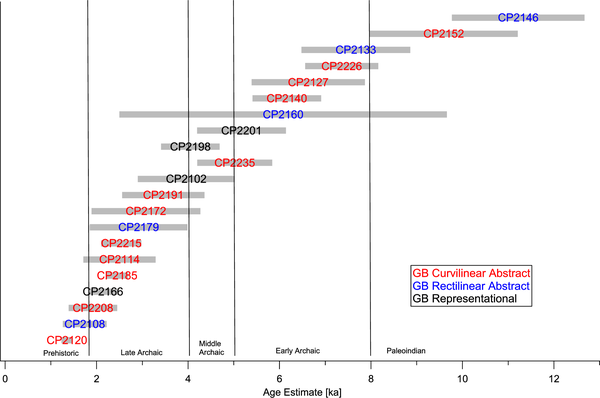
The perennial problem of dating petroglyphs may have finally been solved. A team from the Max Planck Institute has used portable X-ray fluorescence equipment (pXRF) to measure levels of elements in the patina in petroglyphs and comparing that to the levels of the same elements in the rock varnish on the unpecked surfaces have come up with seemingly accurate and reliable age estimates for four sites in the northeastern Great Basin of North America. 

Legend Rock site, near Thermopolis, Wyoming.

"Researchers at the Max Planck Institute for Chemistry have now succeeded in applying their non-destructive method to dating rock art in North America. The analysis shows that rock art in the Great Basin, a region in the western U.S., was produced and continuously renewed for twelve millennia. Indigenous people accessed the same artworks over and over again and endowed them with new meaning, the findings show." (Max Planck Institute 2022)

Map Rock Site, Snake River valley, Idaho.

"Rock art originated some 46,000 years ago and can provide unique insights into the minds of our human ancestors. However, dating of these ancient images, especially of petroglyphs, remains a challenge. In this study, we explore the potential of deriving age estimates from measurements of the areal densities of manganese (Dmn) and iron (Dfe) in the rock varnish on pertoglyphs, based on the concept that the amount of varnish that has regrown on a petroglyph since its creation, relative to the surrounding intact varnish, is a measure of its age. We measured (Dmn) and (Dfe) by portable X-ray fluoresence (pXRF) on dated Late Pleistocene and Holocene rock surfaces, from which we derived accumulation rate of Mn and Fe in the rock varnish. The observed rates were comparable to our previous findings on basalt surfaces in North America. We derived age estimates for the rock art at four sites in the northern Great Basin region of North America based on Dmn measurements on the petroglyphs and intact varnish. They suggest that rock art creation in this region began around the Pleistocene/Holocene transition and continued into the Historic Period, encomassing a wide range of styles and motifs. Evidence of reworking of the rock art at various times by indigenous people speaks of the continued agency of these images through the millennia. Our results are in good agreement with chronologies based on archeological and other archaeometric techniques. While our method remains subject to significant uncertainty with regard to the absolute age of individual images, it provides the unique opportunity to obtain age estimates for large ensembles of images without the need for destructive sampling." (Andreae and Andreae 2022)

Celebration Park site, Idaho.

"In the present study, we conducted in-situ measurements by pXRF on petroglyphs at four sites in Idaho, Wyoming, and Montana to determine the areal densities of Mn and Fe in the varnish that had re-accumulated on the rock since its creation. We also made measurements on the intact varnish surrounding the rock (art) to assess the variability of varnish foration between different rock surfaces. We complimented these data by measuring the Mn and Fe densities on rock surfaces of known geological age to obtain varnish accumulation rates. From these results, we derived age estimates for the petroglyphs and evaluate tham within their archaeological and cultural context. Our study extends significantly the very scarce knowledge base on the rate of rock varnish accumulation in semiarid to mesic regions, provides further validation of non-destructive dating technique for rock art, and elucidates the history of rock art creation at four important archaeological sites representing the Great Basin Macrotradition." (Andreae and Andreae 2022)

Celebration Park site, Idaho.

The four sites tested by the Andreaes are; Celebration Park and Map Rock, two petroglyph sites in the Snake River Valley between Twin Falls and Marsing, Idaho; Legend Rock, 35 km northwest of Thermopolis, Wyoming; and Petroglyph Canyon, 21 km northwest of Lovell, Wyoming, just north of the Montana state line. (Andreae and Andreae 2022)

Celebration Park site, Idaho.

Sites were chosen that had age estimates assigned previously by other methods to allow the team to cross-check their results against previous age estimates. "The diverse rock art spans a broad time period, from the Paleo-Indian era about 15,000 years ago to the recent past. Moreover, the scientists were able to complement their own method with measurements of rock engravings whose ages had previously been dated using independent geochemical methods. Both age estimates were in excellent agreement and thus confirmed each other. The comparison with other archaeological material at the rock art sites, which had been previously dated, also supported the researchers' age estimates." (Max-Planck-Gesellschaft 2022) 


Graph of testing results from Celebration Park site, Idaho.

"'All of our analyses suggest that the earliest petroglyphs were created as early as the transition period from the Pleistocene to the Holocene, about 12,000 years ago, and were repeatedly revised by indigenous people over thousands of years until the recent past,' explains Andreae, a biogeochemist." (Max-Planck-Gesellschaft 2022)

Celebration Park site, Idaho.

If these results hold up through further testing it may be that we have finally achieved at least this one holy grail of rock art research - the ability to date petroglyphs through clues in the patination coating them. Back in the early 80s I made some unsuccessful attempts to do this using a photographic light meter to determine relative darkness of the patina in and ourside of a petroglyph. At roughly the same time Dr. Ronald Dorn was analyzing cation ratios in the varnish to determine the age of petroglyphs, and at that time his method also was not widely trusted and adopted, although I know of instances where his readings successfully matched age estimates for petroglyphs made using other methods. But now we may finally have an inarguable success in dating petroglyphs, and I congratulate the Andreaes' and look forward to their further developments.

NOTE: Some images in this posting were retrieved from the internet with a search for public domain photographs. If any of these images are not intended to be public domain, I apologize, and will happily provide the picture credits if the owner will contact me with them. For further information on these reports you should read the original reports at the sites listed below.  

REFERENCES:

Andreae, Meinrat O., and Tracy W. Andreae, 2022, Archaeometric studies on rock art at four sites in the northeastern Great Basin of North America, 26 January 2022, PLOS, https://doi.org/10.137/journal.pone.0263189. Accessed online 18 August 2022.

Max-Planck-Gesellschaft (Institute), 2022, 12,000-kyear-old rock art in North America, non-destructive method dating petroglyphs in the American West, 28 January 2022, https://mpg.de/18213975/rock-art-petroglyph-dating. Accessed online 17 August 2022.  


Saturday, January 28, 2023

SISIUTL AND CHINESE DRAGONS - A CONNECTION?


Stone carving from Shimao, China. Photograph by Rachel Vaknin, National Geographic.

On Monday, 9 January 2023, I received the following anonymous  comment from Jay (last name unknown). Under the heading “Jay has left a new comment on your post "ANCIENT CHINESE INSCRIPTIONS IN ARIZONA AND NEW MEXICO – REALLY?" Jay wrote “Occurs both ways...What is this stylistically perfect Sisiutl doing deep in China's Shaanxi province around 4000 years ago? (Images just past centre of article)

Central mask from Shimao carved panel. Internet pnotograph, public domain.

Good catch Jay, I really do not know. I would have e-mailed you directly but your comment did not have a return e-mail address. Comments come through Blogger anonymously. I loved your input and find your comparison absolutely fascinating.

On Saturday, 15 August 2020, The National Geographic Channel aired an episode of “Ancient China From Above,” season 1, episode 3, titled “China’s Pompeii.” This program presented the 4,000 year old city of Shimao and, indeed, included some shots of the carving in question with the characteristics of Sisiutl. The program, however, failed to connect that carving with any other cultural influence that would apply to our question.

Sisiutl, the two-headed serpent of the Northwest Coast tribes, North America. Internet photograph, public domain.

I think we can assume some cultural influences passed from groups of people around the North Pacific from China to the cultures of the American Northwest Coast. Of course, I do not actually know if that image from the city of Shimao is meant to be a dragon, or some other creature, but the similarities are striking. Chinese dragons are four-footed creatures and Sisiutl is often described by Northwest Coast cultures as a four-footed creature. The two heads with a central human face in the carving is another obvious similarity. 

Sisiutl from a dance screen by Don Assu, Kwagiulth Museum at Capa Mudge,  We Wa Kai First Nation, British Columbia, 1979.

Given recent advances in knowledge on the time depth of the origins of mythology I really have no problem with assuming that migrating people over many millennia spread the concept of a Sisiutl-like being around the North Pacific. In ancient China it could have evolved into today’s Chinese Dragon. In North America it has spread and evolved into the Unktehi and Uncegilla of the Great Plains, to Michi-Peshu of the Great Lakes region and the horned serpent of the American southwest.

Thank you for your input, and I would encourage you to follow up on the idea. See if you can find two-headed serpent-like creatures from the cultures around the Northern Pacific between Shimao and the Pacific Northwest.

REFERENCE:

https://www.nationalgeographic.com/history/article/mysterious-carvings-evidence-human-sacrifice-uncovered-ancient-city-china#/shimao-carving-face.jpg”


Saturday, January 21, 2023

THE PLEIADES IN ROCK ART – REVISITED:

Marra Wonga rock shelter, Queensland, Australia. Photograph A. Jalandoni.

Although I previously have written about the Pleiades on RockArtBlog (Faris 2015) it is time to revisit the subject on the basis of additional information from Australia.

Pleiades. Photograph from smithsonianmag.com.

"Find the Pleiades" sky chart. Illustration by Ray Norris.

“In many Australian Aboriginal cultures, the Pleiades are a group of young girls, and are often associated with sacred women’s ceremonies and stories. The Pleiades are also important as an element of Aboriginal calendars and astronomy, and for several groups their first rising at dawn marks the start of winter. Close to the Seven Sisters in the sky is the constellation of Orion, which is often called ‘the saucepan’ in Australia. In Greek mythology Orion is a hunter. This constellation is also often a hunter in Aboriginal cultures, or a group of lusty young men. The writer and anthropologist Daisy Bates reported people in central Australia regarded Orion as a ‘hunter of women,’ and specifically of the women in the Pleiades. Many aboriginal stories say the boys, or man, in Orion are chasing the seven sisters – and one of the sisters has died, or is hiding, or is too young, or has been abducted, so again only six are visible.” (Norris 2020)

Astronomers Barnaby and Ray Norris have traced indigenous myths about the seven sisters back to a common source and dated it to as long ago as 100,000 years. “All modern humans are descended from people who lived in Africa before they began their long migrations to the far corners of the globe about 100,000 years ago. Could these stories of the seven sisters be so old? Did all humans carry these stories with them as they traveled to Australia, Europe, and Asia?” (Norris 2020)

Chart illustrating the contemporary positions of Pleione and Atlas in the Pleiades. Illustration by Ray Norris.

When I look at the Pleiades (which I do a lot, it is one of my favorites) I do not see seven stars/sisters. With the naked eye I see six. “Careful measurements with the Gaia space telescope and others show the stars of the Pleiades are slowly moving in the sky. One star, Pleione, is now so close to the star Atlas they look like a single star to the naked eye. But if we take what we know about the movement of the stars and rewind 100,000 years, Pleione was farther from Atlas and would have been easily visible to the naked eye. So, 100,000 years ago, most people would have seen seven stars in the cluster. We believe this movement of the stars can help explain two puzzles: the similarity of Greek and Aboriginal stories about these stars, and the fact so many cultures call the cluster ‘seven sisters’ even though we only see six stars today. Is it possible the stories of the Seven Sisters and Orion are so old our ancestors were telling these stories to each other around campfires in Africa, 100,000 years ago? Could this be the oldest story in the world?” (Norris 2020:5-6)  So the Norrises are assuming that the fact that these stories worldwide featuring seven sisters dates the origin of them to back when the average human eye could actually discern the seventh star (Pleione) which is now optically combined with the star Atlas, which they date to 100,000 years ago.

View of Marra Wongo petroglyphs. Photograph by Paul Tacon.

A recent paper by Tacon et al. interprets a rock art site in Australia as referring to the Pleiades as well. “A large sandstone rock art site, Marra Wonga, near Barcaldine, central Queensland, is the focus of this paper. This 160-metre-long rock shelter is estimated to have over 15,000 petroglyphs, which are mostly animal tracks, lines, grooves and drilled holes, as well as 111 hand-related and object stencils. There is also a cluster of human-shaped foot petroglyphs on the floor of the shelter, some with six or more toes. Unique compositions on the shelter wall include seven large, engraved star-like designs with central engraved pits and large, engraved snake-like designs running across and through other petroglyphs.” (Tacon et al. 2022)

The star panel at Marra Wongo. Photograph by Paul Tacon.

“The seven star-like designs are in an area measuring 85.6 metres high by 213.5 cm wide. (I assume this is a typo and the figures for high and wide are accidentally reversed) Each has lines that radiate out from central pits. They vary in size with three in a row across the top, two below in a second row and two more below these ones in a third. The largest are at either side of the top row and the left side of the bottom row, while the smallest is on the right side of the second row. The star designs are situated amongst macropod and bird tracks, a small possum-like hand, other small designs and a vertical row of six pits. There are also two engraved feet with five toes, one just above and into a radiating line from the second star in the top row and the second just above the left star in the third row and to the left of the second row.” (Tacon et al. 2022)

The star panel at Marra Wongo with stars labeled. Photograph by Paul Tacon.

“While recording Marra Wonga on 11 September 2020, MW and PT found an eighth star-like design at the far right (northern) end of the site just above the rock floor. It is only about 3m from the end of the rock art panel and measured 23.2 cm high by 28.5 cm wide. It is hidden, and was not noticed before, while the seven stars on the central part of the wall panel were meant to be seen, even from some distance.” (Tacon et al. 2022)  Assuming that these symbols are meant to represent stars then the eighth is likely to be unrelated to the Seven Sisters.

The eighth star at Marra Wongo. Photograph by Paul Tacon.

Tacon interprets the star-like patterns in the light of Australian Aboriginal legends about the Pleiades. “The seven star-like designs are said to represent the Seven Sisters that feature in stories across Australia and are linked to the Pleiades star constellation. Most of the stories are associated with the creation of Country, through the Seven Sisters who were very beautiful and came down to earth. They were chased by a (sometimes said to be evil) man with a big penis who wanted to make the sisters his wives. All of the stories involve events that happened at certain places between the man (or sometimes two men, sometimes seven) and the women who are constantly trying to get away. The places were altercations occurred are where there are particularly pronounced features in the landscape, such as hills, claypans, waterholes and, on rare occasions, rock art sites. The different stories all have morals to them. Sometimes their pursuer rapes the older sisters and the other sisters have to heal her. The story then has imbedded important knowledge of which plants they used for healing.” (Tacon et al. 2022)

The work by Norris and Norris gives a believable explanation for why so many cultures see the Pleiades as seven instead of six stars. Additionally, with so many of them identifying the seven stars as Sisters, the explanation from Norris and Norris that the stories date back to a common origin 100,000 years ago can be seen as possible, even perhaps plausible. Now, thanks to Tacon et al., we have an impressive record of that legend in the rock art of the First Nations people of Australia.

NOTE: Some images in this posting were retrieved from the internet with a search for public domain photographs. If any of these images are not intended to be public domain, I apologize, and will happily provide the picture credits if the owner will contact me with them. For further information on these reports you should read the original reports at the sites listed below.

REFERENCES:

Faris, Peter, 2015, Native American Astronomy: The Pleiades – Or Not!, 23 May 2015, https://rockartblog.blogspot.com/search/label/Pleiades.

Norris, Ray, 2020, The world’s oldest story? Astronomers say global myths about ‘seven sisters’ stars may reach back 100,000 years, 22 December 2020, https://phys.org/news/1010-12-world-oldest-story-astronomers-global.html. Accessed on 28 December 2022.

Tacon, Paul S.C., Suzanne Thompson, Kate Greenwood, Andrea Jalandoni, Michael Williams and Maria Kottermair, 2022, Archaeological and contemporary First Nations interpretations of one of Queensland’s largest rock art sites, 20 July 2022, https://www.bradshawfoundation.com/rockartnetwork/marra_wonga.php. Accessed 3 January 2023.