Saturday, February 26, 2022

ROCK ART AND EMOTIONS:


Tsagaglalal, "She Who Watches," Horsethief Lake State Park, Klickitat County, WA. Photo Peter Faris, July 2000.

How many times have you experienced an emotional response to rock art? It can range from the simple joy of finding a panel that you have been searching for to the sense of awe experienced in front of a magnificent panel, but, whether we are aware of it or not, the viewing of rock art can be wrapped in emotional response.


"Thunderstud", Moffat County, CO. Photo Peter Faris, September 1987.

For me, one example of the simple joy of finding rock art was finally seeing the “She who watches” petroglyph over Washington’s Columbia River. Another would be a hike through Vermillion Canyon, observing numerous petroglyphs along the way, and finally reaching the main “Thunderstud” panel.


Grand Gallery, Horseshoe Canyon, Canyonlands, Wayne County, UT, Photo Peter Faris, 28 May 1992.


"Three Kings" panel, McConkey Ranch, Uinta County, UT. Photo Peter Faris, September 1994.


Dinwoody Lakes, Fremont County, WY. Photo Peter Faris, September 1992.

Examples of rock art that produced a much stronger feeling like awe would include the Grand Gallery in Horseshoe Canyon, Canyonlands, Utah; the 3-Kings panel at McConkey Ranch outside of Vernal Utah; and the Dinwoody Lakes rock art in Wyoming. In each instance I felt humbled thinking that centuries or millennia ago someone had purposely created these grand images.

But what other emotions could we expect rock art to elucidate. How about fear? Some researchers speculate that the magnificent painted caves in Europe were the sites of coming of age ceremonies wherein the flickering lights on the images, and accompanying sounds, served to frighten the participants. “Similarly, visual images that are dark and/or obscure typically elicit emotions of anxiety and fear. This is because an impeded visual field is disadvantageous for a human to be able to defend itself.” (Wikipedia) Or again, if some rock art is a territorial marker as some researchers contend, I might be expected to react with a certain level of fear if I see a rock art panel that tells me I have entered the territory of a hostile group. It might signify personal danger.


Mammoth, Rouffignac, France. Internet image, public domain.


Mammoths, Rouffignac, France. Photograph Bradshaw Foundation.


Mammoth, Rouffignac, France. Internet image, public domain.

But these cases are examples of the reaction of a viewer to the rock art, what about rock art purposely created to express emotion? A 2020 paper in the journal Time and Mind by Eyal Halfon and Ran Barkai postulates the emotion of longing in much of the rock art of Europe’s Paleolithic art. They wrote “Mammoths appear in many cave drawings in Upper Paleolithic Europe. Twenty eight percent of the cave drawings are devoted to horses, 21 percent of bison, 10 percent to mammoths, and another 10 percent to wild goats (Paillet and Wolf 2018). An extensive review of 150 caves with cave drawings in France and Spain showed that out of 4,000 artistic representations of animals, ca. 350 are of mammoths (Sauvet and Wlodarczyk [2000] 2001). In the Upper Paleolithic Magdalenian culture (17,000 – 12,000 years ago), the number of artistic representations of mammoths surpassed that of other animals, including horses and bison. The mammoth was prevalent mainly in cave drawings in the Perigord region, where they were usually drawn in red or black outline, and in a number of instances shaped in yellow clay (Paillet and Wolf 2018). These authors also note that, with the exception of a few pieces of ivory, teeth, and bone, there is very little evidence of actual mammoth remains at sites attributed to the Magdelanian. The faunal record actually indicates that the wolly mammoth was already extinct or no longer present in the region where the artistic representations are most prevalent (Paillet and Wolf 2018).” (Halfon and Barkai 2020:13-14)


Mammoth engraved on limestone plaque, Gonnersdorf, Germany. Internet photo, public domain.

Halfon and Barkai also cite excavations of an Upper Paleolithic Magdelanian site in the heart of Germany’s Rhine Valley at the village of Gonnersdorf. Excavations there yielded 61 engravings of mammoths on 46 different stone plates, but faunal remains revealed no significant presence of mammoths (Bosinski and Fischer 1974), and they suggest that what few remains of mammoths were present were collected from the environment as sub-fossils for use as raw materials (Joris, Street, and Turner 2011).


Mammoth engraved on limestone plaque, Gonnersdorf, Germany. Photograph Donsmaps.com.

“Dated mammoth remains from Gonnersdorf and Oelknitz are considerably older than dates obtained from the bones of other species present at the sites. At Gonnersdorf, a series of radiocarbon dates of animal bones places its occupation at between 12.9 and 12.7 kaBP (Hedges et al., 1998). The dates for the mammoth remains are more than 1.5 kaBP older (Stuart et al., 2002). It is likely that the human occupants of the sites deliberately searched for and collected fossil mammoth remains in the region.” (Gaudzinski 2005:187)

It is supposed that these relict mammoth remains were collected as raw material for the creation of tools or other practical uses.


Drawing of a seal engraved on limestone plaque, Gonnersdorf, Germany. Illustration from Donsmaps.com.

“Even more mysterious than the representations of extinct mammoths at Gonnersdorf is the artistic presence of seals at the site. In general, seals are among the less frequent animals found at Upper Paleolithic sites, both in faunal assemblages and in their basic ‘artistic’ form. Overall, 17 creative representation of seals have been identified, mostly in Spain, France, and Germany. This number is especially low in light ot the thousands of animal representations dating to the Magdalenian culture (Cleyet-Merle and Madelaine 1995). At Upper Paleolithic sties with depictions of seals there are at most one or two such depictions. However, at Gonnersdorf nine representations of seals were discovered, despite it being 450 kilometers from the nearest coast (Hansen 2006).” (Halfon and Barkai 2020:13-14)

The authors also point out that the seal images at Gonnersdorf reveal different styles and levels of artistic ability. The range of images and various styles suggests that more than one artist was involved in their creation. (Halfon and Barkai 2020:13-14)


Drawing of a seal from a limestone plaque, Gonnersdorf, Germany. Hansen, "Beyond Seals", fig. 31, page 68.

“Several scenarios have been proposed – and refuted – to explain the images: migration of seals in the Rhine; lakes that housed seal populations; drastic climate change, and more. However, the most plausible explanation for the drawings of the seals is that the humans who drew them had seen seals and remembered them (Hansen2006). This explanation was first proposed by the site excavators, who postulated that the inland artists had visited the distant coast and knew those animals very well. They were thus able to draw them with confidence and accuracy (Bosinski and Bosinski 1997). Thus, the seals of Gonnersdorf and the mammoths of Perigord might represent a residual memory of longing and yearning, much in the same way that writers write vividly about events that took place long ago or artists paint familiar landscapes from memory.” (Halfon and Barkai 2020:13-14)


Drawing of a seal from a limestone plaque, Gonnersdorf, Germany. Hansen, "Beyond Seals", fig. 36, page 71.

“At Gonnersdorf the seal depictions are found in all four concentrations, clustered inside or in the immediate vicinity of the house/tent-like structures, thus they can be ascribed (to) the habitation phases of the respective houses/tents. This means that the seals were depicted during at least two different habitation phases, and maybe during three or more. Therefore, the seals were a part of people’s imagery over a long period of time, indicating either repeated visits of seals, or astoundingly accurate mnemonics, spanning generations.” (Hanson 2006:95)

As to the question of visits of seals swimming up the Rhine, Hanson (2006:94) points out that “Gonnersdorf was situated more than 450 km from the sea which represents a very long distance for seals to migrate.”


Drawing of a seal from a limestone plaque, Gonnersdorf, Germany. Hansen, "Beyond Seals", fig. 37, page 71.

So, at the site of Gonnersdorf in Germany we have concentrations of images of mammoths apparently created some time after the disappearance of mammoths in the area, and seals in a place that is very unlikely for seals to be found. Halfon and Barkai (2020:14) attribute this to the emotions of “longing and yearning.” Longing and yearning certainly represent emotion in Paleolithic Art if they are right. It is perhaps analogous to looking back to a previous Golden Age that we humans are so prone to do. What other emotions might we find in a deep analysis of the motives of the creation of rock art?


NOTE: Some images in this posting were retrieved from the internet with a search for public domain photographs. If any of these images are not intended to be public domain, I apologize, and will happily provide the picture credits if the owner will contact me with them. For further information on these reports you should read the original reports at the sites listed below.


PRIMARY REFERENCES:

Gaudzinski, S., et al., 2005, The use of Proboscidean remains in every-day Palaeolithic life, Quaternary International 126-128, pp. 179-194.

Halfon, Eyal and Ran Barkai, 2020, The material and mental effects of animal disappearance on indigenous hunter-gatherers, past and present, Time and Mind (journal), DOI:10.1080/1751696X.2020.1718309

Hansen, M. C. 2006. “Beyond seals. The representation of seals on Engraved Slate Plaquettes from the Magdalenian site Gönnersdorf (Central Rhineland, Germany).” Thesis in Archeology, University of Trømso, 134.

Wikipedia, Art and Emotion, https://en.wikipedia.org/wiki/Art_and_emotion. Accessed on 25 January, 2022.

SECONDARY REFERENCES:

Bosinski, G., and H. Bosinski. 1997. “Robliendarstellungen Vim Gonnersdorf, Sonderveroffentlichungsn.” Geologisches Der Universitat Zu Koln 82: 81–87.

Bosinski, G., and G. Fischer. 1974. Die Menschendarstellungen von Gönnersdorf der Ausgrabung 1968 (Der Magdalénien-Fundplatz Gönnersdorf 1). Wiesbaden: Franz Steiner Verlag

Cleyet-Merle, J., and S. Madelaine. 1995. “Inland Evidence of Human Sea Coast Exploitation in Palaeolithic France.” in Man and Sea in the Mesolithic, edited by A. Fischer, 303–308. Oxford: Oxbow Books

Hedges, R.E.M., Pettitt, P.B., Bronk Ramsey, C., van Klinken, G.J., 1998, Radiocarbon dates from the Oxford AMS system: archaeometry datelist 25, Archaeometry 40, 227-239.

Paillet, P., and S. Wolf. 2018. “Le mammouth dans l’art paléolithique.” L’Anthropologie 122 (3): 522–545. doi:10.1016/j.anthro.2017.11.004.

Sauvet, G., and A. Wlodarczyk. [2000] 2001. “L’art pariétal, miroir des sociétés paléolithiques.” Zephyrus: Revista de Prehistoria y Arqueología 53–54: 217–240.

Stuart, A.J., Sulerzhitsky, L.D., Orlova, L.A., Kuzmin, Y.V., Lister, A.M., 2002, The latest wooly mammoths (Mammuthus primigenius Blumanbach) in Europe and Asia: a review of the current evidence, Quaternary Science Reviews 21, 1559-1569.

Sunday, February 20, 2022

ROCK ART PAINTINGS OF HONEYBEE COMBS IN THE WESTERN CAPE - A SWEET SUBJECT:


African bee honeycombs. From Tribe, 2021, fig.1.

In my last column I reported on pictographs from Spain of people collecting honey from the nests of wild bees dated 7,500 – 8,000 years ago.


Pictograph identified as African bee honeycomb. From Tribe, 2021.

In a recent paper Geoff Tribe (2021) identified pictographs of pendant arches (like upside-down rainbows) as representations of honey combs in bee’s nests. These images are frequently represented in the western cape of South Africa. This identification is strengthened by a pictograph in red and white showing a swarm of bees as if leaving a crack in the rock. “In this painting it appears as if the bees are flying out of a crevice in the wall – very much as they would in the wild where many colonies make their nests within rock crevices. The large number of bees, especially concentrated at the lip of the crack and spreading outwards, indicates either an orientation flight or an absconding swarm.” (Tribe 2021)


African honeybee. Internet photograph, public domain.

People have been appropriating the honey from nests of wild bees literally forever. The practice probably predates humanity altogether as primates are known to also rob bee’s nests so this could probably be traced to before the origin of the hominid line. “Wild honeybee nests in southern Africa have been robbed for millennia by Bushmen (San) who were the original inhabitants of the sub-continent before the arrival of the Bantu tribes from the north and the European settlers from the south. Honey was possibly the only sweetness known to them which was obtained not only from honeybees but also from stingless Trigona bees. Bee brood was also a much relished source of food. Honeybee nests were marked some way and individually or tribally owned and were robbed at the appropriate season when the combs were full of honey. Being nomadic, the San travelled vast distances following the availability of food according to the seasonal cycle.” (Tribe 2021)

“There are many thousands of paintings on the walls of caves or rock overhangs in southern Africa which are thousands of years old, with some extending into the early colonial period. The San (Bushman) painters covered a wide variety of subject matter, the interpretation of some of them fill many scholarly books.” (Tribe 2021)


Closeup of pictograph identified as African bee honeycomb. From Tribe, 2021.

“One painting that occurs in many parts of southern Africa and which was initially thought to depict a necklace was subsequently shown to represent combs of honeybees. Necklaces were worn by the San and were made out of small pieces of ostrich egg shells in which a hole was drilled and then strung together with a piece of string. However, a Zululand commercial beekeeper, Robin Guy, on visiting the preponderance of paintings in the Natal Drakensberg identified these ‘necklaces’ as depicting hanging honeybee combs within a honeybee nest.” (Tribe 2021) This would seem to make a great deal of sense. Depicting necklaces without the wearer does not strike me a likely, honeycombs considerably more so.


Painting of bees leaving a crack in the rock. From Tribe, 2021, fig. 2a.


Closeup of painting of bees leaving a crack in the rock. From Tribe, 2021, fig. 2a.

Additionally, the creator of these images often use incorporation of natural features as mentioned above with the illustration of the bees flying out of a crack in the rock. In other cases “the artist has made use of the natural shape of the cave wall to incorporate the convex bump on which to paint the catenary combs. This give a more realistic three dimensional effect of what a real nest would look like if viewed from below. Similarly, honeybee nests are often found hanging under projecting rocks, and the artist has made use of the small projection from the cave wall under which to paint the combs – simulating what occurs in nature.” (Tribe 2021)

Much discussion goes into the meanings and motivations behind the production of rock art, and while a range of these meanings and motivations can be proposed for the depiction of honeycombs, I prefer to think of them as a product of the sheer joy of a mouthful of native honey, sweet and sticky, added to the diet of a hunter-gatherer.

NOTE: Some images in this posting were retrieved from the internet with a search for public domain photographs. If any of these images are not intended to be public domain, I apologize, and will happily provide the picture credits if the owner will contact me with them. For further information on these reports you should read the original reports at the sites listed below.

REFERENCES:

Tribe, Geoff, 2021, Rock Paintings of Honeybee Combs in the Western Cape, Ujubee, http://ujubee.com/?p=372, accessed 7 January 2022.

Saturday, February 12, 2022

SOME SWEET PICTOGRAPHS – HONEY COLLECTING IN SPANISH ROCK ART:


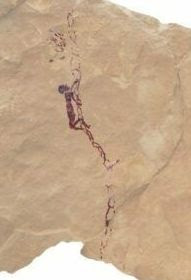
Close-up. A honey hunting scene at abrigo de Barranco Gómez in Castellote, Teruel, Spain. Online photograph, public domain.

Sorry, I just could not resist, but finding this report was really a sweet experience. It shows a honey gatherer climbing a rope to gain access to a beehive in Spain. “Within the foothills of the Iberian System Mountain Range in northeastern Spain, archaeologists have discovered a 7,500-year-old painting depicting prehistoric humans gathering honey. The exceptionally detailed image shows a figure climbing a rope ladder to reach a colony of bees.” (Saed 2021)


Painting shown on overhanging roof, abrigo de Barranco Gómez in Castellote, Teruel, Spain. Luis Rajadel photograph.

“Manuel Bea, a researcher from the University of Zaragoza, authenticated the painting alongside colleagues Ines Domingo and Jorge Angas. ‘We have a perfect photograph,’ he explains, that provides insight into just how these practices were conducted: by climbing ropes. The Barranco Gomez rock shelter was found by a nearby resident in 2013, but the analysis of the painting published just this year.” (Saed 2021)

“Alongside the honey painting, two others were discovered at the Barranco Gomez site, including a scene depicting a pair of archers and an image of a hind, a female red deer, on the run. The paintings, Bea explains, are reminders of the ingenuity of human evolution.” (Saed 2021)


Photo of painting on overhanging roof with drawing of image, abrigo de Barranco Gómez in Castellote, Teruel, Spain. Luis Rajadel photograph.

The red-painted pictograph shows a honey hunter climbing a rickety rope ladder with a cloud of dots which we assume represent the cloud of wild bees nesting high in an opening in a cliff.


It turns out that images of honey-gathering are not all that rare in rock art. There is another one in Spain as well as a number found in Africa. The other recently reported image of honey-gathering in Spain is found in Cueva de la Araña - “Cave of the Spiders”.


Drawings of honey gatherer from Cuevas de las Arañas, (left) by Eduardo Hernandez. Both from Bogard,  2021, The Araña Caves of Valencia: Entering a Bygone Era Through Rock Art, 6 July 2021.

“The Cuevas de la Araña (known in English as Araña Caves or the Spider Caves) are a group of caves in the municipality of Bicorp in Valencia, eastern Spain. The Caves are in the valley of the river Escalona and were used by prehistoric people who left rock art. They are known for painted images of a bow and arrow goat hunt and for a scene depicting a human figure.” (Wikipedia) This scene also illustrates a human figure climbing up ropes to a hole in a cliff, carrying a basket and surrounded by a cloud of flying bees.

“The dating of such art is controversial, but the famous honey-gathering painting is believed to be epipaleolithic and is estimated to be around 8000 years old.” (Wikipedia)

The remarkable similarities in these two panels, so near to each other in dating, illustrate how important honey-gathering was to the people of that era.

NOTE: Some images in this posting were retrieved from the internet with a search for public domain photographs. If any of these images are not intended to be public domain, I apologize, and will happily provide the picture credits if the owner will contact me with them. For further information on these reports you should read the original reports at the sites listed below.

REFERENCE:

Bea, M., Domingo, I. Angas, J., 2021, Descubierta en un abrigo de Castellote la mejor representacion de recolectores de miel del Arte Levantino, https://heraldo.es/noticias/aragon/teruel/2021/07/07/Descubierta-en-un-abrigo-de-Castellote-la mejor-representacion-de-recolectores-de-miel-del-Arte-Levantino

Bogard, Cecilia, 2021, The Araña Caves of Valencia: Entering a Bygone Era Through Rock Art, 6 July 2021, https://www.ancient-origins.net/ancient-places-europe/ara-caves-0015539

Saed, Omnia, 2021, Found: A 7,500-Year-Old Cave Painting of Humans Gathering Honey, 16 December 2021, Atlas Obscura, https://atlasobscura.com/articles/honey-cave-painting

Wikipedia, Cuevas de la Araña, https://en.wikipedia.org/wiki/Cuevas_de_la_Araña, accessed 5 January 2022.

Saturday, February 5, 2022

DATED NEANDERTAL CAVE ART PROVIDES A NEW CANDIDATE FOR OLDEST ROCK ART:

"ARTISTIC SURPRISE - Red horizontal and vertical lines painted on the walls of a Spanish cave date to at least 64,800 years ago, a new study finds. Since Homo sapiens had not reached Europe at that time, Neandertals must have created this art, researchers propose. The animal-shaped figure, right, was not dated and its makers remain unknown. Photograph P. Saura." (Bower 2018).

We now have a new candidate for the oldest cave art. Previously, the oldest date for cave art was 45,500 BP for a painted pig in a cave on the Indonesian island of Sulawesi (see RockArtBlog June 5 and February 13, 2021). This date had been obtained by Uranium-Thorium dating. Now, a new round of dating from caves in Spain had come up with astounding dates varying around 65,000 years in age. The Spanish dates also came from Uranium-Thorium dating and so should be considered as seriously as the Indonesian dates have been.


"HAND OFF - Three handprints on a Spanish cave wall (circles) were created by blowing or spitting pigment on hands. Neandertals made these hand stencils at least 66,000 years ago, a new study concludes. Photograph H. Colado." (Bower 2018).

In the sciences there are always doubters, indeed the scientific method requires doubt, yet these results seem pretty solid. “Still, it is ‘nearly impossible’ to generate accurate age estimates of rock art based on uranium measures alone, researchers concluded in 2017 in Quaternary International. Depending on shifting cave conditions and varying amounts of uranium drainage from mineral deposits, this method can over-or underestimate when rock art was created, the scientists argued. Other researchers defend this technique as providing valuable minimum and maximum age estimates for rock art.” (Bower 2018) What I would argue is that if uranium-thorium dating is acceptable for one place, in lieu of evidence that would invalidate it, it should be acceptable for another place as well.

The team were careful and took precautions to control any contamination of the samples. “Here we report U-Th dating results of carbonate formations associated with rock art in three Spanish caves: La Pasiega (Cantabria), Maltravieso (Extremadura), and Doña Trinidad (or Ardales; Andalucia). Our criteria for sample selection and subsequent sampling strategy strictly followed previously described methods. The reliability of the U-Th dating results is controlled by quality criteria for the carbonate as well as by the collection and analysis of multiple subsamples of a given crust.” (Hoffman et al. 2018:912)


Red streaks on a speleotherm. Photograph from Phys.org, 2 August 2021.

“Criteria for reliable minimum (or maximum) ages were met by all samples. The oldest minimum ages from the three caves are consistent and, at 64.8 ka or older for each site, substantially predate the arrival of modern humans in Europe, which has been variously estimated at between 45 ka and 40 ka ago.” (Hoffman et al. 2018:913)

While I am sure that this will not be the last report that credits Neandertals with producing cave art, I find it quite exciting that we are learning so much about their cognitive abilities.

“The authorship of the so-called ‘transitional’ techno-complexes of Europe, which, like the Chatelperronian, feature abundant pigments and objects of personal ornamentation, has long been the subject of debate. Direct or indirect (via acculturation) assignment to modern humans has been based on an ‘impossible coincidence’ argument – that is, the implausibility that Neandertals would independently evolve the behavior just at the time when modern humans were already in, or at the gates of Europe. By showing that the Chatelperronian is but a late manifestation of a long-term indigenous tradition of Neandertal symbolic activity, our results bring closure to the debate.” (Hoffman et al. 2018:915)

“Cave art such as that dated here exists in other caves of Western Europe and could potentially be of Neandertal origin as well. Red-painted draperies are found at Les Merveilles (France; panel VII) and El Castillo (Spain), whereas hand stencils and linear symbols are ubiquitous and, when part of complex superimpositions, always for the base of pictorial stratigraphies. We therefore expect that cave art of Neandertal origin will eventually be revealed in other areas with Neandertal presence elsewhere in Europe. We also see no reason to exclude that the behavior will be equally ancient among coeval non-Neandertal populations of Africa and Asia.” (Hoffman et al. 2018: 915)

This is the truly exciting part of this, that we may eventually find art that was produced by other non-modern hominins, perhaps Denisovans or even Homo erectus. (See A Whole New Type of Rock Art – Ammoglyphs, in RockArtBlog, 22 May 2021)

NOTE: Some images in this posting were retrieved from the internet with a search for public domain photographs. If any of these images are not intended to be public domain, I apologize, and will happily provide the picture credits if the owner will contact me with them. For further information on these reports you should read the original reports at the sites listed below.

REFERENCES:

Bower, Bruce, 2018, Cave Art Suggests Neandertals Were Ancient Humans’ Mental Equals, February 22, 2018, https://www.sciencenews.org

Hoffman, D. L. et al., 2018, U-Th dating of carbonate crusts reveals Neandertal origin of Iberian cave art, 23 February 2018, Science, sciencemag.org, pp. 912-15


Saturday, January 29, 2022

THE PORTRAYAL OF COLOR PATTERNS AND SHADING ON HORSES IN CAVE PAINTING:

Continuing the quest for shadows in rock art, specifically the majestic art of Europe’s painted caves.


Countershading on painted horses in Lascaux cave, France. Internet photograph, public domain.


Countershading on modern horses. Internet photograph, public domain.

The normal color pattern in many large herbivores such as portrayed in Europe’s painted caves is described as “countershading” wherein the fur tends to be darker on the top of the animal and lighter on the underside.

“Countershading, or Thayer’s Law, is a method of camouflage in which an animal’s coloration is darker on the upper side and lighter on the underside of the body. This pattern is found in many species of mammals, reptiles, birds, fish, and insects, both predators and prey, and has occurred since at least between 145.5 and 65.5 million years ago, or the Cretaceous period.” (Wikipedia)

There are other theories than camouflage for the evolution of countershading. “Many theories about countershading suggest that the dark color of the skin or fur on top, containing melanin, shields against ultraviolet radiation and helps animals get more heat from sunlight. But one of the oldest theories suggests that countershading enhances visual camouflage by counteracting the effects of light and thus making animals harder to see. In other words, if an animal is darker on top and lighter underneath, this can offset shading from light and make it harder for predators to detect it.” (Levine 2016)

Paleolithic horses showing color scheme variations, with countershading. Illustration from Wikipedia.


Przewalski's horse showing countershading. Internet photo, public domain.

The wild equines (Equus ferus ferus) found in Europe at that time are assumed to have appeared much like the last truly wild horse in the world today, Przewalski’s horse (Equus ferus przewalski). “Several genetic characteristics of Przewalski’s horse differ from what is seen in modern domestic horses, indicating neither is an ancestor of the other. For example, the Przewalski has 33 chromesome pairs, compared to 32 for the domestic horse. Their ancestral lineages split from a common ancestor between 38,000 and 160,000 years ago, long before the domestication of the horse.” (Wikipedia)

The phenotype of the Przewalski is a good match for many of the painted horses from the caves. “The Przewalski’s horse is stockily built, smaller, and shorter than its domesticated relatives. Typical height is about 12 – 14 hands (48 to 56 inches, 122 – 142 cm), and the average weight is around 300 kilograms (660 lbs.).” (Wikipedia) Many of the painted examples show this stocky build with relatively short legs.

The Przewalski’s horse’s coat pattern is based on a bay or dun coloring of medium brown with distinct countershading. This is exactly the pattern of many of the horses from wall paintings in the caves of Lascaux and Chauvette with hair colors ranging from red to black.


Panel from Lascaux cave, France, with horse in center. Fig. 5.4, p. 67, Paul Bahn, Journey Through The Ice Age, photo Jean Vertut.

Close-up, horse from Lascaux cave, France, with shading indicated on the underside. Fig. 5.4, p. 67, Paul Bahn, Journey Through The Ice Age, photo Jean Vertut.

Most of the horses portrayed in European cave painting show this countershading. In other cases animals that should bear a countershaded patterning are found with darker underneath. I would suggest that this represents a variation of the cast shadow – dimensional shading. With a light source above a three dimensional object direct light hits the top of the object making it brighter, while the bulk of the object obscures the bottom of the object causing less light to reach it rendering it less brightly illuminated.


Horse from Chauvette cave, France, with dark strokes on the underside suggesting shading. Internet photo, public domain.


Another horse from Chauvette cave, France, with subtle shading on the underside. Internet photo, public domain.

If this is correct, not only were the cave artists producing a marvelously realistic result in the presence of their animal subjects, they were also portraying the effects of light and shade on three-dimensional surfaces, a subject taught today in basic art classes – did the painters of Lascaux and Chauvette take a class? This focus on the effects of light and shade in art was seldom seen again until the studies of the great Leonardo da Vinci and later the French Impressionism of Monet, both of whom studied the effects of light falling on a surface. Were the cave painters indeed scientific artists like Leonardo, or Impressionists, or both?

NOTE: Some images in this posting were retrieved from the internet with a search for public domain photographs. If any of these images are not intended to be public domain, I apologize, and will happily provide the picture credits if the owner will contact me with them. For further information on these reports you should read the original reports at the sites listed below.

REFERENCES:

Levine, Jennifer, 2016, The science behind animal coloration, 27 January 2016, Cell Mentor, http://crosstalk.cell.com/blog/the-science-behind-animal-coloration.

Wikipedia, Countershading, https://en.wikipedia.org/wiki/Countershading, accessed on 17 January 2022

Wikipedia, Equine Coat Color, https://en.wikipedia.org/wiki/Equine_coat_color, accessed 19 January 2022

Wikipedia, Przewalski’s horse, https://en.wikipedia.org/wiki/Przewalski’s_horse, accessed 21 January 2022

Saturday, January 22, 2022

A 3,500-YEAR-OLD GHOST IMAGE:


Babylonian ghost tablet. Photograph British Museum, from the internet.

I know, I know it isn’t really rock art – it’s a Babylonian clay tablet, but a 3,500 year old picture of a ghost is so cool I just could not resist.


Babylonian ghost tablet - enhanced. Photograph British Museum, from the internet.

A Babylonian clay tablet which had been on a shelf in the collections for the British Museum’s Middle Eastern department for decades was recently decoded and this discovery was made. The text on one side of the tablet was spells for a ritual to exorcise ghosts, and on the other side the curator found a previously unknown illustration of the rite. “The ghost tablet, for example, had never been displayed to the public, and no one had translated its text. Nor had anyone noticed the hidden ghostly image on the reverse side of the clay tablet, either. That side appears blank until it’s viewed under a light at just the right angle, when the image of the ghost seems to leap out at the viewer.” (Smith 2021) Any rock art enthusiast is aware of the sometimes requirement for extreme side-lighting to bring out shallow engravings.

“Irving Finkel, the curator of the British Museum’s Middle Eastern department and a specialist in cuneiform, the angular writing system of the ancient Babylonian civilization, recently translated the text of a ritual, which had remained unread and ignored since the British Museum acquired the tablet in the 1800s. At that time, museums across Europe were in a rush to stockpile Babylonian artifacts, and curators would often pay local people to loot clay and stone tablets, along with other artifacts, from archaeological sites in what is now Iraq. Most of those items arrived with little or no information about their context and ended up in storage. The ghost tablet, for example, had never been displayed to the public, and no one had translated its text. Nor had anyone noticed the hidden ghostly image on the reverse side of the clay tablet, either. That side appears blank until it’s viewed under a light at just the right angle, when the image of the ghost seems to leap out at the viewer.” (Smith 2021)


Dr. Irving Finkel, photograph Dale Cherry, 2014.

The tablet was found broken, “at least half of it is missing. But the object still holds carefully detailed instructions on getting rid of pesky ghosts. The directions call for the exorcist to make figurines of a man and woman; prepare two vessels of beer; and, at sunrise, speak the ritual words calling on the Mesopotamian god Shamash , who was responsible for bringing ghosts to the underworld. Finkel says the idea was to transfer the ghost into one of the figurines.” (Gershon 2021)

The illustration on the obverse side of the tablet shows a figure that Finkel identified as female leading the ghost away to the underworld. Finkel stated that the “absolutely spectacular object from antiquity had been overlooked until now. ‘It’s obviously a male ghost and he’s miserable. You can imagine a tall, thin, bearded ghost hanging about the house did get on people’s nerves. The final analysis was that what this ghost needed was a lover’ he said.” (Alberge 2021) Thus, supposedly, the female figurine.

So, the inference is that the ghost was in desperate need of a female companion. “He is shown walking with his arms outstretched, his wrists tied by a rope held by the female, while an accompanying text details a ritual that would dispatch them happily to the underworld.” (Alberge 2021)

It seems remarkable to me that the Babylonians had such a detailed and lengthy rite to exorcise ghosts, as if this were a very common problem. “You dress the man in an everyday shift and equip him with travel provisions. You wrap the woman in four red garments and clothe her in a purple cloth. You give her a golden brooch. You equip her fully with bed, chair, mat, and towel; you give her a comb and a flask. At sunrise towards the sun you make the ritual arrangements and set up two carnelian vessels of beer. You set in place a special vessel and set up a juniper censer with juniper. You draw the curtains like that of the diviner. You draw them in position and say as follows, Shamash[god of the sun and judge of the underworld by of the underworld by night].” (Alberg 2021) And finish with the warning  "do not look behind you." (Alberg 2021)

Having to put up with such a plethora of ghosts could lead to serious problems. “In Mesopotamia, souls could return as ghosts that manifested themselves as sickness among the living. Doctors called on those suffering from these kinds of illness to confess any sins that may have summoned the dead before treating them with spells to placate the ghosts.” (Gershon 2021)

Now where am I going to get two carnelian vessels?


NOTE: The images in this posting were retrieved from the internet with a search for public domain photographs. If any of these images are not intended to be public domain, I apologize, and will happily provide the picture credits if the owner will contact me with them. For further information on these reports you should read the original reports at the sites listed below.

REFERENCES:

Alberge, Dalya, 2021, Figures of Babylon: oldest drawing of a ghost found in British Museum vault, 16 October 2021, https://theguardian.com/culture

Gershon, Livia, 2021, 3,500-Year-Old Babylonian Tablet May Contain Earliest Known Depiction of a Ghost, 22 October 2021, https://www.smithsonianmag.com

Smith, Kiona N., 2021, This is the world’s oldest image of a ghost, Arstechnica.com, https://arstechnica.com/science/2021/10/this-is-the-world’s-oldest-image-of-a-ghost