1. Considering the amount of effort that would have been expended manufacturing paint, and the value of high quality red ocher, the remainder not used up for body painting or whatever primary purpose they had, might have been used to put those patterns on pebbles just to avoid wasting it.
Saturday, March 23, 2019
AZILIAN PAINTED PEBBLES:
Wikipedia,
Public Domain.
Following
the heights (at least the artistic heights) of the Magdalenian culture in
Western Europe was the period known as Azilian "in the Franco-Cantabrian region of northern Spain and southern
France. It probably dates to the period of - around 14,000 years ago
(uncalibrated) and followed the Magdalenian culture. It can be classified as
part of the Epipaleolithic or the Mesolithic periods, or both."
(Wikipedia)
"Archaeologists
think the Azilian represents the tail end of the Magdalenian as the warming
climate brought about changes in human behavior in the area. The effects of
melting ice sheets would have diminished the food supply and probably
impoverished the previously well-fed Magdalenian manufacturers, or at least
those who had not followed the herds of horse and reindeer out
of the glacial refugium to new territory. As a
result, Azilian tools and art were cruder - than their Ice Age predecessors
- or simply different." (Wikipedia)
We, as humans, seem to have a tendency to evaluate
any large cultural change as a cultural collapse or loss of civilization,
instead of just a change, and the transition from Magdalanean to Azilian has
been no exception.
"Diagnostic artifacts from
the culture include Azilian points (microliths with rounded retouched backs),
crude flat bone harpoons and pebbles with abstract decoration. The
latter were first found in the River Arize at the
type-site for the culture, the Grotte
du Mas d'Azil at Le Mas d'Azil in the French Pyrenees.
These are the main type of Azilian art, showing a great reduction in scale and
complexity from the Magdalenian Art of the Upper Palaeolithic." (Wikipedia)
Up until very recently the major form or category of decorative art we knew
of associated with Azilian sites was
large numbers of those painted pebbles.
"Azilian pebbles carry simple designs colored and/or decorated with paint made from red ochre (iron peroxide), applied from the creator's fingers. Dots, borders and bands of color, zig-zags, ovals and dashes are featured. About 1400 pebles like these were found at Le Mas d'Azil, southwestern France - the painted motifs have been suggested to represent words or numbers, as in writing." (Wikipedia)
Other suggestions have related to calendrical or mathematical purposes, game pieces, or even just interior decoration (home beautification). I actually find many of them to be quite decorative and I am more disposed to assume the decorative explanation than accept mathematical or calendrical explanations. Perhaps, when a batch of paint had been manufactured for some other purpose, the painted pebbles represented a way to use up what was left1. I would think that a lot of these painted pebbles lying around the rock shelter would provide a cheerful atmosphere. We have our bric-a-brac lying around our houses, why wouldn't they? This has been treated by most authors as cultural impoverishment, but, in the words of cosmologist Martin Rees (as cited by Carl Sagan) "absence of evidence is not evidence of absence." (wiki.c2.com)
Now, a new
discovery of an Azilian site in France shines a brighter light on this
interpretation. "While major changes
in stone tool technology between the Magdalenian and Azilian clearly mark
important adaptive changes, the discovery of 45 engraved schist tablets from
archaeological layers at Le Rocher de l'Impe'ratrice attests to iconographic
continuity together with special valorization of aurochs as shown by a
"shining" bull depiction. This evidence suggests that some cultural
features such as iconography may lag far behind technological changes. We also
argue that eventual change in symbolic expression, which includes the later
disappearance of figurative art, provides new insight into the probable
restructuring of the societies." (Naudinot et al. 2017) But, while the
authors of this paper see the continuation of large animal symbolism as
iconographic "lag" perhaps this imagery still fitted the spiritual
need of the population. Our common religion has lasted for close to 2,000 years
without a major change in symbols, perhaps the large animals are symbolic of
the Azilian people's beliefs. Indeed, some artists still find creating images
of animals to be pertinent and satisfying. If you are doing it right why change
it? At least it should prompt a reinterpretation of the cultural and social life
and accomplishments of the Azilian people. More on this newly discovered
Azilian art next week.
1. Considering the amount of effort that would have been expended manufacturing paint, and the value of high quality red ocher, the remainder not used up for body painting or whatever primary purpose they had, might have been used to put those patterns on pebbles just to avoid wasting it.
NOTE:
Some images in this posting were retrieved from the internet with a search for
public domain photographs. If any of these images are not intended to be public
domain, I apologize, and will happily provide the picture credits if the owner
will contact me with them. For further information on these reports you should
read the original reports at the sites listed below.
REFERENCES:
https://en.wikipedia.org/wiki/Azilian
https://en.wikipedia.org/wiki/Painted_
pebbles
https://wiki.c2.com/?AbsenceOfEvidenceIsNot
EvidenceOfAbsence
Naudinot,
N, Bourdier C, Laforge M, Paris C, Bellot-Gurlet L, Beyries S, et al.
2017 Divergence
in the Evolution of Paleolithic Symbolic and Technological Systems: The Shining
Bull and Engraved Tablets of Rocher de l'Ime'ratrice, PLoSONE
12(3):e0173037. doi:10.1371/journal. pone.0173037, March 3, 2017.
Labels:
Azilian,
France,
painted pebbles,
pictograph,
rock art
Friday, March 15, 2019
NEW DISCOVERIES IN AZILIAN ART:
Rocher de l'Impe'ratrice,
Archaeology Magazine,
March/April 2019, p. 44.
As I wrote
in RockArtBlog last week art historians have long considered the Azilian (ca.
14,000 BP) descendants of the great Magdalenian culture in Europe to be
culturally deprived and impoverished. The main art form for which they were
known were painted pebbles which, while decorative, are unimpressive compared
to the beautiful Magdalenian cave paintings that preceded them. All in all they
seemed to have lost a lot of ground when evaluated on cultural achievements.
Cave art from the preceding periods in Europe left the magnificent animal
panels of Lascaux, Chauvette, Altamira, and the other decorated caves. Azilian
sites seemed to show no such art.
This
picture has, however, changed considerably with the discovery of carved stone
plaques in the Azilian layers at the rock shelter of Rocher de l'Impe'ratrice, Rock of the Empress,
in France. "Rocher de l'Impe'ratrice"
is a small rock-shelter approximately 10 m long, 3 m deep and 2 m high, located
near Plougastel-Daoulas at the western extremity of Brittany (France). The
shelter is at the foot of a 50 m high quartzite cliff dominating the Brest
roadstead. The site sits about 50 m a.s.l on a southern steep slope overlying
Brioverian shale bedrock. The steep topography is covered by silty-clayey
solifluction deposits rich in shale flags." (Naudinot et al, 2017:3)
Rocher de l'Impe'ratrice,
www.lemonde.com
Public domain.
Some of the
subjects portrayed on these engraved slabs are monumental animal forms,
directly referencing the large painted panels on Magdalenian cave walls,
suggesting a continuity of belief.
Horse plaque (both sides),
Rocher de l'Impe'ratrice,
decouvertes-archeologiques.blogspot.com
Public domain.
This new
discovery "provides critical data to
investigate the tempo of technological and symbolic change during the Azilian.
The association of a lithic industry with a rich artistic assemblage of 45
engraved (and sometimes charcoaled) schist stones suggest a clear arrhythmia
between symbolic production and technological adaptations. Here the possible
techno-economic adaptations to climatic changes appear to have had no direct
influence on the symbolic and perhaps spiritual universe of the first
"Azilian" people who perpetuated an age-old tradition." (Naudinot
et al, 2017:2)
Rocher de l'Impe'ratrice, archaeologynewsnetwork.blogspot.com,
This should
be a reminder to us to be very careful about underestimating so-called
"primitive" peoples. Instead of the culturally impoverished people
that the Azilians had been portrayed as, we find they were the inheritors of
this magnificent tradition that we have long admired. The only lack was our
lack of evidence, and now that we have that a whole re-evaluation would seem to
be in order.
Public domain
NOTE:
Some images in this posting were retrieved from the internet with a search for
public domain photographs. If any of these images are not intended to be public
domain, I apologize, and will happily provide the picture credits if the owner
will contact me with them. For further information on this report I direct you
to the original report at the site listed below.
REFERENCE:
Naudinot,
N, Bourdier C, Laforge M, Paris C, Bellot-Gurlet L, Beyries S, et al.
2017 Divergence
in the Evolution of Paleolithic Symbolic and Technological Systems: The Shining
Bull and Engraved Tablets of Rocher de l'Impe'ratrice, PLoSONE
12(3):e0173037. doi:10.1371/journal. pone.0173037, March 3, 2017.
Labels:
Azilian,
cave art,
France,
petroglyph,
rock art
Saturday, March 9, 2019
ARE THESE UTE WOODEN MAPS? - OR APOPHENIA - PAREIDOLIA - MIMETOLITHS - MANUPORTS
Supposed Ute map,
engraved in wood,
with explanation.
Supposed Ute map,
left side,
with explanation
Supposed Ute map,
right side,
with explanation.
I have been
writing recently on the phenomenon known as Apophenia - the "human tendency to seek patterns in random information." (Wikipedia)
This is manifested in pareidolia (recognizing ponies in the clouds, for
instance), and also by fascination with mimetoliths (items that naturally look like
something else - mimic them).
Identified as a Map of Stratton
Open Space and Drainage.
Well, it
turns out that there are plenty of people who experience that, whose facility
for seeing artifacts in natural objects is considerably more sensitive than
mine (or they are just a lot better at fooling themselves). I was recently sent
a number of photos of pieces of pine branches showing insect boring patterns
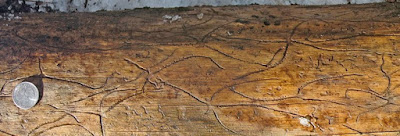
that the discoverer is certain represent maps created by Ute Indians. He has even been able to identify the area they portray, now a neighborhood in Colorado Springs, Colorado. Now, to me,
they represent prime examples of Apophenia/Pareidolia,
and even could be classified as Mimetoliths
(mimicking actual maps), but the discoverer appears completely convinced by
what he has found. Indeed, he apparently agrees that most pieces of wood
that can be found with these markings are merely insect tracks, but he believes
he can tell a difference and recognize the few examples that he has collected
as "the real thing."
Map of Stratton Open Space,
Parks Department, City of
Colorado Springs, CO.
I think of
this situation as paralleling the rock art/ogam controversy. I know those marks are not
ogam, but I cannot convince the proponents - indeed, I have no way of proving
it to them. This is the power of Apophenia,
it is psychologically ingrained deeply into our makeup. Once, our ancestors were
on the lookout for predators in the underbrush who could be recognized by the
shape of a lion's ear through a break in the foliage, the contour of the side of a jaguar's head in a shadow, this is instinctive and was basic to our very survival.
Our subconscious does this all the time, it is primal and not under our
conscious rational control. Whereas scientific facts are merely new ideas on the
surface that we trade between ourselves, nowhere near as powerful in our
overall conscious-subconscious makeup.
So, I do
not expect to be able to convince the discoverer of what I recognize as the
truth - insect chewed wood. That would be merely boring fact. He has the power
of belief on his side, and he knows down to his soul that he has made this
important, historically significant discovery. He is, of course, wrong, but I
almost envy him the strength of his belief. (Although I suspect that with a microscope we could detect the actual bite marks of the larvae that tunneled through the wood.)
This also
represents the ideal time to introduce another term sometimes applied in this
field - a Manuport. "In archaeology
and anthropology, a manuport is a natural object which has been moved from its
original context by human agency but otherwise remains unmodified."
(Wikipedia) These pieces of tree limb are manuports because they interested
their collector enough to pick them up and take them back to his residence.
Mimetoliths that are seen to be interesting enough often become Manuports. In this case - you be the judge.
NOTE: For these particular objects I cannot use the term mimetolith (which basically translates as rock that mimics) because they are not rocks. Perhaps we can call them mimetoports to indicate that they are mimics that were collected by a human and transported.
Also: I am purposely withholding the name of this individual to preserve his privacy. If he wants me to release it he can e-mail me and I will pass it along.
REFERENCE:
https://en.wikipedia.org/wiki/Apophenia
https://en.wikipedia.org/wiki/Manuport
Labels:
Apophenia,
manuports,
maps,
Mimetolith,
Pareidolia
Saturday, March 2, 2019
PAREIDOLIA:
The mountainous face on Mars
in the most favorable light.
Public domain.
One
phenomenon that we have to keep in mind when discussing meaning or intention in
rock art is pareidolia. "Pareidolia
is a psychological phenomenon in which the mind responds to a stimulus, usually
an image or a sound, by perceiving a familiar pattern where none exists. Common
examples are perceived images of animals, faces, or objects in cloud
formations, the Man in the Moon, the Moon rabbit, hidden messages in recorded
music played in reverse or at high- or lower-than-normal speeds, and hearing
indistinct voices in random noise such as that produced by air conditioners or
fans." (Wikipedia)
The so-called face on Mars
under the more normal lighting
conditions. Public domain.
The moon rabbit
(dark areas). Public domain.
One example
of pareidolia that recently received considerable attention among fringies was
the so-called face on Mars, a rock formation that under certain lighting
conditions resembles a human face, but under other lighting conditions can be
seen to be just a mountain (of course that did not stop the fringies from
adopting it as proof of alien civilization).
I can think
of a couple of excellent examples of pareidolia in classic rock art. The first
(literally the first discovered) is the bulls of Altamira. Even back in the
1960s in the very small unit on Cave Painting and Paleolithic art in Gardner's Art Through The Ages we were told that
the bulls were on the cave ceiling because natural rounded projections from the
rock reminded the painter(s) of their shape, and they were painted to fit those
contours and shapes.
The second
example of pareidolia in cave painting that comes to mind is the Spotted Horse in Pech-Merle,
where the horses head and placement were suggested by the shape of a rock projection
on a corner of the cave wall. In both of these instances a form recognized in
the shape of the rock suggested the content of the painting - pareidolia.
Robert Bednarik
gave a number of examples of pareidolia in rock art in an excellent paper in 2016 (see below). Do yourself a favor and read it. What
examples can you think of?
NOTE:
Some images in this posting were retrieved from the internet with a search for
public domain photographs. If any of these images are not intended to be public
domain, I apologize, and will happily provide the picture credits if the owner
will contact me with them. For further information on these reports you should
read the original reports at the sites listed below.
REFERENCES:
Bednarik,
Robert G.
2016 Rock Art
and Pareidolia, Rock Art Research, Vol. 33, No. 2, pp. 167-181.
(https://en.wikipedia.org/wiki/Pareidolia)
Labels:
Altamira,
Apophenia,
face on Mars,
manuports,
Pareidolia,
Pech-Merle,
rabbit in the moon,
rock art
Saturday, February 23, 2019
WHALE HUNTERS IN CHILEAN ROCK ART:
El MÄ—dano rock art panel,
Atacama Desert Chile,
Showing whale hunting.
Fig. 7D, Ballester, 2018.
El MÄ—dano rock art panel,
Atacama Desert Chile,
Showing whale hunting.
Fig. 7A, Ballester, 2018.
Remarkable
recent reports of rock art panels from the Atacama Desert on the western coast
of Chile have portrayed a seemingly improbably, and surprising, subsistence
technology - whaling. While we have known that the early inhabitants of this
region were culturally sophisticated, I never would have guessed that the
inhabitants of one of the world's most arid deserts would have the resources to
develop that technology.
El MÄ—dano rock art panel,
Atacama Desert Chile,
Showing whale hunting.
Fig. 1C, Ballester, 2018.
"El MÄ—dano-style rock art from
the Atacama Desert Coast in Chile provides one of the most spectacular and
expressive representations of ancient marine hunting and maritime traditions.
These red pictographs comprise hundreds of hunting scenes and portray a complex
marine hunter-gatherer society."
(Ballester 2018)
Remarkably,
in this area, the rock art preserves many scenes of men harpooning whales,
other marine mammals, and large fish, from rafts, not ocean-going canoes mind
you, from rafts. "The raft employed
in pre-Hispanic times was similar to those described centuries later by
Europeans. Such rafts comprised two large cylindrical floating sections made of
sea lion skin, which when tied together measured almost 3m in length. The
floating sections were carefully sewn together using hundreds of cactus spines
and cotton thread in a zig-zag pattern. Finally, the floating sections were
completely sealed and water proofed with a red ochre substance."
(Ballester 2018)
"In the Izcuña ravine, 328
different paintings were found on 24 differrent blocks of rock. Many have been
degraded by moisture brought by camanchacas, or cloud bank that form over the
Chilean coast and move inland. But enough of the art has been preserved to date
it to the other El MÄ—dano art. The most common type of art shows the
silhouettes of large fish. Other images show hunting scenes with rafts and
weapons. The study's author, Benjamin Ballester, notes that the fish or whales
are always drawn oversized to the hunters and their rafts, making the prey a
daunting antagonist."
(Gibbens 2018)
El MÄ—dano harpoons and heads,
Atacama Desert, Chile.
Ballester, 2018, Fig. 9.
Dating of
the rock art panels is still in question, but, based upon the techology pictured
in the hunting scenes, has been loosely assumed to fall between 3000 BP and
1500 BP. "Archaeological evidence
suggests that this technology was developed in the Atacama Desert during the
Formative Period (c. 3000 BP) and became popular in coastal areas around 1500
cal BP." (Ballester 2018)
This is
also indicative of the differences in subsistence strategies between various
cultural centers of the Atacama Desert at this time, and the cooperative
dealings between them. Communities in the river valleys and around oasis'
developed agricultural based subsistence, other groups, probably more into the
foothills, relied on a pastoralist lifestyle, while groups along the coast
looked to marine resources for subsistence and surplus to trade.
""Marine [hunts] were one
of the most important elements of their subsistence, bult they were also great
fishers and mollusk gatherers," he says. "From their coastal
settlements, they actively participated in large-scale exchange networks with
agro-pastoralist communities from the interior valleys and oasis of Atacama,
specially circulating dried fish in exchange of manufactured goods."" (Gibbens 2018)
While we
have to respect the efforts of all members of any successful society and give
them credit for their contributions, I have to confess that the image of these
prehistoric hunters with their handmade harpoons paddling out to sea on a raft
made from marine-mammal-hide floats strikes me as remarkably courageous and
ambitious. Even more so is the fact that most of the images show the rafts with
lone occupants. ". . the hunting
activity is represented as a single practice, mainly conducted by one raft. In
most cases they exhibit only one seafarer inside the boat. Overall, hunting is
represented as a specialized, solitary, individual social practice, led by a
selected few people. As previously mentioned, in hunting scenes, rafts and prey
are connected by lines that represent harpoon ropes." (Ballester 2018)
What a
wonderful record of the life and times of these people. I am in awe.
NOTE:
Some images in this posting were retrieved from the internet with a search for
public domain photographs. If any of these images are not intended to be public
domain, I apologize, and will happily provide the picture credits if the owner
will contact me with them. For further information on this I refer you to the
report by Benjamin Ballester (2018) listed below.
REFERENCES:
Ballester,
Benjamin
2018 El Mėdano rock art style: Izcuña paintings
and the marine hunter-gatherers of the Atacama Desert, Antiquity, Vol. 92,
Issue 361, pages 132 -148, https://www.cambridge.org/core/journals/antiquity/article/el-medano-rock-art-style-izcuna-paintings-and-the-marine-huntergatherers-of-the-atacama-desert/3109A81F4CAD9D0E8F2AE1730FC710B8/core-readern
Gibbens,
Sara
2018 Dramatic
Whale Hunts Depicted in Ancient Rock Art, National Geographic, https://news.nationalgeographic.com/2018/02/ancient-rock-art-shows-whale-hunts-atacama-chile-spd/
Labels:
Atacama Desert,
Chile,
El Medano,
pictographs,
raft,
rock art,
watercraft,
whaling
Saturday, February 16, 2019
EXTINCT ANIMALS IN ROCK ART - THE TIAHUANACO TOXODON?
Quadruped from Viracocha
statue, Semi-subterranean
Temple, (head to upper
right, tail to lower left),
Tiahuanaco, Bolivia.
Magicians of the Gods,
Gaham Hancock, p. 389.
In the past
I have presented a number of columns on RockArtBlog about extinct animals
portrayed in rock art, both real and imagined, even including one on April 1,
2015 about extinct giraffes pictured in Utah that was meant as an April Fool's
Day joke (it did, however, succeed in detecting a few April Fools).
Viracocha statue,
Semi-subterranean Temple,
Tiahuanaco, Bolivia.
ancient-origins.net,
Public Domain.
There are
many real examples of animals that are no longer extant that are pictured on
caves walls and cliffs. The most famous examples that come to mind are the
mammoths and aurochs of European Paleolithic cave art. Examples that are not
accurate include all of the so-called dinosaurs found by fringies in rock art.
Another example of an extinct animal that I consider to be unwarranted is
represented by nebbish-looking quadrupeds at Tiahuanaco that the fringies have
declared to be pictures of Toxodons.
Toxodon platensis,
Wikipedia,
Public Domain.
"Toxodontidae, is an extinct
family of notoungulate mammals known from the Oligocene to the Holocene (5,000
BP) of South America, with one genus, Mixotoxodon, also known from the
Pleistocene of Central America and southwestern North America (Texas). They
somewhat resembles rhinoceroses, and had teeth with high crowns and open roots,
suggesting that they most often fed on tough pampas grass. However, isotopic
analyses have led to the conclusion that the most recent forms were grazing and
browsing generalists."
(Wikipedia)
Close-up of Viracocha statue
head, the quadrupeds can be faintly
seen on the right side of the head.
Photograph Graham Hancock.
Well, if
the Toxodon survived until 5,000 BP isn't it possible that someone in early
Tiahuanaco saw one to picture on stone? No, it is not. The earliest date estimates
for Tiahuanaco were Posnansky's 11,000 - 17,000 years BP were based upon geological
estimates and archaeoastronomy. "Beginning
in the 1970s Carlos Ponce Sangines proposed the site was first occupied around
1580 BC, the sites oldest radiocarbon date. This date is still seen in some publications
and museums in Bolivia. Since the 1980s, researchers have recognized this as
unreliable, leading to the consensus that the site is no older than 200 or 300
BC." (Wikipedia) Perhaps some of these cryptozoology enthusiasts
are genuinely fooled by the original improbably early dating of the ruins. I
suspect, however, that most of them are just cynically publishing these stories
for financial gain or career notoriety.
Quadrupeds on right side of
head. Drawing of Viracocha
statue. davidpratt.info
Indeed, in
reading various reports of the Tiahuanaco Toxodon, it is difficult to even
determine where he is supposedly pictured. Some reports imply that the image(s)
are carved on the gateway of the sun. In his book Magicians of the Gods, Graham Hancock (p. 389) correctly states
that the figures are carved on the sides of the head of a humanoid statue. This
figure was found in a structure known as the Semi-subterranean Temple and is
assumed to represent the deity Viracocha. Many sculptures of the figure of
Viracocha have been found but this is the only one with these particular
quadrupeds carved on the sides of the head, and what these represent is a
mystery, but I am confident that they do not represent the poor Toxodon, long dead and
gone.
NOTE:
Some images in this posting were retrieved from the internet with a search for
public domain photographs. If any of these images are not intended to be public
domain, I apologize, and will happily provide the picture credits if the owner
will contact me with them. For further information on these reports you should
read the originals at the sites listed below.
REFERENCES:
ancient-origins.net
Hancock,
Graham
2015 Magicians
of the Gods, St. Martin's Press, New York.
https://en.wikipedia.org/wiki/Tiwanaku
https://en.wikipedia.org/wiki/Toxodontidae
www.davidpratt.info
Labels:
Bolivia,
extinct animals,
petroglyph,
rock art,
Tiahuanaco,
Toxodon,
Viracocha
Friday, February 8, 2019
VANDALISM, OR LIFE-SAVING SIGN?
Cambodian Mine Action Center
sign at Laang Spean
Cave, Cambodia.
While we
are almost always opposed to modern paint being sprayed on the rocks (tagging)
there is a picture in Archaeology
Magazine (Jan.-Feb. 2019) that we have to applaud. It is a photograph of
red initials CMAC painted on the cliff at the mouth of a cave in Cambodia. CMAC
stands for Cambodian Mine Action Centre, the organization tasked with locating
and neutralizing land mines left over from the wars of the 1960s and 1970s in
southeast Asia. This is only a small part of the story in their article Cambodia's Cave of Bridges, by Karen
Coates, and well worth reading. It chronicles new research in a cave named
Laang Spean (Cave of Bridges) which has opened new windows on Cambodia's past.
This CMAC inscription tells the local people, and the archaeologists working in
the cave, that they have cleared nearby mines and it is safe to go there.
RockArtBlog has to applaud this particular tagging. I do not know how much rock
art can be assigned a life-saving function, but I think it is a wonderful idea
- and I wonder what other examples might be found.
NOTE:
The image in this posting was retrieved from the internet with a search for
public domain photographs. If any of this image is not intended to be public
domain, I apologize, and will happily provide the picture credits if the owner
will contact me with them. For further information on these reports you should
read the original at the site listed below.
REFERENCE:
Coates,
Karen
2019 Cambodia's Cave of Bridges, Archaeology, pages 48 - 52,
January-February, 2019, Vol. 72, No 1.
Subscribe to:
Posts (Atom)