Saturday, November 19, 2016
VANDALIZED BY MOTHER NATURE - CHINESE ROCK ART DESTROYED BY FLOODING:
Flood damage upon chinese rock
art, Helan Mountain, Ningxia
Autonomous Region, China.
http://www.archaeology.org/news?page=2
A recent
story on www.archaeolgy.org reported considerable damage to rock art on cliffs
of Helan Mountain in the Ningxia Autonomous Region of northwest China by heavy
rains and flooding. "China.org.cn reports that rare flooding in the Ningxia Hui
Autonomous Region of northwest China has damaged some of the thousands of
prehistoric carvings on the cliffs of Helan Mountain. The images are thought to
have been created by nomads who lived in the area between 3,000 and 10,000
years ago. Some of the images were damaged by mud and silt, and about a dozen
images that had been carved on individual rocks were carried away by the flood
waters. Other pictures were lost when layers of mountain rock peeled off or
cracked in the heavy rains. Hu Zhiping, deputy director of the Helan Mountain
Cliff Painting Administration, said that the extent of the damage is still being
assessed." (www.archaeology.org 2016:2)
Helan
Mountain was decorated with an estimated 20,000 examples of rock art scattered
over several hundred kilometers. These had been created by nomadic tribes once
living in the area and are believed to be between 3,000 and 10,000 years in
age. "An
employee at the scenic area which has about 6,000 cliff paintings, said about a
dozen paintings on individual rocks were unaccounted for." (www.archaeology.org 2016:2)
This is
another reminder of the ephemeral nature of much rock art. This statement may
seem counterintuitive when we are discussing an art form that depends upon
solid rock for its medium, but you can visit museums all over the world that
are full of ancient works of art that are in better condition than the contents
of many rock art sites that are younger in age than those works of art in the museums.
The morale of this story is that is
still critical that we fully record all rock art so that digital records may be
protected for the future.
REFERENCE:
http://www.archaeology.org/news?page=2
http://www.china.org.cn/china/2016-08/26/content_39169375.htm
Labels:
China,
flood damage,
petroglyphs,
rock art,
vandalism
Saturday, November 12, 2016
A NAVAJO ROCK ART SITE IN THE CENTRAL COLORADO MOUNTAINS?
Almont rock art site, CO.
Photo, Jared Allen, 2016.
I recently
received some fascinating pictures and information from Jared Allen. Jared
shared some photographs of a rock art site near Almont, in Gunnison County,
Colorado. A couple of the photos show deeply incised grooves or the sort
usually defined as tool sharpening grooves, although some of the grooves appear
to be arranged purposefully to create a tree-like image. Much more interesting,
however, are a couple of Jared's photographs that illustrate what appear to be
Navajo Yei (Holy People) figures. Almont is a considerable distance from the
current region of Navajo habitation, so what gives here?
Almont rock art site, CO.
Photo, Jared Allen, 2016.
Almont,
Colorado, is approximately 9 miles north of the town of Gunnison, and 60 miles
NW of Saguache. Some references place the early Navajo and the boundaries of
Dinetah, the Navajo homeland, far enough north and east of their present
territory that it includes the San Luis Valley in south/central Colorado. "Dinétah
encompasses a large area of northwestern New Mexico, southwestern Colorado, southeastern Utah, and northeastern Arizona. The boundaries are inexact, and are generally marked by mountain peks which correspond to the four cardinal directions." (Wikipedia) Indeed, Mount
Blanca, one of the Navajo four holy mountains is located in the Sangre de
Cristo mountain range on the east side of the San Luis Valley.
Almont rock art site, CO.
Recurved bow held by
figure on the right.
Recurved bow held by
figure on the right.
Photo, Jared Allen, 2016.
The right figure in this group appears to be holding a recurved bow considered a hallmark of athapaskan peoples and, thus, a possible Navajo identifier (see below).
Yei pictographs showing recurved
bow, Delgadito Canyon. Picture
from www.nm.blm.gov/.
bow, Delgadito Canyon. Picture
from www.nm.blm.gov/.
"In Navajo tradition, the Holy People, or Yeis, are sometimes shown holding "recurved" bows. This technological innovation is thought by some to have been introduced by the ancestors of today's Navajo and Apache. The distinctive double curve is sometimes shown alone as a symbol for Naayee' Neizghani, or Monster Slayer, one of the Hero Twins." (www.nm.blm.gov/)
If these images are indeed Navajo in origin they are probably dated from back early in the athapaskan entrance into this area, as with the passage of time the Navajo gravitated farther south and west. "The Navajo occupation of the region has been divided into two major phases - the Dinetah phase (ca. 1500-1630, which includes the entrance and settling of the area by the Navajo, and the Gobernador phase (ca. 1630-1800), during which time the Navajo culture became fully defined." (Wikipedia)
So, if
these Navajo figures are authentic, they are probably fairly early, or evidence
of a later wanderer.
REFERENCES:
http://www.nm.blm.gov/features/dinetah/navajo_history_2.html
Wikipedia
Labels:
Colorado,
Navajo,
petroglyphs,
pictographs,
rock art,
Tool grooves
Saturday, November 5, 2016
DINOSAUR TRACKS ON THE LINTEL BUILT INTO AN ANCESTRAL PUEBLO DWELLING:
I have written elsewhere about the fact that when I was an undergraduate the field of Art History also included studying architecture and design/decoration. I do not see so much of that these days but, as for me, both architecture and design/decoration are legitimate branches of Art History and thus are eligible for inclusion here in RockArtBlog. The following combines both in an example of an Ancestral Puebloan structure in Utah.
Lintel over doorway, Ancestral Pueblo.
Photograph: Joshua Smith.
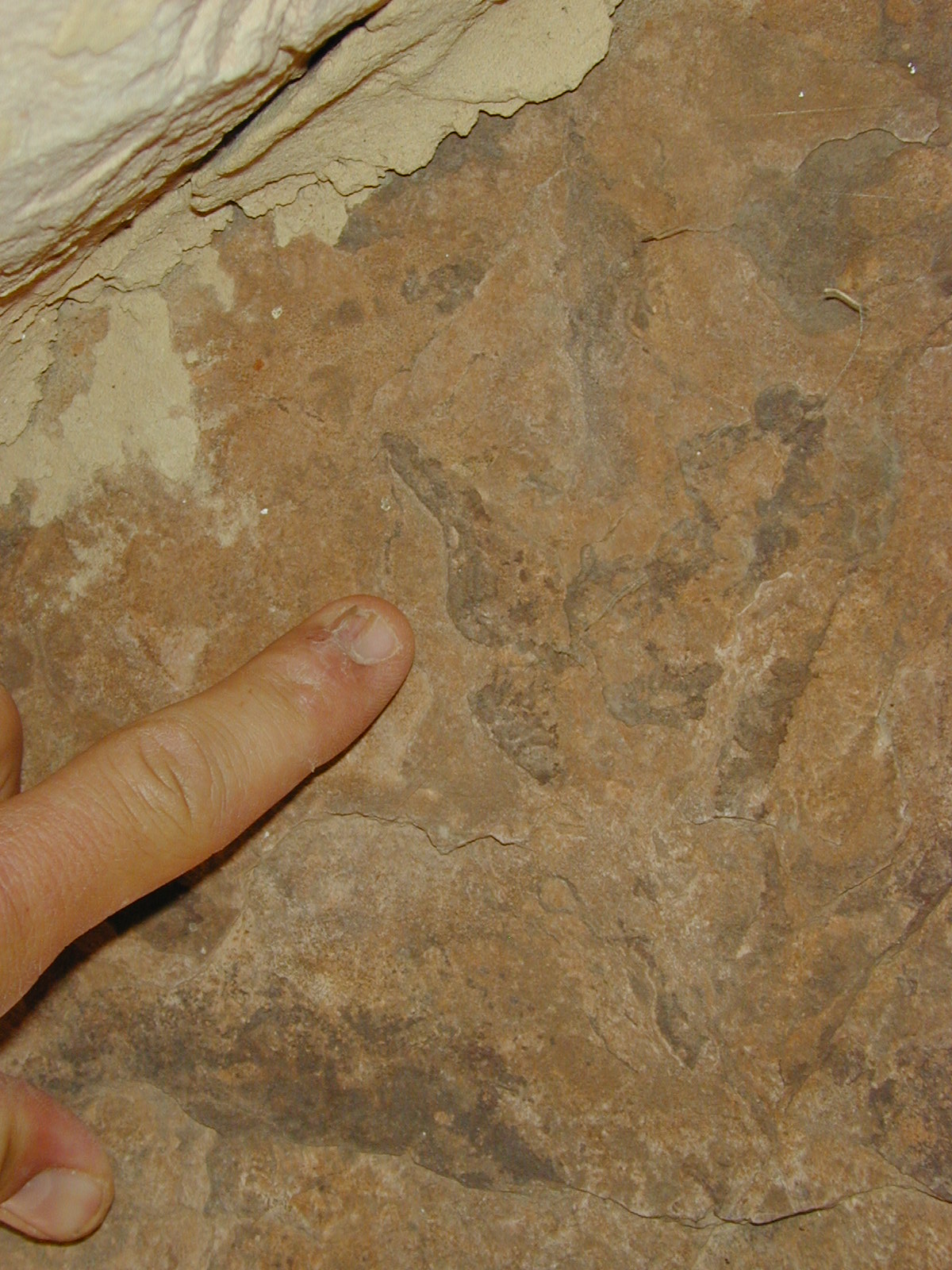
Humans are fascinated by fossils. This was as true for our early ancestors as it is for us. On October 6th, 2016, I had the pleasure of meeting and talking with Joshua Smith, a contract paleontologist in Grand Junction, Colorado. We met at his favorite coffee shop and I had an excellent breakfast burrito and a cup of good coffee while we talked about Native American fossil knowledge. Smith showed me photographs of one of his discoveries, an instance of incorporation of fossil dinosaur footprints into the architecture of an ancestral puebloan building in Utah.
View of the underside of the lintel,
Ancestral Pueblo. Photograph:
Joshua Smith.
Smith first noticed them in 2003. While the building had long been known to archaeologists, apparently no one had noticed the tracks on the underside of the lintel over the doorway until Smith came along (an good example of we see what we expect to see, and an excellent reason for cross-disciplinary studies in rock art).
Pointing out one track on
the lintel, Ancestral Pueblo.
Photograph: Joshua Smith.
Some of the structure is dated from Basketmaker II, AD 50 - 500 (Wikipedia), but most of the construction appears to date from the Pueblo III period, AD 1150 - 1350 (Wikipedia). While the structure is constructed of cream-colored sandstone from nearby, the pinkish-colored sandstone of the lintel stood out as coming from a different source, although also local. In examining it Smith found the two dinosaur tracks on the underside where they were exposed to view. This may be important as the stone could have just as well been placed with the tracks on the upper side hidden from view. This suggests that they were purposely left so they could be viewed, and that they had some significance to the builders and occupants of the structure (Smith 2016).
Pointing out one track on
the lintel, Ancestral Pueblo.
Photograph: Joshua Smith.
Dinosaur tracks are classified into separate ichnospecies from dinosaur remains because they often cannot be pinned down to the exact species that made them. These tracks fall into the category known as Grallator. "Grallator tracks are characteristically three-toed (tridactyl) and range from 5 to 15 centimeters (or 2 to 6 inches) long. While it is usually impossible to match these prints with the exact dinosaur species that left them, it is sometimes possible to narrow down potential trackmakers by comparing the proportions in individual Grallator ichnospecies with known dinosaurs of the same formation." (Wikipedia)
Outlined track on the lintel, Ancestral
Pueblo. Photograph: Joshua Smith.
Smith identified the tracks as belonging to a small theropod dinosaur, similar to a coelophysis, based upon his knowledge of the age of the rock formation and the species extant in that time. (Smith 2016) Previously, I have written about Native American knowledge of fossil tracksites and cited a Navajo example identifying them as "giant lizard footprints". (Faris 2011) Whether the tracks had a spiritual value to the builder, or were just included for decorative purposes, this important discovery not only adds another example of Native American fossil knowledge, it provides evidence of another facet of their beliefs and material culture in which this knowledge could be expressed. Thank you Josh.
REFERENCES:
Faris, Peter
2011 Dinosaur Footprints and the Giant Lizard Petroglyphs at Cub Creek, Dinosaur National Monument, Feb. 9, 2011,
http://rockartblog.blogspot.com.
Smith, Joshua, personal communication, 2016.
Wikipedia
Labels:
Anasazi,
architecture,
decoration,
fossil tracks
Wednesday, October 26, 2016
CRESCENT JUNCTION SITE, GRAND COUNTY, UTAH:
Petroglyph panel, Crescent Junction
site, Grand County, Utah.
Photo: Peter Faris, Oct. 8, 2016.
Driving in
to the Crescent Junction (Utah) rock art site one goes right past a Department
Of Energy radioactive tailings disposal site. This reminded me of a RockArtBlog posting on June 10, 2009,
titled Protecting Rock Art, in which I discussed poison ivy as a protection for
rock art panels, and speculated upon the efficacy of using rock art sites for
radioactive or toxic waste disposal to protect the rock art (Faris 2009). This
is close in concept, but the disposal is near the rock art, not around it, and, I think, coincidental. In other words they were not looking to protect rock art, they were looking for empty land to dump their radioactive tailings at.
Petroglyph panel, Crescent Junction
site, Grand County, Utah.
Photo: Peter Faris, Oct. 8, 2016.
Petroglyph panel, Crescent Junction
site, Grand County, Utah.
Photo: Peter Faris, Oct. 8, 2016.
It is a
good site though, worth visiting. I was there on a field trip from the 2016
Annual Meeting of the Colorado Archaeological Society (CAS) which was held in
Grand Junction over the weekend of October 6-8. Members of the Grand Junction
chapter of CAS are to be congratulated for an excellent meeting and programs.
The
Crescent Junction site is on a number of scattered boulders at the base of the
Bookcliffs formation on the North edge of the Grand Valley.
Fremont figure, Crescent Junction
site, Grand County, Utah.
Photo: Peter Faris, Oct. 8, 2016.
Some of the
rock art is archaic imagery with anthropomorphs, quadrupeds, footprints, and
symbols intermixed. Many of the human figures seem to be Fremont in origin which
give us a timeframe of AD 1 to 1300 (Wikipedia).
Bat? Crescent Junction
site, Grand County, Utah.
Photo: Peter Faris, Oct. 8, 2016.
One of the
interesting figures seen here has been identified as a bat by folks in the
area. It may be, maybe not, but it is interesting. Also some very complicated
panels which could be designated as palimpsests because of intertwined and
overwritten figures and symbols.
All in all
it is a great example of the type of marginal Fremont site found throughout
western Colorado and eastern Utah.
REFERENCE:
Faris,
Peter
2009 Protecting
Rock Art, June 20, 2009, http://rockartblog.blogspot.com/search/label/poison%20ivy
Wikipedia
Labels:
Fremont,
petroglyphs,
poison ivy,
radioactive tailings,
rock art,
Utah
Saturday, October 22, 2016
WRITING-ON-STONE PROVINCIAL PARK, ALBERTA, CANADA:
Cliffs and hoodoos at Writing-On-Stone
Provincial Park, Alberta, Canada.
Photo. Peter Faris, June 25, 2016.
On June 25,
2016, I had the opportunity to visit a world-class rock art site,
Writing-On-Stone Provincial Park, Alberta, Canada. Sitting in the valley of the
Milk River, this magical area of cliffs, hoodoos, and petroglyphs, was sacred
to the Blackfeet people and still evokes an aura of mystery in the mind of a
visitor. There is much more rock art here than a person could expect to see in
a number of days so I did not resent the fact that the guided tour skipped a
number of sites that we could see as we drove by. I still filled the time
available with visiting, photographing, and appreciating some remarkable rock
art.
Rock art at Writing-On-Stone
Provincial Park, Alberta, Canada.
Photo. Peter Faris, June 25, 2016.
Although I
would not trade this opportunity to visit Writing-On-Stone for the world I must
admit to a couple of disappointments with it. First, the sky was an even
overcast gray diffusing the daylight and making photography very difficult.
Although I do know that I took pictures of rock art I cannot now find the rock
art in some of the pictures that I did take. We all know how the lighting
affects rock art photography, and this day was one of the more extreme I have
had to put up with. I saw the petroglyphs while I was there, but they do not
show up in some of the photographs.
Mitigated cliff at Writing-On-Stone
Provincial Park, Alberta, Canada.
Photo. Peter Faris, June 25, 2016.
The second
disappointment regards an attempt made to mitigate vandalism to rock art
panels. Over the years since the discovery of the site by Anglos people have
been adding their names, initials, dates, etc., to the rock art panels. This is
the all-too-common vandalism the we see on most known rock art panels. This
mitigation was done by removing the inscription, with a hand wielded dental
pick in instances where prehistoric rock art might be affected, to grinding the
inscriptions off the rock face with a steel-bristled brush, sometimes held in a
rotating electric drill. This was done because there was concern that the
vandalism would negatively impact on their application to become a UNESCO World
Heritage Site, so they had it removed. Hired workers and volunteer crews between
July 26 and August 10, 2012, removed graffiti from 47 panels, and between September 13 and September 21, 2012,
they removed graffiti from a further 47 panels, 94 panels in total were
affected.
Mitigated cliff at Writing-On-Stone
Provincial Park, Alberta, Canada.
Photo. Peter Faris, June 25, 2016.
Once the
graffiti had been chipped or ground off the work area was camouflaged by painting
colorants back onto the surface to mimic the patina of the rock face. Colorants
used were natural pigments collected in the area, yellow ochre from a rock
shelter in the area, red ochre from nodules found on the ground beneath the
cliff faces having weathered out of the rock, and for grayish tones charcoal
from local vegetation. These colorants were finely ground and mixed with water
from the milk river and then brushed onto the surfaces to emulate the untouched
rock surfaces nearby.
These
techniques were of limited success as by the time of my visit the camouflaging
colorants were obviously washed off by weather and the graffiti removal scars
stood out as large light-colored, smooth areas very noticeably different from the
natural rock surface. Personally, I dislike this technique greatly, I would
rather see good, honest initials and names "defacing" the rock face
than these large smooth unnatural-looking scars.
Damaged prehistoric petroglyphs
at Writing-On-Stone Provincial
Park, Alberta, Canada. Photo.
Peter Faris, June 25, 2016.
Even more
disturbing to me is the fact that in many cases prehistoric petroglyphs were
damaged by the removal of overlying graffiti. I have a number of photographs
that illustrate this damage (although as I said above they are very difficult to see because of the lighting). Even sillier to me is the fact that staff had gone
to some effort to compile a list of the inscriptions that had historical
significance, i.e. early explorers and settlers, that they stipulated should be
left alone while other graffiti was to be removed whenever possible. Had they
just waited, the passing of time would have given the later inscriptions
historical significance as well. Remember, all that history is, is what
actually happened, and they had actually happened. A prehistoric petroglyph
carved over an earlier prehistoric petroglyph was vandalism when it happened.
Be that as
it may, this is now also a part of the history of Writing-On-Stone, a
lamentable part to be sure, but a part. No matter what else it is,
Writing-On-Stone is still a world class rock art site and should not be missed
if the opportunity to visit it comes up. And now it can also be considered an educational
site that displays a number of what I consider to be mistaken assumptions about
what an authentic rock art site is, and should be. Please world, if anyone out
there is listening, please do not replicate these techniques elsewhere.
Saturday, October 15, 2016
INSCRIPTION CAVE AND SENTINEL ROCK, PERRY PARK, DOUGLAS COUNTY, COLORADO:
Sentinel Rock, Perry Park, Douglas
County, Colorado. Photo: Peter Faris,
September 19, 2016.
Every once in a while on RockArtBlog I like to throw in some information on historical inscriptions to present material of interest to historians and genealogists. I first became interested in historical inscriptions a number of years ago when I was asked to give a rock art presentation to a genealogical society, and going through my rock art slides I found that I had inscriptions among the rock art pictures that really had a fascinating back story.
On
September 19, 2016, I was guided by my friend Garry to Inscription Cave, in
Perry Park, near Larkspur in Douglas County, Colorado. Garry is a very
knowledgeable local historian, and the president of a local historical society,
who generously gave of his time and knowledge to show me this interesting site.
Inscription Cave, Perry Park, Douglas
County, Colorado. Photo: Peter Faris,
September 19, 2016.
Inscription
cave is near the base of Sentinel Rock which is a local landmark. "In the late 1800s, the cave was
used as a stopping place for stagecoaches by people going to Larkspur, where
they linked up with the railroad that connected them with Denver and Colorado
Springs. The rock was a good stopping place because at its base is the cave,
which travelers used as a refuge from rain and snow when needed. While they
waited for the stagecoach, some of them carved their initials, names, and/or
dates into the soft rock of this cave." (O'Hara 2015)
Carrie Curtis, 1871, Inscription Cave,
Perry Park, Douglas County, Colorado.
Photo: Peter Faris, Sept. 19, 2016.
To me this
is precisely the fascination that such inscriptions possess. They are a direct
link to the history and people of an area. "The
history of Perry Park goes back to the earliest days of settlement in Colorado.
- The Hayden Survey of 1869 called the region Pleasant Park. John Perry,
president of the Kansas Pacific Railroad, discovered the area while searching
for railroad routes; by the early 1870s he owned 4000 acres here. Later owners
decided to make "Perry Park" a tourist haven. A hotel was built in
1889 at the foot of 300-foot-high Nanichant Rock, and the house that later
became the site of the golf course headquarters (Manor House) was built in
1891." (O'Hara 2015)
San Francisco, 1871, Inscription Cave,
Perry Park, Douglas County, Colorado.
Photo: Peter Faris, Sept. 19, 2016.
Examining
the names and dates of Inscription Cave (almost all of the inscriptions are
actually outside the cave on the cliff face) gives one insight into family
names that have been important in the area as well as the comings and goings of
visitors. The earliest dates that I saw were Carrie Curtis, 1871, and another that says San Francisco, 1871. The Curtis family were one of the pioneering
families in Douglas County Colorado. An inscription that reads H. H. Curtis, 1876, records the visit of
the patriarch of the Curtis clan, and other Curtis's that are represented on
the rock over different dates are Bess,
Fern, and H. B. Of course, many
other names are recorded as well, from 1871 up to Carrie and Jerry, 1961. A Smith family is represented by H. J. Smith, 7-4-81, and W. H. Smith, Boston, 09, perhaps records
a visit by a family member from Massachusetts.
H. H. Curtis, 1876, and H. J. Smith, 7-4-81. Inscription Cave, Perry Park, Douglas
County, Colorado. Photo: Peter Faris,
Sept. 19, 2016.
There is
nothing like these little pieces of local history to give one a feeling of
being grounded in place and time. Thank you Garry for your time and effort. I
enjoyed it greatly.
NOTE: The designation Inscription Cave is our own and is not an official name for this feature.
REFERENCE:
REFERENCE:
O'Hara,
Garry
2015 Sentinel Rock, self-published.
Tuesday, October 11, 2016
DINOSAURS IN ROCK ART? THE BLACK DRAGON CANYON PTEROSAUR - REVISITED:
Drawing of the traditional image
of the supposed "pterosaur" in
Black Dragon Canyon, UT. From
Geggel, 2015, Photos:'Winged Monster'
Rock Art in Black Dragon
Canyon',
August 18, 2015,
http://www.livescience.com/51892-
photos-utah-rock-art.html.
On May 24,
2014, I posted a column titled DINOSAURS IN ROCK ART? - THE BLACK DRAGON CANYON
PTEROSAUR, about the supposed pictograph of a pterosaur seen on a cliff wall in
Utah. In that column I stated: "To me one of the strangest sub-studies of the
field of rock art consists of attempts of creationists and evolution deniers to
find dinosaurs in rock art. Apparently this is to prove that humans and
dinosaurs lived concurrently because that is the only way primitive people
would have their examples to portray. As best I can tell this is the work of a
group of creationists who ascribe to the theory that the bible says the earth
is only 6,000 years old based upon 17th century Bishop Usher’s
calculation that “the first day of creation began at nightfall preceding Sunday, October 23, 4004 BC” (Wikipedia), so dinosaurs and humans have to
have coexisted." (Faris
2014)
Chalked pictograph in Black Dragon
Canyon, UT. Public Domain.
I then continued, citing Phil Senter
whose July 2012 exploration of the subject (Rock Art “Dinosaurs”, More “Dinosaur” and “Pterosaur” Rock Art That
Isn’t, Palaeontolical Association) took on the crazy ideas
of creationists and evolution-deniers directly. I wrote "Whatever their motivation, there are a few tired examples that
get trotted out over and over to supposedly prove that there are indeed
portrayals of dinosaurs in rock art. Of these, perhaps the most ubiquitous
example is the supposed pterosaur pictograph in Utah’s Black Dragon Canyon. In
2012 Phil Senter stated “An alleged
pterosaur painting in Black Dragon Canyon, Utah, is actually not a single
painting. Its "head" and "neck" are a painting of a person
with outstretched arms. Its torso and limbs are those of a painting of a second
person with outstretched arms, whose body continues into the
"pterosaur's" "wing." The other "wing" is a
painting of a horned serpent. The three paintings only appear connected because
someone outlined the group with chalk.” (Senter 2012)" (Faris 2014)
Phil Senter's analysis of
the image.
Senter
presented a detailed analysis showing that the supposed pterosaur was a
combination of smaller painted (and quite faded) Fremont images. An August 18,
2015 article in LiveScience written by Laura Geggel, and titled "Photos:
'Winged Monster' Rock Art in Black Dragon Canyon'" presents a project that
resulted in even better analysis of the image and shows the original imagery in
greater detail using DStretch analysis of high quality photographs of the panel.
The new DStretch analysis of the
pictograph, Black Dragon Canyon, UT.
From LiveScience.com.
Now a more
recent (2015) analysis of the image of the supposed "pterosaur" in
Black Dragon Canyon has utilized DStretch to provide even more detail of the
real image. This study was conducted by Jean-Loïc Le Quellec, Paul Bahn and Marvin Rowe, ("The
Death of a Pterodactyl," Antiquity, Volume 89, p 872-884, 2015, Copyright
Antiquity Publications Ltd., published by Cambridge University Press.), and
reported on in LiveScience by Laura
Geggel in her article Photos: 'Winged Monster' Rock Art in Black Dragon Canyon,
August 18, 2015. Where Senter had conclusively proven that the image was not a
pterosaur, but was instead a combination of Fremont pictographs including a
pair of anthropomorphs, a pair of animals, and a long sinuous image which might
represent a therianthropomorphic figure, Le Quellec, Bahn, and Rowe, have now
given us even more detailed images of the original Fremont figures, and even
more proof of the fallacy of the Creationist position. And, thank you to Laura
Geggel and LiveScience for making this accessible. Go to
http://www.livescience.com/51892-photos-utah-rock-art.html to read the whole article and see a number of detailed photographs.
REFERENCES:
Faris,
Peter
2014 Dinosaurs in Rock Art? The Black Dragon Canyon
Pterosaur, May 24, 2014, httpp://rockartblog.blogspot.com/search/label/Black%20Dragon%20Canyon
Geggel,
Laura,
2015 Photos:'Winged
Monster' Rock Art in Black Dragon Canyon', August 18, 2015, http://www.livescience.com/51892-photos-utah-rock-art.html
Jean-Loïc
Le Quellec, Paul Bahn and Marvin Rowe,
2015 The Death of a Pterodactyl, Antiquity, Volume 89, p 872-884, 2015,
Copyright Antiquity Publications Ltd., published by Cambridge University Press.
Senter,
Phil
2012 Rock Art “Dinosaurs”, More
“Dinosaur” and “Pterosaur” Rock Art That Isn’t, Palaeontolical Association, July 2012. (http://palaeo-electronica.org/content/2012-issue-2-articles/275-rock-art-dinosaurs).
Wikipedia
Labels:
Black Dragon Canyon,
dinosaur,
DStretch,
Paul Bahn,
Peter Faris,
Phil Senter,
pictograph,
rock art,
rockartblog,
Utah
Subscribe to:
Posts (Atom)