Monday, March 31, 2014

STONE CARVINGS PROVE THAT GOLF WAS INVENTED IN ANCIENT EGYPT:


Ancient Egyptian golfer with his caddy behind
him holding out his putter. Distinctive
hooked pin in front of him marks the hole.

The modern game of golf is known to have been played in some form or other for a number of centuries. When and where it was actually invented has been debated however. Now, careful analysis of ancient Egyptian carvings in tombs and temples has indicated the true origin of golf to be ancient Egypt.


Ancient Egyptian golfers holding their
distinctive style of golf clubs.

The origins of golf are unclear and much debated. However, it is generally accepted that modern golf evolved in Scotland during the Middle Ages. The game did not find international popularity until the late 19th century, when it spread into the rest of the United Kingdom and then to the British Empire and the United States of America.
A golf-like game is recorded as taking place on 26 February 1297, in the Netherlands, in a city called Loenen aan de Vecht, where the Dutch played a game with a stick and leather ball. The winner was whoever hit the ball with the least number of strokes into a target several hundred yards away. Some scholars argue that this game of putting a small ball in a hole in the ground using golf clubs was also played in 17th-century Netherlands and that this predates the game in Scotland. There are also other reports of earlier accounts of a golf-like game from continental Europe.
In April 2005, evidence re-invigorated the debate concerning the origins of golf.  Recent evidence unearthed by Prof. Ling Hongling of Lanzhou University suggests that a game similar to modern-day golf was played in China since Southern Tang Dynasty, 500 years before golf was first mentioned in Scotland.” (Wikipedia)

Bronze head for a golf club (driver) found
in an ancient Egyptian burial.

New evidence from ancient Egyptian tomb paintings and carvings, however, now shows that golf was invented and played in ancient Egypt over 4,000 years ago. Funny-shaped, but recognizable, golf clubs have been found in ancient Egyptian tombs, and illustrations of the game being played have been found painted and carved on tomb and temple walls leading to the speculation among some so-called “experts” that playing golf was a sacred ritual to the ancient Egyptians.


Wooden putter found in an ancient Egyptian tomb.

Indeed, careful study of many of the golf clubs held by the ancient Egyptian players shows that they have some sort of fork at the other end of the handle, evidently a “grabber” for retrieving the ball from the hole so they would not have to bend down so far (see below). This seems to be a clever adaptation that our contemporary golfers could emulate. Additionally, we can see that the head of the club is at a different angle than modern golf clubs, and the handle is longer so the golfer would have had to stand farther back from the ball to swing at it. 

An ancient Egyptian golfer wearing the distinctive golfing
dress of the period.  Note: in a display of gender equality
his caddy is a female.

How can we explain the fact that golf died out for 3,000 or more years only to be reinvented in China and Europe? Illustrations also show us that golfing outfits, the clothing they wore, was just as silly in ancient Egypt as it was in recent history. Indeed, according to tomb carvings and paintings, it appears that the players often had to wear kilts, animal masks, and headdresses. My guess is that after a short period of popularity in ancient Egypt people just felt too silly wearing the outfits, and quit playing the game. Evidently, the more things change, the more they stay the same. Oh yes, and happy April 1st.

REFERENCES:
Wikipedia

Saturday, March 22, 2014

JOSE PENA INSCRIPTION – CANYON DE CHELLY, ARIZONA:


Peña inscription, Campbell Grant,  Canyon de Chelly,
Its People and Rock Art, 1978, Fig. 2.59, p. 119.

The fascinating thing about historic inscriptions (and prehistoric inscriptions too) is that they make the past come alive. Something marked on the rock gives the sense that you are looking directly into the thought processes of the maker. This inscription speaks directly to an event that changed the whole of existence for the Navajo people of Canyon de Chelly.

 “In August 1861 Ceran St. Vrain and Kit Carson organized the 1st New Mexico Volunteer Infantry Regiment. This regiment fought at the battle of Valverde. On March 31, 1862 the 1st and 2nd New Mexico infantry regiments were consolidated to form the 1st New Mexico Volunteer Cavalry Regiment with Kit Carson as colonel. The regiment was dispersed throughout the Department of New Mexico stationed at various frontier forts. In January 1864 Kit Carson led a detachment of nearly 400 in the battle of Canyon de Chelly." (Wikipedia)

Navajo raiders had reportedly been attacking small communities and isolated farms and ranches and running off stock. Kit Carson was sent with the 1st New Mexican Volunteers to put down the depredations. The 1st New Mexico conducted a sweep through Canyon de Chelly, a stronghold of the Navajo, and rounded up people for “the Long Walk”. Actually, many groups of Navajo (as many as 9,000 people in total) were marched to eastern New Mexico at Bosque Redondo (just south of Fort Sumner) in many different military actions in 1864, but the one led by Colonel Carson was the one most remembered in popular history.

“On the left cliff at the entrance to Many Cherry Canyon, there is a dim inscription carved into the sandstone:
JOSE PEÑA
C H 1 N. M. V. &
PASO EL DIA 13
AD – ENERO DE
1864

“Jose Peña, Company H 1st New Mexican Volunteers passed here the 13th day of January, 1864.” (Grant 1978:118)

“Later that year Carson led a detachment at the first Battle of Adobe Walls. The regiment was mustered out on September 30, 1866. With the declaration of war with Spain in April 1898, 164,932 National Guardsmen entered Federal service. The 1st New Mexico Cavalry entered Federal service as the 2nd Squadron, 1st U.S. Volunteer Cavalry, better known as the "Rough Riders." (Wikipedia)

Not all history is pretty, or happy, but it is all history, and in this inscription we have a concrete reminder of it which we would do well to remember.

REFERENCES:

Grant, Campbell
1978    Canyon de Chelly, Its People and Rock Art, University of Arizona Press, Tucson.


Wikipedia

Saturday, March 15, 2014

ACCURACY IN RECORDING DETAILS IN ROCK ART


Reindeer in Lascaux.

It has long been held that in prehistoric rock art there is no “art for art’s sake,” meaning that art was created for a reason other than purely decorative or aesthetic. Whether or not that is always true is a subject for another time, but there is one implication of this that I want to discuss. It is that if the art is for another reason than “art’s sake” it is probably not done subject to the same motives that drive a modern artist, particularly a desire to maximize the impact of the image by adjusting elements to attract attention and focus. In other words I, as the artist, attempt to control my image to elicit the most emotional effect from the viewer. This does not always provide an entirely realistic record as I make adjustments to the reality that I see to create the effects I desire. If this is not the motive of the prehistoric artist then we might suspect that in many ways their imagery is actually more realistic or accurate in detail than my modern counterpart would be.


Aurochs from Lascaux with raised right front foot.

This was indeed the conclusion found in a 2009 study by Gabor Horvath, a researcher from Eotvos University in Hungary, reported on LiveScience by Stephanie Pappas. They found that "cavemen, or people living during the upper Paleolithic period between 10,000 and 50,000 years ago, were more accurate in their depictions of four-legged animals walking than artists are today. While modern artists portray these animals walking incorrectly 57.9 percent of the time, prehistoric cave painters only made mistakes 46.2 percent of the time.” (Pappas 2012)

“Observing carefully, scientists found that “four-legged animals walk by moving their legs in the same sequence. First, the left-hind foot hits the ground, then the left-front foot, followed by the right hind-foot and finally the right front-foot. Only the speed at which four-legged animals complete this sequence differs. But this simple gait often escapes the notice of artists.” (Pappas 2012)

Gabor and his researchers, “found that 63.6 percent of the animals depicted in anatomy textbooks were drawn in impossible gaits. Half of toy horses, lions, tigers, and other quadrupeds were also wrong. Even depictions in natural history museums failed much of the time: Just over 41 percent of those showed errors.” (Pappas 2012)

Then, “Horvath and his colleagues wanted to look at the same question over the history of art. In the 1880s, photographer Edward Muybridge used motion pictures to show how horses and other quadrupeds really walked. This knowledge spread, so Horvath and his colleagues split their analysis into three time periods: prehistoric art, historical art made before Muybridge's work, and art made after 1887, when Muybridge's work would have been public.” (Pappas 2012)


A. Horse by Leonardo da Vinci, B. Outline of Leonardo's horse,
C. One option for correcting Leonardo's horse, D. Another 
option for correcting Leonardo's horse.

“The researchers plucked 1,000 examples of art from online collections, fine art books and Hungarian museums as well as on stamps and coins. Chance alone would dictate that artists mess up depictions of four-legged gait 73.3 percent of the time, researchers calculated. But art produced after prehistory but before Muybridge showed more errors than chance would allow. In fact, 83.5 percent of depictions from this time period were wrong. The erroneous drawings even included one sketch of a horse by Leonardo da Vinci, known for his anatomical sketches. In the sketch, the horse has its right-hind foot and left-front foot down with its other two feet lifted, and in an unstable position. In fact, four-legged animals keep three legs on the ground at any given time. It’s possible that the high level of pre-Muybridge errors may reflect artists mimicking their peers un-anatomical work, the researchers wrote. But Paleolithic man seems to have been a keen observer of four-footed fauna. Cave art got its depictions right about 54 percent of the time, far better than chance.” (Pappas 2012)

In other words, according to Horvath, in Leonardo’s drawing (A) only one foot should be lifted from the ground. Either the left-hind foot (C) or the right-front foot (D), not both (B). Now we have to be careful to point out that these facts refer to walking animals; trotting, galloping, or running is a different situation entirely, but we can generally tell from a depiction whether the animal pictured is meant to be walking or running. These situations can be illustrated with any of a number of animal paintings from Lascaux cave in France.


Lascaux horse showing foreshortening
in the positions of the feet.

There is, however, another factor which Horvath apparently overlooked (or at least I did not find it addressed in the reports about his study) - foreshortening. Because of perspective if we look at an animal standing on its four legs and our eye level is above the ground, the two farther legs appear to end higher up than the nearer ones, in other words an object farther away will simply look smaller. This is foreshortening. In many of the Lascaux painted animals illustrated we can imagine a ground plane in which a foot that is drawn higher on the rock would actually be portraying a situation where the foot is solidly implanted on the ground but demonstrating foreshortening. This can be seen as a possibility in many of the animals portrayed in Lascaux and other caves, as well as in more recent examples of art, and if Horvath and his team did not take it into account their results could be incomplete. In other words, more of the animals in Paleolithic cave paintings would be standing in correct stances than Horvath recorded.

Otherwise, the art done by artists in our western cultural heritage is often wrong in anatomical details that Paleolithic artist more often got correct. This analysis can be seen as backing up the supposition that there is no “art for art’s sake” in rock art as they were supposedly not making alterations to enhance the drama or beauty of their images.

REFERENCES:

Pappas, Stephanie, Senior writer,
2012    Cavemen Trump Modern Artists at Drawing Animals,
           LiveScience12/5/2012.

Saturday, March 8, 2014

ENTOPTIC PHENOMENA IN ROCK ART – FLOATERS:


Picketwire Canyonlands, south of La Junta, Colorado.
Photo: Peter Faris, January, 1995.

Proponents of the Neuropsychological Model of rock art interpretation attribute much of the “abstract” imagery in rock art to entoptic phenomena, specifically to phosphenes. Entoptic means "within the eye", and phosphenes are the flashes and shapes of white light that you create within the eyeball by pressing on the corners of your closed eyes (and some other ways as well). While I admit that this is certainly possible I am hard pressed to understand why someone would want to record in rock art phosphene images they saw. To recreate those all they would have to do is press on the corners of their eyes again, and – presto, phosphenes! I submit that they might be more likely to record a phenomenon that they could not control – another entoptic phenomenon, the floater.

Wikipedia. http://en.wikipedia.org/wiki/Floaters

“Floaters are deposits of various size, shape, consistency, refractive index, and motility within the eye’s vitreous humour, which is normally transparent. At a young age, the vitreous is transparent, but as one ages, imperfections gradually develop. The common type of floater, which is present in most people’s eyes, is due to degenerative changes of the vitreous humour. The perception of floaters is known as myodesopsia, or less commonly as  myodaeopsia, myiodeopsia, myiodesopsia. Floaters are visible because of the shadows they cast on the retina or refraction of the light that passes through them, and can appear alone or together with several others in one’s visual field. They may appear as spots, threads, or fragments of cobwebs, which float slowly before the observer’s eyes. Since these objects exist within the eye itself, they are not optical illusions but are entoptic phenomena.
Eye floaters are suspended in the vitreous humour, the thick fluid or gel that fills the eye. The vitreous humour, or vitreous body, is a jelly-like, transparent substance that fills a majority of the eye. It lies within the vitreous chamber behind the lens, and is one of the four optical components of the eye. Thus, floaters follow the rapid motions of the eye, while drifting slowly within the fluid. When they are first noticed, the natural reaction is to attempt to look directly at them. However, attempting to shift one's gaze toward them can be difficult since floaters follow the motion of the eye, remaining to the side of the direction of gaze. Floaters are, in fact, visible only because they do not remain perfectly fixed within the eye. Although the blood vessels of the eye also obstruct light, they are invisible under normal circumstances because they are fixed in location relative to the retina, and the brain "tunes out" stabilized images due to neural adaptation. This stabilization is often interrupted by floaters, especially when they tend to remain visible.” (Wikipedia)


My old friend.
I have had one floater as an old friend since about the age of seven, shaped like the loop of ribbon used to show support for cancer patients and research (pink), bringing the troops home and supporting wounded warriors (yellow), and other causes, even patriotism (red, white, and blue). I see it again periodically, every few days, usually when looking at a bright sky, slowly moving through my field of vision, and it seems unchanged after all these years. The fact is that I have no way of knowing if it is the same one at all, I may have been seeing a whole series of floaters, but it looks like the same one. The point is that I cannot control when I will see it. Indeed floaters display the interesting phenomenon, that when you try to follow them with your eye they go away faster.  I submit that this is perhaps a more mysterious phenomenon than phosphenes, and as such, more likely to have been recorded in rock art. Maybe that is just my opinion, but it is possible.

REFERENCE:
Wikipedia - http://en.wikipedia.org/wiki/Floaters

Saturday, March 1, 2014

ARMORED HORSE PETROGLYPHS IN SOUTHEASTERN COLORADO REVISITED:


Armored horse, Farrington Springs, Colorado.
Photograph: Peter Faris, May 2002.


Drawing of armored horse, Farrington Springs, Colorado.

On August 20, 2009, I posted a column entitled Armored Horse Petroglyphs, about the discovery by Mark Mitchell of two petroglyphs of armored horses at the great rock art site of Farrington Springs, in Bent County, Colorado. I wish to study the phenomenon of armored horses in Plains Indian art, especially rock art, in greater depth, and share a few more photographs with you.


Armored horse, Farrington Springs, Colorado.
Photograph: Peter Faris, May 2002


Drawing of armored horse, Farrington Springs, Colorado.

For any student of rock art who wishes to study the subject of horse armor worn by Native Americans one excellent source is the painting on hide known as Segesser I displayed in the Palace of the Governors Museum in Santa Fe. This painting shows in detail horses wearing leather horse armor.


Segesser I hide painting, Museum of New Mexico.

On June 16, 1720, a Spanish expedition set out from Santa Fe to reconnoiter French activity on the northern Plains. “They had camped in tall grass near the confluence of the Platte and Loup rivers in present-day eastern Nebraska, six hundred miles northeast of Santa Fe. The force numbered forty-some presidial soldiers, sixty Pueblo auxiliaries, and a few citizens and servants, all well outfitted.” (Kessell 2002:210) The Spanish expedition had been following the tracks of a large mixed group of Pawnees, Otos, and others. “A message in French had brought an unintelligible response. The populous camp of Pawnees, Otos, and others whose tracks the Spaniards had picked up, appeared not especially welcoming, so the Spanish column had  turned back. According to angry critics later, Villasur made careless decisions that determined the expedition’s fate: he chose an indefensible site for the camp; pastured the horses at some distance, which left his people afoot; failed to post sentries; and went to sleep as casually as if they had reposed in Santa Fe. At sunrise on August 13, while the men were busy catching their unsaddled horses, a horde of gaudily painted Natives who had silently encircled the camp fell screaming upon it. – Only thirteen Spaniards and some forty Pueblo auxiliaries escaped.” (Kessell 2002: 210-11)

The relevance of this Spanish defeat to our subject is that two contemporary paintings were done on elk or buffalo hide, one measuring 17 feet long by 4½ feet high was produced to illustrate the disastrous defeat described above. This colorful illustration was probably created by a mission-trained artist who was informed by the survivors but today the creator is unknown. This remarkable artifact, now known as Segesser II, was shipped in 1758, by Jesuit missionary Felipe Segesser von Brunegg, to his brother in Switzerland, and in 1988 was purchased by New Mexico where it is now displayed at the Palace of the Governors in Santa Fe. (Kessell 2002: 211) 


Riders on armored horses, Segesser I, detail.
Hotz, The Segesser Hide Paintings.

A companion painting measuring 13½ by 4½ feet, known as Segesser I, shows a battle between two tribal groups, with the attackers possibly accompanied by a Spaniard. The painting shows hills and cliffs with deciduous trees populated by bison, deer, and pumas. It is theorized that it represents an encounter between Pueblo Indians and Plains Apaches. Such skirmishes occurred between 1693 and about 1719. (http://media.museumofnewmexico.org/press_releases) Illustrated in this battle two of the attackers ride leather-armored horses. “The attackers’ horses wear neck protectors, like the collars worn by horses in jousting contests, and rawhide armor reaching almost to the ground. – Both of these riders, confined in the long horse armor, remind one of Eskimos in their kayaks.” (Hotz 1970:23)

“They are a later version of the medieval covers worn by horses used in jousting contests. Such coverings for horses were common in seventeenth and eighteenth century America and served as protection both from enemies and from thick underbrush and cactus. They are shown in Spanish drawings on the walls of Canyon de Chelly, in Arizona. The Padouca Apaches are supposed to have adopted them and to have glued sand on the outsides for reinforcement.” (Hotz 1970:55) In the examples shown in Segesser II the legs and hips of the riders are inside the leather cover which comes up to fasten around their waists.

There is considerable disagreement as to the tribes involved in various depictions of hide-armored horses, but Lewis and Clarke did describe hide horse armor among the Shoshone so examples from the Plateau and the northwestern part of the Great Plains may well be Shoshone. Farther east and south the issue becomes cloudier as many references exist that say the armored horses were ridden by Padoucah warriors, and the identity of the Padoucahs is not agreed upon. The great George Bird Grinnell identified the Padoucah with Plains Apache groups early after the contact period (Grinnell 1920) while others associate the name Padoucah with Comanches, although, as seen above the Museum of New Mexico identifies the portrayals in the Segesser I as Plains Apache. Either of these groups could have been responsible for the two armored horses at Farrington Springs. This is an area that both Plains Apache and Comanches passed through, and these figures represent a fascinating part of the history of the west.

NOTE: For pictures of most of the armored horses currently known in rock art check out the Mavis and John Greer’s site at http://greerservices.com/html/armored_horses.html.

REFERENCES:

Grinnell, George Bird
1920    Who Were The Padoucah?, American Anthropologist, Vol. 22, No. 3, July-September 1920.

Hotz, Gottfried
1970    The Segesser Hide Paintings, Masterpieces Depicting Spanish Colonial New Mexico, Museum of New Mexico Press, Santa Fe.


Kessell, John L.
2002    Spain in the Southwest, University of Oklahoma Press, Norman.

Saturday, February 22, 2014

ROCK ART AND FOSSILS – FATE BELL SHELTER, A SPECIAL PLACE:


Pictographs, Fate Bell Shelter, Val Verde 
County, Texas. Photograph: Peter Faris, 2004.

In 2004, we had the privilege to tour rock art of Val Verde County, Texas, with Teresa Weedin and a group from the Colorado Archaeological Society, guided by James Zintgraff, who had done so much to protect and study it.


Pictographs, Fate Bell Shelter, Val Verde 
County, Texas. Photograph: Peter Faris, 2004.

A large proportion of the rock art in this area is found in large rock shelters in the limestone bedrock, like Fate Bell Shelter seen here. This limestone is quite fossiliferous, begging the question, is the rock art linked to the fossils in any way? Do fossils interest you? They have always fascinated me, and I think that is the normal reaction of most people to the idea of a shell or other part of a formerly living thing now in solid stone. I would bet that the early native American inhabitants of this area felt the same way.


Ammonite fossil, Fate Bell Shelter, Val Verde 
County, Texas. Photograph: Peter Faris, 2004.

John Felix has suggested that the shapes in the earliest rock art were copied from fossils found in nature (http://www-personal.umich.edu/~feliks/impact-of-fossils/index.html). It is not difficult to imagine a coiled ammonite fossil inspiring the first spiral petroglyph. This is certainly a possibility, although I cannot imagine how we can prove it. We do, however, know of instances where fossils are accompanied by rock art which certainly suggests some link (although the link could just be the rock, but I believe it is more - people are fascinated by fossils).  In this part of Texas it does seem to at least the casual observer that locales with prominent fossils also tend to have rock art. That is certainly the case with some of the major sites displaying Pecos River Style rock art. Some of these sites are Fate Bell Shelter, Halo Shelter, Painted Canyon, and White Shaman.


Watercolor paintings of the pictographs in Fate Bell Shelter.
From W. W. Newcomb, The Rock Art of Texas Indians, 
Paintings by Forrest Kirkland, 1967. 

In this posting I am going to present Fate Bell Shelter in Seminole Canyon State Historic Park, Val Verde County, Texas. “The site was first excavated by the University of Texas between October 20 and November 18, 1932, by a crew of five men led by James E. Pearce and A. T. Jackson. The 1932 expedition was the only major excavation of the shelter. A smaller excavation was carried out by Mark Parsons in 1963 as part of the salvage operations prior to the construction of Amistad Dam. Various projects since then have documented the Indian rock art extant in Fate Bell Shelter and in the surrounding area.” (http://www.tshaonline.org/handbook/online/articles/bbf01)

“Fate Bell Shelter is best known for its pictographs, which are among the best documented and best preserved of the Pecos River Style. This Style, which may date between three and four thousand years before the present, is generally considered the oldest of the types found in the Lower Pecos area. This would place the art in the middle Archaic period. The Pecos River style is a polychrome style that is considered a manifestation of the shaman cult. The central characters of the pictographs are faceless anthropomorphic figures, elaborately dressed and often holding a variety of accessories such as atlatls, darts, and fending sticks. The figures are often depicted with their arms outstretched, and in later pictographs the shamans’ arms are increasingly stylized and seem to be more akin to wings than arms. At one end of the shelter there are also examples of Red Linear figures – a Late Archaic Period style characterized by very small stick figures engaged in various activities.” (http://www.tshaonline.org/handbook/online/articles/bbf01)


 Fossils in limestone block, Fate Bell Shelter, Val Verde
County, Texas. Photograph: Peter Faris, 2004.

The remarkable thing about the fossils in Fate Bell Shelter is that some of them are displayed prominently in a large, roughly cubical, block of limestone. This limestone block was placed in the shelter in a location that suggested it had been moved there from elsewhere (there was no corresponding void in the ceiling above suggesting to me that it had fallen). It had many fossils that I believe to be Elimia tenera (in the family Pleuroceridae) shells showing on its surface, and the upper surface was quite polished. It looked like it had been oiled and burnished, perhaps by butt polish or intentional preparation. In his 1933 report on his studies at Fate Bell, Pearce stated: “On the surface, at the outer edge of the shelter, is a boulder of limestone that evidently was used in working down and polishing bone and wood implements. The upper surface of the stone is 60 by 37 inches. The entire surface is worn exceedingly smooth and some portions, around the rims of old eroded depressions, are as slick and shiny as glass. In addition, there are several hundred grooves with sharp, well-defined edges. The depths of the grooves vary from 1/16 to ½ inch and the lengths range from ½ to 10 inches. The presence of numerous bone implements in the midden deposit explains the use of this stone.” (Pearce 1933:37-38) You can see by this that Pearce believed that the polish was caused by abrasion from sharpening awls and other artifacts. This struck me as unlikely because the smoother the boulder became the less effective as a sharpening stone it would become. I think that the job would have been abandoned long before it achieved its present state of polish. Remember too that it has sat there for many centuries, it must have been even more polished originally. More interestingly, Pearce did not mention the fossils showing on this block. Either he considered them unimportant, or perhaps he was discussing a different block of stone, but then why did he not discuss the one we saw? I can only assume that Pearce, as a traditional archaeologist, had no interest in fossils and did not bother to mention them in depth. A final point is that limestone is a soft rock and would not have been very effective as a sharpening stone.

To me, it was hard to escape the conclusion that there was some sort of correspondence or connection between the pictographs and the fossils at Fate Bell Shelter. Both were prominently placed, both took a lot of work to put in place and prepare, and both are examples of things that the people would have found special and meaningful. Also seen at Fate Bell Shelter was a fossil ammonite in the bedrock. I am certain that a detailed search would have turned up many more fossils.

In his 1933 report of the excavations of Fate Bell Shelter Pearce listed two fossils found in burial contexts. However, he did not identify the type of fossils they were, and careful reading of the inventories in his burial descriptions only yielded mention of one fossil found. This example of one (or two) fossils included in grave goods seems to me to reinforce the significance of fossils and thus, the relationship of those fossils to the rock art of Fate Bell Shelter.

The 1930s excavation of Fate Bell Shelter also produced samples of the paint that were used to create the pictographs. I will take this up in a separate posting at a future date. Additionally, material items found in the rock shelters in this region often include painted pebbles, and this was certainly the case at Fate Bell Shelter. I will focus on the painted pebbles in a future posting as well.

REFERENCE:


Newcomb, W. W., Jr.
1967    The Rock Art of Texas Indians, Paintings by Forrest Kirkland, University of Texas Press, Austin and London.

Pearce, J. E., and A. T. Jackson,
1933    A Prehistoric Rock Shelter In Val Verde County, Texas, Anthropological Papers of the University of Texas, Vol. 1, No. 3, Bureau of Research in the Social Sciences, Study No. 6, University of Texas, Austin.

Friday, February 14, 2014

DIGHTON ROCK - THE FIRST ROCK ART PHOTO IN NORTH AMERICA:


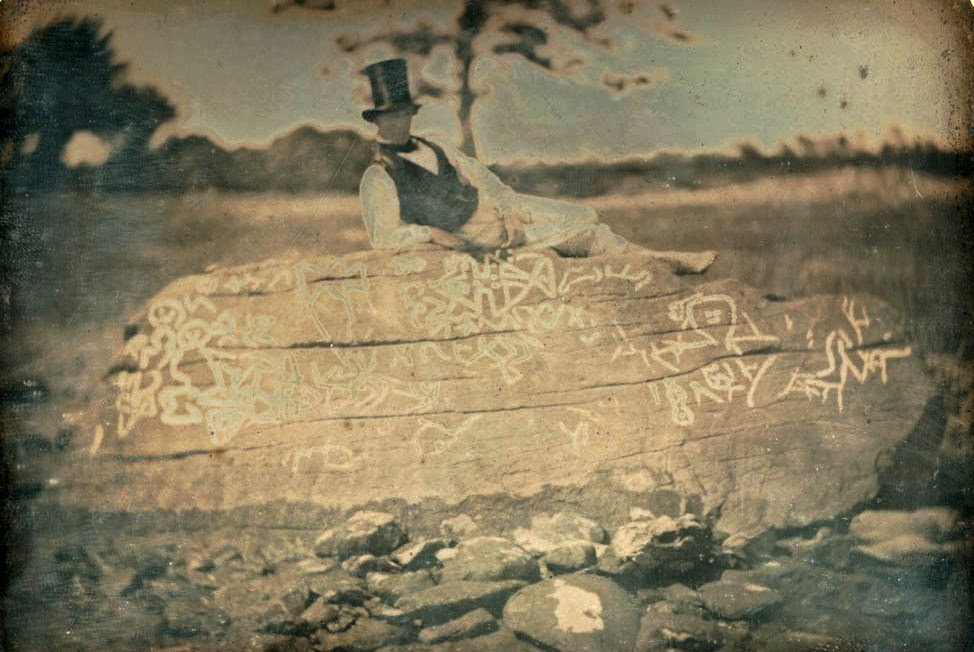
Seth Eastman on Dighton Rock, daguerreotype, 1853.

On February 1, 2014, I posted a column entitled "Dighton Rock - North America's Oldest Rock Art Report" about how this petroglyph boulder is the first known rock art site in America to be reported about. Dighton rock, however, holds another distinction in addition to being the subject of the first known rock art and archaeological site to be reported in writing. It may also be the subject of the first photograph taken of rock art in North America. 

On May 4, 2013, I posted a column entitled "The Oldest RockArt Photograph", in which I discussed a letter in Charles Darwin’s correspondence that mentioned an 1874 photograph of a bear pictograph from Picketwire Canyonlands that had been sent to Darwin. At that time I posited that it may be the oldest known rock art photograph, certainly in North America (although the photograph has not been located in Darwin’s correspondence).


                           Seth Eastman on Dighton Rock,
                               daguerreotype, 1853.

Now, I have another candidate for the title of oldest North American rock art photograph. In his 1991 book Fantastic Archaeology: The Wild Side of North American Prehistory (University of Pennsylvania Press, Philadelphia) Stephen Williams showed an 1853 daguerreotype of Dighton Rock in Berkley, Massachusetts. Williams described it as follows: “I believe that it (Dighton Rock) is the first American archaeological artifact to be captured by photographic means. Henry Rowe Schoolcraft, whom we encountered some pages ago with reference to the Grave Creek Stone, had as his major artist for his monumental six-volume work a young West Pointer named Seth Eastman. His busy army career took him from Minnesota to Texas and finally to the Seminole Wars in Florida.
Eastman, a talented artist, carefully documented Indian life on the frontier while on these military travels between 1829 and 1849. Though much of his work for Schoolcraft was studio-done on artifacts and the like, he did travel to New England, where he drew both the Dighton Rock and the Newport Tower. These drawings are all fine and good, but Eastman made archaeological history in 1853 when he sat atop Dighton Rock on shirtsleeves and a silk vest, with the inscription “enhanced” by chalk, and had a daguerreotype image made of the scene. What a way to be immortalized.
Schoolcraft used Eastman’s drawing of the Rock in his 1854 work.” (Williams 1991:215-6)

Online searching has turned up two versions of the photo; in one Eastman wears a top hat, and in the other version he is bare-headed. There are also variations that have the image reversed. In any case the early date of 1853 makes these daguerreotypes an excellent candidate for the title of Earliest Rock Art Photo!

REFERENCES:

Williams, Stephen
1991    Fantastic Archaeology: The Wild Side of North American Prehistory, University of Pennsylvania Press, Philadelphia.