Saturday, September 2, 2017

AUGUST 21, 2017 SOLAR ECLIPSE - LESSONS LEARNED AND THEORIES BURNED:


Photograph Becky Green Bowman,
August 21, 2012, Knoxville,
Tennessee.

We were lucky enough to reach a location (Wheatlands, Wyoming) to view the August 21, 2017 solar eclipse in totality. I will omit any whining about the traffic, and the price gouging for motel rooms, and will focus on the ideas that came out of
observing this amazing phenomenon.


August 21, 2017 eclipse in partial
phase, the moon's encroachment on
the Sun is not visible. Photograph
Peter Faris, August 21, 2017.

One lesson that was immediately apparent as we watched the eclipse proceed was that the old wife's tale about explorers saving their lives from primitive natives by correctly predicting an eclipse must be totally untrue. As the moon proceeded to cover the sun the appearance of the sun did not vary. The world got dimmer, and cooler, but the brilliance of the remaining portion of the sun made it impossible to see a bright disk being consumed by the dark moon. The sun remained an unbearably bright light in the sky up until literally just a moment before totality. The process of a "sky monster" eating the sun could not, I repeat could not, have been viewed without proper eclipse filters.

I also believe that this would apply to eclipse mythology such as this.
"To the Vikings thought that an eclipse occurred, when a pack of wolves chased the sun across the sky and then captured the celestial orb. Meanwhile in Vietnam, it was a giant frog that devoured our nearest star. And in the Pacific Northwest, the Pomo Indians rationalized that the culprit was a giant bear. Even in ancient China, people believed that a giant dragon was the cause of the sun's demise." (https://owlcation.com/)


Photograph by Becky Green
Bowman, August 21, 2017,
Knoxville, Tennessee.

As was observable during the August 21, 2017 total eclipse, you do not see any sort of diminishing crescent during a solar eclipse, indeed you do not see anything removed from the disc of the sun until it is literally in the "diamond ring" phase of the eclipse immediately followed by the blackened disc of totality.

Pinhole projection of partial eclipse.
Photograph Peter Faris, May 20, 2012.

In order to see the bite being taken out of the sun you either need proper eclipse filters, or you need to use the pinhole camera technique to project its image on a white surface.

This realization should be applied to any rock art identified as a representation of an eclipse. If it shows a crescent it is probably not an eclipse, because the creator of the rock art would not have seen a crescent when observing the eclipse supposedly being pictured.


Raftopolis Ranch, Moffat County,
Colorado. Photograph Peter Faris,
September 1987.


Pecos rock art, Texas. 
Photograph Teresa Weedin.

On February 9, 2013, I posted a column titled A Possible Total Eclipse Of The Sun In Rock Art, showing a petroglyph from northwestern Colorado which shows the sun as a disc surrounded with triangular prominences or flames. This was followed on February 23, 2013, with another posting titled Another Possible Solar Eclipse Symbol In Rock Art about my identification of the Zia Sun Symbol as a possible representation of a total solar eclipse. Both of these cases show a symbol that can be interpreted as the totality stage of a solar eclipse. A definite disc surrounded by rays or prominances.


Chaco Canyon, New Mexico.
Photograph phys.org,
Public Domain.


Chaco Canyon, New Mexico.
Photograph newsweek.com,
Public Domain.

A widely reported recent example of a petroglyph from Chaco Canyon which supposedly illustrates a solar eclipse does indeed show rays or prominences (flames?) around its edges, but it lacks the circle defining the blackened interior of the sun obscured by the moon. For this reason, while I accept it as a possible sun symbol, I certainly cannot accept it as an illustration of an eclipse. To my thinking it just does not fit all the criteria to illustrate a total eclipse.


REFERENCES:

https://owlcation.com/stem/The-Myth-and-Reality-of-Solar-Eclipses

Faris, Peter
2013 A Possible Total Eclipse Of The Sun In Rock Art, February 9, http://rockartblog.blogspot.com/2013/02/a-possible-total-eclipse-of-sun-in-rock.html

2013 Another Possible Solar Eclipse Symbol In Rock Art, February 23, http://rockartblog.blogspot.com/2013/02/another-possible-solar-eclipse-symbol.html

Sunday, August 27, 2017

A NEANDERTAL NOTCHED BONE:


http://www.newslocker.com/en-uk/profession/archaeology/2017-03-31/
Public domain.

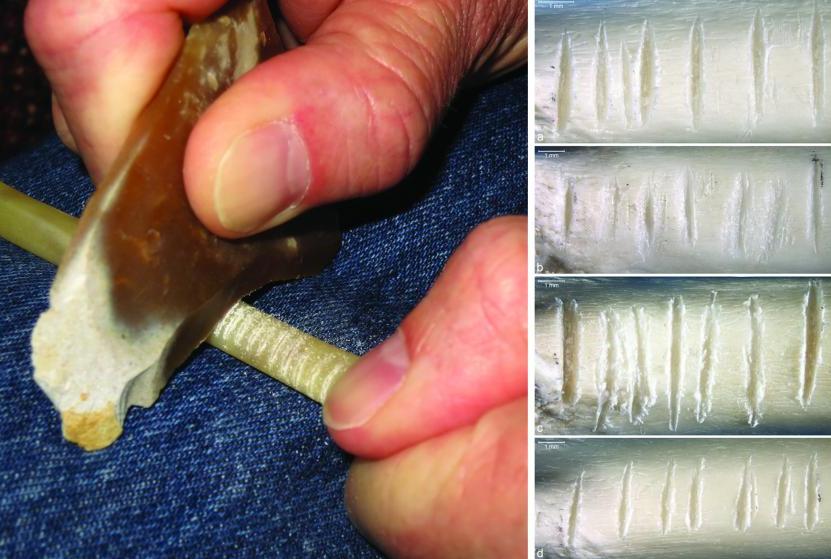
I have periodically presented material that is not actually rock art as we usually define it, but I have always been able to convince myself (and hopefully you) that this material had bearing on some aspect of rock art. Some examples are past columns about aspects of Neandertal culture and evidence of their ability to plan and think symbolically (for previous examples click on Neandertal in the cloud index at the bottom of the blog). A recent paper published on PLOS Online titled A Decorated Raven Bone From the Zaskalnaya VI (Kilosovskaya) Neanderthal Site, Crimea, by Ana Majkic, Sara Evans, Vadim Stepanchuk Alexander Twvelykh, and Francesco d'Errico, and appearing March 29, 2017, discussed a raven bone that bears a row of human created notches. The authors state that "This object represents the first instance of a bird bone from a Neanderthal site bearing modifications that cannot be explained as the result of butchery activities and for which a symbolic argument can be built on direct rather than circumstantial evidence." (Majkic et al 2017) In other words, these are obviously not butchery cuts, they were made purposefully and as the result of thought, analysis, and decision.


Closeup views of notched bone,
media.eurekalert.org.
Public Domain.

"Microscopic analysis of the notches indicate that they were produced by the to-and-fro movement of a lithic cutting edge and that two notches were added to fill in the gap left between previously cut notches, probably to increase the visual consistency of the pattern". (Majkic et al 2017)


Replication experiment,
media.eurekalert.org
Public Domain.


The authors replicated the creation of the notches by sawing a chipped stone edge back and forth on a modern turkey bone to test their assumptions. They concluded that the marks were intentional and not accidentally produced by butchering the raven for food or other purpose. "Previous studies of altered bird bones at Neanderthal sites have caused researchers to argue that the objects were used as personal ornaments. But this is the first direct evidence to support a symbolic argument for the modifications of bird bones." (dailymail.co.uk 2017)
                                  
"This object represents the first instance of a bird bone from a Neanderthal site bearing modifications that cannot be explained as the result of butchery activities and for which a symbolic argument can be built on direct rather than circumstantial evidence." (dailymail.co.uk 2017)

It seems most likely that this raven bone was being altered for purposes of human adornment, to be used as a hair pin or pendant. Now we have  more proof of purposeful planning among the Neandertal, a very human trait, and one that should force many people to rethink their assumptions about Neandertal culture. Perhaps they were us after all.

NOTE: Images in this posting were retrieved from the internet after a search for public domain photographs. If any of these images are not intended to be public domain, I apologize, and will happily provide the picture credits if the owner will contact me with them. For further information on these reports you should read the originals at the sites listed below.

REFERENCES:


http://journals.plos.org/plosone/article?id=10.1371.journal.pone.0173435

http://www.media.eurekalert.org.

http://www.newslocker.com/en-uk/profession/archaeology/2017-03-31/.

Saturday, August 19, 2017

IMAGES OF FOOTWEAR IN ROCK ART - ANASAZI SANDALS:


Shod footprint, Three Rivers, Otero
County, NM. Photo Jack and Esther
Faris, November 1988.


Closeup of shod footprint, Three Rivers,
Otero  County, NM. Photo Jack and
Esther Faris, November 1988.

As mentioned last week, a subject of interest in rock art is the portrayal of footwear. What do these images mean, what is their implication, what do they represent? Among the Ancestral Puebloan peoples, and most other people of the southwest, the common footwear was the sandal. For the sake of this discussion I will assume that any image of the outline of a human foot that does not display toes represents shod foot, showing a piece of footwear, sandal or moccasin.


Plaited sandal, Kayenta Anasazi,
Arizona, 900-1300 AD, yucca
leaves and cordage. Natural
History Museum of Utah.

Sandals were woven out of plant fibers or bark (often juniper), but perhaps the most common sandal was hand woven of yucca leaves (although especially fine examples might be twined out of cotton fibers). More than one technique was used in their production. The simplest ones were plaited with a warp in one direction, crossed by a weft in the other direction in an over-under alternating pattern. More complicated, and finer, results were obtained by twining, and the finest examples were often decorated by using different colors of dyed material, or by painting them subsequent to their weaving.


Twined yucca fiber sandal,
Glowacki, Fig. 10, p. 141.

Glowacki observed in 2015 that "Changes in sandal technology and the iconography depicted on murals and in rock art imply widespread reorganization in Western Mesa Verde influenced in part by changing relationships with an perceptions of Chaco and Aztec that altered local interactions and practices. For example, twined sandals, made of finely woven yucca with raised geometric designs on the tread or designs that were painted or dyed after production were used until the early 1200s, subsequently being replaced by plaited sandals." (Glowacki 2015:140)


Alex Patterson, 1992, A Field
Guide To Rock Art Symbols, p. 173.

These are assumed to have been used as ceremonial dance footwear, given the amount of work, and the specialized knowledge, required to produce them. "the intricacies of the unique geometric designs on the tread, and the impracticality of wearing finely twined sandals for daily use." (Glowacki 2015:140)


Footprint petroglyph, Spruce Tree
House, Mesa Verde, CO., Photo
Peter Faris, July 2002.

"The high frequency of sandal imagery in Western Mesa Verde and the depictions of sandals on rock art panels near habitations and on the inside and outside walls of rooms and kivas suggest that twined sandals had a different role in Western Mesa Verde culture than in other parts of the region." (Glowacki 2015:140-42)


Alex Patterson, 1992, A Field
Guide To Rock Art Symbols,
p. 173.

"Twined yucca sandals fell into disuse across the northern Southwest coincident with both the decline of Chaco and the extreme drought conditions of the mid-1100s." (Glowacki 2015:142)


Franktown Cave sandal, Franktown,
Colorado. 3345 - 3033 B.C. 
https://collectioncare.auraria.edu


The ubiquity and time-depth of the plaited yucca sandal is easily illustrated by the Franktown Cave sandal, recovered from a dry cave near Franktown, Colorado, and dated from between 3345 and 3033 B.C.(www.collectioncare.auraria.edu)  Indeed, anywhere and anytime that people had access to yucca they seem to have produced sandals for footwear.

Would an image of a sandal or moccasin serve as a symbol of travel, or does Glowacki have it correct that it is a symbol of ceremonial significance? In this latter case a depiction of a sandal print, especially a geometrically decorated sandal print, might represent a ceremonial dance. Or does it represent something else entirely? What do you think?

NOTE: Some of the images in this posting were obtained through an internet search for "Public Domain." If I have used any images that were not intended to be public domain please inform me and I will be happy to give full credit.


REFERENCES:

Glowacki, Donna M.,
2015 Living and Leaving, A Social History of Regional Depopulation in Thirteenth-Century Mesa Verde, University of Arizona Press, Tucson.

https://collectioncare.auraria.edu/content/yucca-woven-sandal-franktown-cave

Patterson, Alex
1992 A Field Guide To Rock Art Symbols, Johnson Books, Boulder, CO.


Saturday, August 12, 2017

IMAGES OF FOOTWEAR IN ROCK ART - FREMONT MOCCASINS:


Fremont moccasin print petroglyphs,
Dinosaur Nat. Mon. Grand County, UT.
Photo: Peter Faris, June 1986.

A subject of interest in rock art is the portrayal of footwear. What do these images mean, what is their implication, what do they represent? For the sake of this discussion I will assume that any image of the outline of a human foot that does not display toes represents a shod foot - showing a foot wearing footwear, a sandal or moccasin. Such shod foot prints are a common subject of Fremont Rock Art of the Dinosaur National Monument.


Fremont style moccasin, Hogup cave,
Utah. Wikimedia, Public Domain.

A large number of leather moccasins have been retrieved from dry caves and rock shelters in Utah. Promontory Caves, on the shores of Utah's Great Salt Lake were first excavated in the 1930s, and excavations resumed in 2011 under the supervision of Dr. Jack Ives of the University of Alberta.

"The site - part of a complex of natural shelters known as the Promontory Caves - contains "exceedingly abundant" artifacts numbering in the thousands, Ives said, marking a human occupation that began rather suddenly about 850 years ago. Scant ceramic sherds and basket fragments, meanwhile, bear strong sigs of influence from other Great Basin cultures, including the Fremont. This wealth of artifacts may go a long way in demystifying the distinctive, little-researched populations often referred to as the Promontory Culture." (De Pastino 2015)


Promontory Cave moccasins,
westerndigs.org,
Public Domain.

"But it was the staggering amount of footwear in the caves that captured the attention of archaeologists, past and present. With soles made from a single piece of bison leather, lined with fur, and sewn together at the heel, the moccasins are made in a style typical of the Canadian Subarctic, Ives said, a fashion his team describes as being "decidedly out of place in the eastern Great Basin. These moccasins and other cues have led some experts to theorize that the cave's inhabitants were part of a great migration from the far north, a wave of people who moved into the Great Basin in the 12th and 13th centuries, and eventually gave rise to cultures that include the Apache and the Navajo." (De Pastino 2015)

Note, this description of the Promontory Culture people of Utah connects them with at least influence from the Fremont people if not sharing the Fremont culture outright. The Fremont, and other, people of Utah and Northwestern Colorado commonly wore leather moccasins. Fremont researchers describe the Fremont people as possessing a unique form of moccasin made from the hide removed from the lower leg of a deer and having the dew claws of the deer left on. "The Fremont made moccasins from the lower-leg hide of large animals, such as deer, bighorn sheep or bison. Dew claws were left on the soles, possibly to act as hobnails, providing extra traction on slippery surfaces." (nps.gov)


Fremont moccasin print petroglyphs,
Dinosaur Nat. Mon. Grand County, UT.
Photo: Peter Faris, June 1986.

The migration mentioned above, known as the Athapaskan migration occurred roughly 500 years ago. It is believed to have involved a relatively small group that assimilated and intermixed with resident groups along their route and in the southwest. Their influence is illustrated by the fact that the Athapaskan family of languages is now dominant in much of the southwest. The Navajo and Apache peoples are descendants of these Athapaskan migrants and their languages are closely related to Chipewyan, an Athapaskan language spoken in the subarctic. (ScienceDaily 2008) The relationship of these migrants to the Fremont people is still not fully understood, but the Fremont wore a type of moccasin inspired by the Athapaskan migrants, suggesting a strong influence.


Fremont moccasin print petroglyphs,
Dinosaur Nat. Mon. Grand County, UT.
Photo: Peter Faris, June 1986.

One location with a large number of petroglyphs of footwear (shod footprints) is found at Station #17 on Harper's Corner Road, in Dinosaur National Park, right by the northwestern Colorado/northeastern Utah Border. This is classical Fremont territory and rock art in this area is predominately Fremont, dating from sometime after 100 AD to ca. 1300 AD.


Fremont moccasin print petroglyphs,
Dinosaur Nat. Mon. Grand County, UT.
Photo: Peter Faris, June 1986.

Would an image of a moccasin have served as a symbol of travel, or does it represent something else entirely? What do you think?

NOTE: Some images in this posting were retrieved from the internet in a search for public domain photographs. If any of these images are not intended to be public domain, I apologize, and will happily provide the picture credits if the owner will contact me with them. For further information on these reports you should read the originals at the sites listed below. 


REFERENCES:

De Pastino, Blake,
2015 Utah Cave Full of Children's Moccasins Sheds Light on Little-Known Ancient Culture, http://westerndigs.org/utah-cave-full-of-childrens-moccasins-sheds-light-on-little-known-ancient-culture/

https://www.nps.gov/care/learn/historyculture/fremont.htm

https://www.sciencedaily.com/releases/2008/07/080715104932.htm

Saturday, July 29, 2017

WHY I AM SKEPTICAL ABOUT A RUSSIAN CIRCLE OF HOLES BEING AN ANCIENT SUNDIAL:


 Russian stone circle purported to
be a sundial/moondial.

LiveScience article by Stephanie Pappas, dated October 15, 2014, announced the discovery of a combination Sundial/Moondial carved into a rock found in 1991 near Rostov, Russia. It has been provisionally dated to the Bronze Age. Found in the grave of a man who died in his 50s it is marked with round holes arranged in a circle.

"The slab is marked with round divots arranged in a circle, and an astronomical analysis suggests that these markings coincide with heavenly events, including sunrises and moonrises." (Pappas 2014) The astronomical analysis was done by researcher Larisa Vodolazhskaya of the Archaeoastronimical Research Center at Russia's Southern Federal University.
Pappas's article describes this discovery in light of a similar one found in the Ukraine, but unfortunately the descriptions are somewhat confused an which discovery fits which description is pretty difficult to determine. Perhaps they were assumed to be similar.

The circle of holes is described as being 0.9' (feet) in diameter. Once the researchers had decided that it marked sunrise/moonrise alignments they approached it as if it were a piece of astronomical equipment that could be used to predict events, or even carry out "research." (Seeker 2014)

As I listed in the headline for this posting I am very skeptical about these conclusions for a number of reasons. First; there is no information provided about how the original position of the rock slab was determined. Without such data it would not be possible to determine any alignments at all.
Second; the holes are anything but precise, they are not the same size or even perfect circles. Were they assuming the sight line runs from an edge of each dot, or the center of each dot, or from this edge to that center? If it were an edge the holes would have to be exactly the same to make alignments reliable.
Third; the diameter of the arrangement was given as about 9/10 of a foot. This small diameter means that there is much too short a sight-line to determine such precise data.
Fourth; the holes do not make a circle but are more oval in arrangement. Again, a considerable lack of precision makes any reliable results doubtful. These reasons illustrate why I am so skeptical about the circles of dots being useful as astronomical equipment.

So what could it have been used for? I am much more comfortable considering it to be a game or counting board for a number of reasons. Any game that involved moving markers could have been played and my criticisms such as size and shapes of holes, small diameter, and oval outline would not affect a game at all. Indeed, the small diameter would make it easier to use as a game board. And for counting, the user could move a pebble from hole to hole to indicate numbers of whatever is considered significant. So until better information comes along, I am in the thumbs-down column as to this discovery representing significant astronomical knowledge by these ancient people.


REFERENCES:

http://www.seeker.com/mysterious-slab-in-russia-may-be-a-sundial-1769195077.html

Pappas, Stephanie,
2014 Illuminating! Ancient Slab May Be Sundial-Moondial, LiveScience.

FIRST PALEOLITHIC ROCK ART IN GERMANY: ENGRAVINGS ON HUNSRUCK SLATE.


Paleolithic slate engravings,
Hunsruck, Germany.
Public domain.

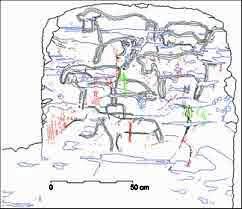
A recent paper on thefreelibrary.com reported the discovery of the first large-scale paleolithic art in Germany. Originally discovered in 2010, the engravings were found on a rock face in the mountainous Hunsruck area.
The engraving shows a group of three horses and one other unidentified animal deeply carved into the surface of a large slate boulder.


Close-up of Paleolithic slate
engravings, Hunsruck,
Germany. Public domain.

A number of experts, including Paul Bahn in 2013, have authenticated the find and attribute it to the paleolithic period. Other examples of open-air paleolithic art have also been attributed in France and Spain, but this is Germany's lone example so far.


Drawing of the Paleolithic slate
engravings, Hunsruck,
Germany. Public domain.

This boulder is located in the German state of Rhineland-Palatinate, near the village of Gondershausen. The slate deposits in this area have long been mined and are famous for fossils recovered. Analysis of the images has discovered that at least three periods of engraving were undertaken, with the deep lines of the animal engravings coming first. Lighter lines, added later, are hard to decipher with portions obscured by lichen growth, and weathering.

Hopefully other examples of large-scale paleolithic art will be discovered there to add to our knowledge of the people of that time and place.

NOTE: Images in this posting were retrieved from the internet in a search for public domain photographs. If any of these images are not intended to be public domain, I apologize, and will happily provide the picture credits if the owner will contact me with them. For further information on these reports you should read the originals at the sites listed below.


REFERENCE:

https://www.thefreelibrary.com/First+Palaeolithic+rock+art+in+Germany%3A+engravings+on+Hunsruck+slate.-a0446932799

Saturday, July 22, 2017

EARLY VISITORS TO CAVE ART SITES - ROUFFIGNAC:


Bust of Francois de Belleforest,
Wikipedia. Public domain.

On July 1, 2017, I published an article that I called NIAUX CAVERN - AN EARLY VISITOR'S GRAFFITI, in which I wrote about Ruben de la Vialle who visited Niaux and left his name and the year 1660 on the wall.

Another early visitor to a painted cave in France was the French writer Francois de Belleforest who wrote about Rouffignac and mentioned the "paintings" he found within, in 1575.


Map of Rouffignac cave,
entrance at lower right.

"The original entrance is still wide open today. It was a popular place to explore, particularly in the eighteenth, nineteenth, and twentieth centuries, as we can see from the numerous inscriptions on the walls. There are names and dates that cover four centuries. No one in those days knew about the existence of Paleolithic culture, so it is understandable that the art was ignored, even though some drawings were quite visible. In fact, as early as 1575, Francois de Belle-Forest wrote about the wonders of this cave and mentioned the 'paintings,' adding that he thought the place to be one of idolatry, possibly with sacrificial rituals dedicated to Venus or some other 'infernal' pagan deity. His interesting manuscript provides supplementary evidence for authentication of the art. Indeed, as prehistoric art was unheard of until the mid-1800s at the very earliest, no fake 'prehistoric' depictions could have been done before then, certainly not in 1575." (Rothenberg 2011:98-9)


Mammoth and ibexes, Rouffignac.
Public Domain.


Close-up of mammoth and ibexes, 
Rouffignac. Public Domain.

I am unable, obviously, to determine exactly which paintings Belleforest might have seen (although I assume they were the ones nearest the entrance). Rouffignac is, however, called the "Cave of 100 Mammoths" for its large number of portrayals of that creature, so perhaps he saw mammoths.


Mammoth frieze, Rouffignac.
Public Domain.

Rouffignac is decorated with 158 mammoths, 28 bisons, 15 horses, 12 capricorns (ibexes), and 10 wooly rhinoceros. Seventy-eight percent of all the animals depicted are mammoths. (Wikipedia) We must regret that Belleforest did not delineate further what he saw, to allow us to identify the specific images, but we should certainly celebrate him as an early visitor to a cave art site.


NOTE: The images in this posting were retrieved from the Internet with a search for Public Domain images. If they were used inappropriately and are not intended to be Public Domain I apologize to the owner of the picture's rights. If this is the case please inform me.


REFERENCES:

Rothenberg, David,
2011 Survival of the Beautiful, Art, Science, and Evolution, Bloomsbury Press, New York.

Wikipedia.