Saturday, February 21, 2015

WHO MADE IT – ROCK ART BY BEGINNERS:


Westwater Creek, Grand County, Utah.
Photograph Peter Faris, October 8, 2001.

In considering who made the rock art we tend to avoid one inconvenient truth. No matter how beautiful some of our favorite panels are the artist who created them had to start somewhere. Nobody can accomplish a high quality work of art without considerable practice and experience. Back in my early days of art teaching we used to say that a student must make a requisite number of mistakes before they can count on getting it right. As students of rock art I think we all too often ascribe poorly done images to someone rushing, not taking the required time to get it right, instead of admitting that many images were done very poorly because of inexperience, and perhaps youth.

On  February 15, 2015 , I addressed one aspect of this question in a posting entitled A Beginner's Mistake which discussed a petroglyph on McConkie Ranch near Vernal, Utah, which showed drastic changes in scale from top to bottom based on an inexperienced artist's overlooking of the problem of fitting the scale of his image to the size of the available surface (originally posted on June 30, 2013). 


Westwater Creek, Grand County, Utah.
Photograph Peter Faris, October 8, 2001.

The illustrations above, from upper Westwater Creek, in eastern Utah, show some examples of imagery that may have been produced by inexperienced artists. The white equestrian figures in the illustration at top were created by a Ute artist that I assume was quite young, or inexperienced, or both. Equally, the horsemen in the grouping in the second illustration are so crudely done that we may be justified in assuming that their creator was just learning the trade.

Guthrie, in The Nature of Paleolithic Art (2005), presented many examples of Paleolithic art from the caves of Europe that he identified as beginner’s mistakes, and while he may be right or wrong on specific examples he certainly had a great point. Nobody gets to start at the top; you start at the bottom, make your mistakes, and work your way up.

Paleolithic art, perhaps drawn by inexperienced
artists. Guthrie, R. Dale Guthrie, 2005,
The Nature of Paleolithic Art, p. 8.

“Paleolithic art contains the work of many inexperienced artists. Throughout this book I’ll show you quite a few works by artists who are developing their drawing facility. Such works are usually bypassed in popular books on this subject. And they are not easily integrated into most theories explaining Paleolithic art.” (Guthrie 2005:8) This is self-selection bias, they are overlooked and so our whole picture of ancient art is skewed toward what we see as a high level of quality and professionalism.


Paleolithic art, perhaps drawn by inexperienced
artists. Guthrie, R. Dale Guthrie, 2005,
The Nature of Paleolithic Art, p. 12.

“Rather scribbly works by inexperienced Paleolithic drawers who did a lot of redrawing. A, Ibex, Espelugues, Fr. B-C, Horses, Lascaux, Fr. D, Wild cattle or aurochs, Limeuil, Fr. E, A mix of images from Les Combarelles, Fr. Horses in B and C are speared; the one in C is penetrated by a spear in the gut and bleeding profusely (this portrays a botched killing job, as a spear-hunter must hit the thorax for a clean kill).” (Guthrie 2005:12)

As I said above, while Guthrie may be right or wrong on any specific example I believe that he has put his finger on a serious oversight that still affects rock art studies. Instead of looking at what we can learn from all images (including the crudest or least aesthetic), we ignore some to focus on the best and most beautiful. This adds a measure of self-selection bias to our supposedly objective investigations. In the end we may have a one-sided or biased viewpoint on all rock art because of this.


REFERENCE: 

Guthrie, R. Dale
2005    The Nature of Paleolithic Art, University of Chicago Press, Chicago.

Sunday, February 15, 2015

A BEGINNER’S MISTAKE – BIGFOOT MAN AT MCCONKIE RANCH:


http://adventr.co/201103/dry-fork-mcconkie-ranch.

Among the marvelous Fremont culture rock art at McConkie Ranch outside Vernal, Utah is the figure known as Bigfoot Man. Done in what Polly Schaafsma called the Classic Fremont Style this figure presents us with an example of a beginner’s mistake. I started my working career by teaching art at a few colleges and my curriculum responsibilities usually included life or figure drawing. Anyone who has actually taught art will recognize this panel immediately as a common error made by beginning students in figure drawing. What it represents is someone starting to draw the figure on a scale that is too large for the surface. Depending upon where the student started the head may be too big for the rest of the body, or some other portion may be seen as outsized. Then they recognize that they have to change the scale to fit the rest of the figure onto the surface. In the case of Bigfoot Man the artist ambitiously began with a pair of large feet and quickly realized that he had to reduce the scale of the rest of the figure to fit onto the chosen rock face.

Some other points to note in this panel; the figure has been given knobby knees which I interpret as an attempt to realistically portray the patella, or knee-cap, and he is shown with six fingers on his hand (polydactylism again). Finally, notice that not only is this panel pecked, but paint has then been added as well, particularly in his headdress. It is an example of mixed-media. Many of the students in my former classes would actually have been happy to have done so well in their initial attempts. This figure is portrayed with details of clothing and headdress as well as weapons. He has a spear or something on his back projecting up above his right shoulder, and he holds a club or axe in his left hand.


Funny looking - yes? This is, however, diagnostic of a situation in which the creation of rock art was actually being taught to someone, and probably critiqued by the teacher. In our culture we call that an art school and it suggests a high degree of sophistication in the Fremont culture as well as providing clues as to how their rock art was produced.

NOTE: This material had originally been posted a couple of years ago but I deleted it in order to update it and add  additional information.


Saturday, February 14, 2015

STONE BLINDS AND DRIVELINES - ROLLINS PASS, CO:


Drive line, Rollins Pass, Grand County, CO.
Photograph Peter Faris, 25 July 1987. 

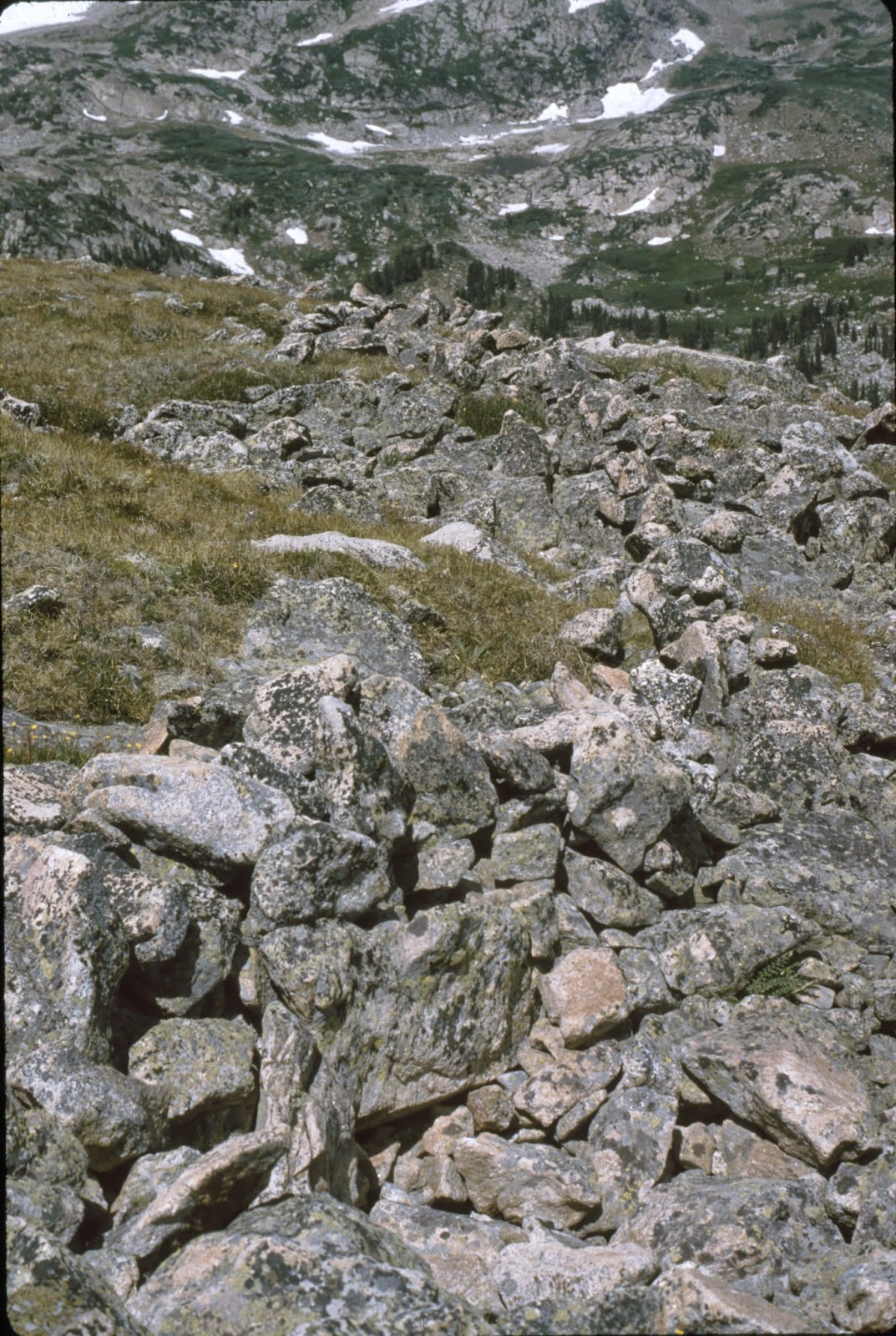
Over the years I have discussed features that we classify as geoglyphs a few times. Under our western cultural classifications of art we have always included architecture so I feel that I can properly include rock constructions under the classification of rock art. In this posting I want to mention the amazing rock alignments and constructions on the top of Rollins Pass in Grand County, Colorado at 11,671’ altitude in the Colorado Rocky Mountains. I have had the opportunity to visit there a couple of times, the first in 1987 with Dr. James Benedict who researched high altitude archaeology for many years and was certainly the expert on the Rollins Pass alignments.


A section of the drive line, Rollins Pass, Grand County,
CO. Photograph Peter Faris, 25 July 1987.

These comprise 12 game drives and associated stone hunting blinds and other features. “Several drives are small, perhaps single construction episode walls containing less than 150 meters of rock alignments, while others are large, likely aggraded drives, which contain over 1500 meters of drive features much like other game drives in the Indian Peaks such as Sawtooth Mountain and the Arapaho Pass System.” (Pelton 2012:55)


Close-up of stone construction, Rollins Pass, Grand
County, CO. Photograph Peter Faris, 25 July 1987.

At the time of my first visit to the area in 1987, Dr. Benedict gave a rough estimate of over 1 mi. of fence, 174 pit blinds, and 184 cairns, and gave his date estimates as from ca. 6,000 - 3,000 BC. Obviously people had expended a great deal of time and energy to create these features in the thin air of nearly 12,000 feet above sea level.

“Six of the 12 sites contain less than 500 meters of rock alignments, three contain between 500 meters and one kilometer, two contain between one and two kilometers of rock alignments, and one contains over two kilometers (2,041 meters) of rock alignments. In terms of the total number of pit or hunting blind features, seven sites contain one to ten, two sites contain 11 to 20, two contain between 30 and 40, and one contains over 40.” (Pelton 2012:55)


 Hunting blind, Rollins Pass, Grand County, CO.
Photograph Peter Faris, 25 July 1987.

The hunting blinds may have been partially excavated pit features which were then surrounded by a rock wall that the hunter could conceal behind as the animals were driven toward them. Excavations in hunting blinds have proven that people were indeed in them, at least on occasion, as dropped items and tool sharpening flakes have been reported.

We can only surmise how exactly they were used, but I can easily imagine a group of hunters gathering in some of the blinds on top of the pass while the rest of the clan hikes down to lower altitude in the forest. There they could spread out in a long line and begin a noisy drive up towards the pass on top, driving any animals ahead of them and funneling them toward where the hunters waited. In such a scenario the Rollins Pass complex would function as sort of the reverse of a buffalo jump. In this case instead of driving the game to fall down, they were driving them to climb up, but the results would have been much the same.

A view of the summit of Rollins Pass and the modern road across it seen from within one of the hunting blinds shows a section of drive line couple of the cairns visible as longer rocks standing on end. The landscape in the back ground gives a good idea of the altitude and the conditions found here.


View from within a stone blind of the drive line, Rollins Pass,
Grand County, CO.photograph Peter Faris, 25 July 1987.
Cairns represented by vertical rocks in right center.

“The number of cairns per site is most often related to a specific design element of certain game drives - in which cairn alignments are utilized in the place of rock wall alignments, a construction technique that requires far less labor investment and exhibits no discernible pattern, in terms of cairn quantity, between sites. Based on the numbers from the 12 previously recorded game drives, the “average” game drive at Rollins Pass contains around 670 meters of rock alignments, between 15 to 16 pit or hunting blind features, and between 9 to 10 cairns.” (Pelton 2012:55-56)

These cairns most probably were similar to the inuksuk built by Inuit hunters to help guide the reindeer to a desired hunting ground. How effective could such a complex be? Dr. Benedict stated that one day during one of his recording trips to the site he watched a deer or elk wandering up the slope stop and divert to the side when it came to one of the drive lines, even in there modern broken down and aggraded condition.

As rock alignments, and very impressive ones at that, these drive line complexes certainly classify as a category of geoglyphs, and as we consider architecture to be one component of the arts, I feel completely justified in including these in RockArtBlog.

REFERENCE:

Pelton, Spencer R.
2012    Putting Rollins Pass on the Map: Revitalizing the Research of a High Altitude Archaeological Landscape, pages 54-57, Colorado Archaeology, Spring 2012, Vol. 78, No. 1, Colorado Archaeological Society and Colorado Council of Professional Archaeologists.

Saturday, February 7, 2015

ROCK ART THEMES ON OTHER MEDIA - MOGOLLON BIGHORN SHEEP DESIGNS:


Bighorn maze, Three-Rivers Petroglyph Site, New Mexico.
Photograph: December 1988, Jack and Esther Faris.

This intriguing petroglyph is from the great Three Rivers Petroglyph Site in New Mexico. More than 21,000 glyphs of birds, humans, animals, fish, insects and plants, as well as numerous geometric and abstract designs are scattered over 50 acres of New Mexico's northern Chihuahuan Desert. The petroglyphs at Three Rivers, dating back to between about 900 and 1400 AD, were created by Jornada Mogollon people.

It shows a complicated design of desert bighorn sheep heads at the ends of lines. These are often referred to in the literature as Bighorn staffs (like a walking stick). One problem with the identification as staffs is that the lines are not straight; after extending a short distance below the bighorn head they bend off at an extreme angle, even shooting straight up. Also, as far as I can tell, Mogollon artifacts recovered to date do not include bighorn-sheep-headed staffs (although I do not pretend to have a comprehensive knowledge of Mogollon collections on museum shelves). So they are probably not staffs. This design has also been referred to as a bighorn maze which might make a little more sense, but, of course, we have no real idea as to its intention. No-one can seemingly come up with a suggestion as to why they felt the need to create a maze with bighorn sheep heads on it – other than the catchall “for ritualistic purposes” which we all too often fall back on when we don’t really have an idea at all.


Mimbres bowl, cover photo from Brody, J. J., Catherine J. Scott,
and Steven A. LeBlanc,1983, Mimbres Pottery: Ancient Art of the
American Southwest, Hudson Hills Press, New York. 

My fascination with this design is partly founded in its resemblance to the design on a classic Mimbres pottery bowl from the Mattocks site, now in the Maxwell Museum of Anthropology, The University of New Mexico, Albuquerque. The bowl measures H. 4 ⅛ in. (10.5 cm), diam. 9 ¼ in. (23.5 cm). (Brody et al. 1983:15) Mimbres pottery dates from a period of about six hundred years (AD 550 – 1150). “ Gila River  Rio Grande Valley and it western tributaries in southwest New Mexico. Differentiation between the Mimbres branch and other areas of the Mogollon culture area is most apparent during the Three Circle (AD 825-1000 roughly) and Classic Mimbres (AD 1000-1150) phases, when architectural construction and black and white painted pottery assume locally distinctive forms and styles” (Wikipedia). The design on this bowl has two mountain sheep heads on the ends of lines, which take off at angles much like the design of the petroglyph. I find the resemblance striking.


General Mogollon culture area. Three Rivers Petroglyph
Site is the star at the upper right, and the bowl came
from roughly the location of the star on the left.

So, is there any real connection, or just a coincidence? Mimbres pottery was produced within a portion of the Mogollon cultural area so geographically we can say they may be connected. Thematically they are obviously similar. The dates of Classic Mimbres pottery (AD 1000 – 1150) fall easily within the span of the production of petroglyphs at Three Rivers. Although I still have to admit that I do not know the significance of the design of the bighorn sheep head on the end of lines like this I do think that both the Mimbres bowl in question, and the petroglyph at Three Rivers, may well have some motivation in common, perhaps they refer to a commonly held belief, or a material item generally recognized throughout the Mogollon territory, so yes, I say they are certainly connected - at least in my mind. What do you think?

REFERENCES:

Brody, J. J., Catherine J. Scott, and Steven A. LeBlanc
1983    Mimbres Pottery: Ancient Art of the American Southwest, Hudson Hills Press, New York.


Wikipedia

Saturday, January 31, 2015

AND CLOSER TO HOME:


Ute equestrian figure. West of Denver, CO.
Photograph Peter Faris, September 22, 2005.


Location of Ute equestrian figure. West of Denver,
CO. Photograph Peter Faris, September 22, 2005.


Field sketch of Ute equestrian figure. West of
Denver, CO.  Peter Faris, September 22, 2005.

On September 22, 2005, I visited a rock art site in the foothills west of Denver. It is the second site that I know of in what is called the “Hogback Valley” the gap between the first ridge of foothills – “the Hogback” – and the Rocky Mountains west of Denver. This site sported a small, crudely painted, black figure that apparently represents an equestrian figure. Judging from the location it was probably created by the Ute.


Rock shelter west of Denver, CO.
Photograph Peter Faris, January, 1995.


Linear markings in rock shelter west of Denver, CO.
Photograph Peter Faris, January, 1995.

The other site I mentioned I last visited in January 1995. It consists of numerous short grooves in a rock shelter, and yes, attempts have been made to read them as Ogam - just not by me. It has been long held that there was no rock art in the Denver metro area. We now know of a couple of minor sites west of Denver, and a few others from up and down the Front Range, the eastern foothills of the Rocky Mountains in northern Colorado between say Pueblo and the Wyoming border.

The question is – why aren’t there more? The answer to that is presently unknown. If we could figure it out it might provide insights into why rock art was created, and where? There are certainly plenty of good rock faces for rock art. So why is there so little? What we can say is that the Front Range of northern Colorado was, for much of recent prehistory, and I suspect farther back in time as well, basically a frontier, a place where cultures of the Great Plains rubbed up against the peoples of the mountains.

Doesn’t that suggest that this rock art was not created as signs to other people? A very few minor examples of pictographs and petroglyphs, essentially hidden away and hard to find do not make for very good communication of messages of ownership, and they make poor “No Trespassing” signs. That suggests to me that the few examples we do find must have more local or personal relevance. The creation of it was not to broadcast a message to larger society in general, it seems to have been meant for much more private purposes, but what they may be I cannot say. What do you think?

And Oh yes, I did not mention the locations because I have been asked to keep them secret by the managers of the land they are on, sorry. 

Saturday, January 24, 2015

THE HERO TWINS IN ROCK ART:


War or Hero twins with sky themes and other
petroglyphs. Galisteo Dike, New Mexico.

Among the Ancestral Puebloan peoples two mythical beings that were of importance in their creation cycle, and early mythology were the Hero Twins. These beings were involved in ridding the earth of the monsters and giants that threatened humans after the emergence. They were not, however, kachinas (katcinas) but instead are semi-divine cultural heroes.


Possible War or Hero Twins portrayal.
Galisteo Dike, New Mexico.

“In Zuni narratives that describe the time of the beginning, the Twin War Gods are culture heroes who bring the ancestors of the contemporary Zuni out of the fourth underworld to the surface of this earth; they contribute to making these people into “finished beings”; they shape the features of the earth’s surface (the Fifth World); they destroy or petrify the monsters that populate this world’ and they create constellations, stars, and other astronomical objects by throwing the body parts of various monsters into the sky.” (Williamson and Farrer 1992:76)

“In addition to depicting them as culture heroes or War Gods, some Zuni narratives also describe these twins as sons of the Sun Father – the Morning and Evening Stars, who serve as heralds for various ceremonial and agricultural activities.” (Williamson and Farrer 1992:76)


Homes of the Hopi Hero or Warrior Twins.
Chimney Rock National Monument, Colorado.
Photograph Peter Faris, 15 September 2002.

On September 23, 2009, I posted the column Chimney Rock and the Twin War Gods  in which I related the story of a delegation of Hopi elders who visited Chimney Rock National Monument after the Japanese attack on Pearl Harbor to awake the heroes - which live in the two rock spires at Chimney Rock - to assist the United States during World War Two.


Possible Hero or War Twins from
McConkey Ranch, Vernal, Utah. Fremont
culture. Photograph Peter Faris.

Many instances of paired figures in rock art as well as other forms of Native American art and craft show are assumed to be representations of the Hero Twins. Examples I present here include a pair of panels from Galisteo Dike in New Mexico and a Fremont panel from McConkey Ranch near Vernal, Utah. The Fremont example appears to me to be an unfinished pair of shield figures from their resemblance to so many other shield figures at that locale. Also both figures were obviously created by the same artist on stylistic and technical reasons so they can be assumed to have been intended to represent warrior twins.


 “Drinking Vessel Depicting Hero Twins,
Mexico, Maya, Central Campeche,
c. A.D. 593-830 (Cat. No. 39)”
(Fields and Zamudio-Taylor, 2001:43)

From farther south I illustrate a depiction of the Mayan version of the Hero Twins on a drinking vessel. (Fields and Zamudio-Taylor 2001:43)

The Hero Twins can thus be seen as a very real (and continuing) influence on Native American culture in the Southwest and Mesoamerica. These, and many other portrayals, provide a fascinating insight into the beliefs and influences of the peoples and cultures and are a very interesting theme in the rock art and other arts of the native peoples of the region.


REFERENCES:

Fields, Virginia M., and Victor Zamudio-Taylor,
2001    Aztlan: Destination and Point of Departure, pages 38 – 77, Fig. 15, p. 43, The Road To Aztlan: Art From A Mythic Homeland, edited by Fields, Virginia M., and Victor Zamudio-Taylor,  Los Angeles County Museum of Art, Los Angeles.

Williamson, Ray A. and Claire R. Farrer
1992    Earth and Sky, Visions of the Cosmos in Native American Folklore, University of New Mexico Press, Albuquerque.

Saturday, January 17, 2015

METEORITES IN ROCK ART – A POSSIBLE PORTRAYAL:


Head of Sinbad, Emery County, UT.
Photograph Peter Faris, Aug. 1993.

On May 6, 2009, I posted a column titled “WHEN THE STARS FELL” about the November 12-13, 1833, Leonid meteor storm. On January 18, 2013, in a posting entitled METEORITES I speculated on the possibility of portrayals of meteorite observances in rock art. Then, on February 16, 2013, in METEORITES IN ROCK ART – CONTINUED? I expanded that to associate later Navajo Star Ceilings to the November 12-13 meteor storm of 1833. Now I wish to continue that thread with a Barrier Canyon Style panel (BCS) from Utah which appears to show two figures and a group of four meteors streaking through the sky. The panel in question is one of two remarkably well preserved panels located at Sinbad, in Utah. This site is located in the San Rafael Swell, in east central Utah.

Kenneth Castleton, Petroglyphs and Pictographs of
Utah, Volume One: The East and Northeast, 1984,
p. 133, Fig. 3.36.

This BCS rock art is usually dated by experts at from 6,000 to 7,000 years old. The two figures display the traits of classic Barrier Canyon Style (BCS). The left figure is a standard Barrier Canyon Style (BCS) figure with the goggle eyes, indeed, the eyes of this figure are a little more detailed than usual with what appears to be the iris of the eye portrayed as well. It is accompanied by the floating serpent so common the Barrier Canyon Style (BCS) figures on the  side. The figure on the right of the panel is not a standard BCS figure. It wears an ornate headdress and has a large pectoral on its chest. It has a bird flying just over its right shoulder, a group of small birds or insects flying around its headdress, and it holds a BCS standard plumed serpent in its left hand. Additionally, there are a group of symbols between the two figures above their shoulders which may represent birds seen flying from the front or back instead of in profile, and a row of seven small white figures between the two larger figures at approximately waist height.

Finally, to the right of the right hand figure are a group of four circles which are attached a cluster of lines extending out to the right, and looking like nothing more than four round things flying through the air and leaving a trail behind them. These are the figures that I am proposing as meteors.


1833 Meteor storm in White Swan Winter Count, from
Candace S. Greene and Russell Thornton, 2007, The
Year the Stars Fell: Lakota Winter Counts at the
Smithsonian, Smithsonian National Museum.


These shapes show enough similarity to many of the Winter Count portrayals of the 1833 Meteor Storm that I believe we have to consider the possibility that they too represent a group of meteors flying through the sky. They could either represent a dense meteor shower or storm (similar to the 1833 example, although BCS rock art is many thousands of years older), or a large meteor that has broken up into four pieces in the atmosphere. In Fall of 2012 I was lucky enough to observe a large fireball in the sky. As it fell pieces broke off and became smaller points of light on their own. This is known as a bolide and the pictographs at Sinbad could represent an effective attempted portrayal of that phenomenon.

It is also possible that these were meant to represent birds. Between the two figures are a half dozen small circles with lines sticking out on both sides, very like the possible meteors. These resemble birds seen from the front or back so that a wing is seen sticking out on both sides of the round body. These shapes are not included in Castleton's drawing but can be clearly seen in the photograph. We must keep this in mind as a possibility. I suggest that it is more likely however, that these are meant to be other meteors so what we are seeing is a proper meteor storm.

And, of course, not being able to resist the irony in the situation, you have caught me stating that this rock art panel illustrates four Flying Objects that are Unidentified, but I would much rather conclude that they are a meteors or a bolide than UFOs. 

SOURCES:

Castleton, Kenneth B.,
1984    Petroglyphs and Pictographs of Utah, Volume One: The East and Northeast, Utah Museum of Natural History, Salt Lake City, Fig. 3.36, p. 133.

Greene, Candace S. and Russell Thornton
2007    The Year the Stars Fell: Lakota Winter Counts at the Smithsonian,  Smithsonian National Museum.