Saturday, August 2, 2014
DINOSAURS IN ROCK ART: NOT EVEN CLOSE! – A TRICERATOPS PETROGLYPH NEAR MONTROSE, COLORADO?
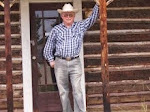
Dr. Don Patton pointing to the claimed petroglyph
of a triceratops near Montrose, CO, in this
photograph from www.bible.ca
Absolutely amazing, isn’t it? This is another example of the
extremities that the Evolution-deniers and Young-Earthers will go to in order
to prove that humans and dinosaurs lived together a few thousand years ago.
Remember, that the goal is to prove the position that the bible says the earth
is only 6,000 years old based upon 17th century Bishop Usher’s
calculation that “the first day of creation began at nightfall preceding Sunday, October 23,
4004 BC” (Wikipedia). In order for that to be true humans and
dinosaurs have to have coexisted for some period. Therefore, they study the
rock art record for pictures that they can brand as dinosaurs. This picture (from www.bible.ca) shows a supposed triceratops petroglyph near Montrose, Colorado. In this picture the hand of Dr. Don Patton points to the image in question.
The anthropomorphs in this panel are Fremont in style which
would date the panel to between over 2,000 years to approximately 1,250 years
BPE. There is, of course, absolutely no way to prove that all the images were
done back then, or that some were not added more recently. In fact, of the
horns on this supposed triceratops one is obviously newer than the others; it
is more heavily abraded, and brighter (less patinated) suggesting that it is
considerably newer, and the longest one looks modified as well. So I have to
assume that this so-called triceratops image has been modified, and it really
wasn’t all that close to the original model anyway. It would seem that if people had indeed been living among dinosaurs when this image was created it should look a lot more like the real thing. In fact, to me, it looks
much more like a Fremont portrayal of a dog which someone modified by adding
another “horn” to two existing ears. In fact dog portrayals are relatively
common in Fremont culture rock art.
By the way, this Dr. Don Patton has a background in geology,
and his PhD is in Education. (http://www.bible.ca/tracks/ask-creationist.htm)
Perhaps someone ought to have educated him about never touching the rock art.
It messes up any attempts at scientific dating. But then, if the dating
cannot be reliably established, it cannot be proven that this is not at all
genuine. Perhaps there is a motive for his handling the surface of the rock
like this after all.
Now, according to conventional science the triceratops lived
in the late Cretaceous period, 65 to 70 million years ago. Its range was Wyoming, Colorado, Montana,
South Dakota, North Dakota, Alberta, and Saskatchewan, so this could have been
within the area that they frequented, but they frequented it 65,000,000 years
ago, not 6,000. (http://www.uwyo.edu/geomuseum/exhibits/triceratops.html)
This has obviously devolved into another situation where we
have diametrically opposite belief systems and I doubt if the twain shall meet.
Young earth believers will probably continue to see dinosaurs in rock art, and
I, just as adamantly, will not see dinosaurs in rock art. How about you?
REFERENCES:
http://www.bible.ca/tracks/ask-creationist.htm
Wikipedia.
Labels:
Colorado,
creationism,
dinosaur,
Montrose triceratops,
petroglyph,
rock art
Saturday, July 26, 2014
SPLIT ROCK SITE, PICKETWIRE CANYONLANDS, COLORADO – A POSSIBLE SOLSTICE/EQUINOX MARKER:
Split Rock site, Picketwire Canyonlands, CO.
Photograph: Peter Faris, 21 June, 1998.
This photo represents a fascinating possibility, not any
sort of certainty, but I put it out here for someone to look into if
interested. I took the picture on June 21, 1998, the Summer Solstice, about
mid-afternoon, at the Split Rock site in the Picketwire Canyonlands, south of
La Junta, Colorado. As you can see a finger-like pointer of sunlight is
approaching a group of seven (?) engraved vertical lines carved inside the passage of the giant split boulder. Now I was not there
at sunrise, or at noon, or sunset, so I cannot speak to how this played out,
but it certainly is intriguing from an archaeoastronomical viewpoint. It
occurred to me then, as it does now, that the outer lines on the grouping might
mark the points reached by the finger of light on the equinoxes, and the
midpoint on the solstices. And then there is that interesting spot of light
centered on the fifth line from the left. I have not been back to the site and
have not done the field research to prove any of this, but I pass it on to
whoever is interested to check out. Just please cite me correctly and let me
know how it plays out, we can publish it on RockArtBlog.
Labels:
archaeoastronomy,
Colorado,
equinox,
petroglyph,
Picketwire,
rock art,
solstice
Saturday, July 19, 2014
MORE EL MORRO ROCK INSCRIPTIONS – DIEGO DE VARGAS, 1692:
El Morro, Cibola County, New Mexico.
The site of El Morro rock in Cibola County, in western New
Mexico, has seen much history. This large rock outcrop has a permanent pool of
water in that arid environment, and prehistorically had a pueblo built on top
of the rock. Ancestral Puebloan rock art can be found on the cliffs and spires
of El Morro, as can the inscriptions and names of later comers. Thus, El Morro
is literally a history book of the region imprinted with those stories and
messages from the past.
Ancestral Puebloan images, El Morro, Cibola County,
New Mexico. Photograph Peter Faris, June 1993.
One of these was the inscription of Diego de Vargas Zapata
Luján Ponce de León y Contreras. “Diego
de Vargas Zapata Luján Ponce de León y Contreras (born in Spain, 1643 – 1704),
commonly known as Don Diego de Vargas, was a Spanish governor of the New Spain
territory of Santa Fe de Nuevo México, today the US states of New Mexico and
Arizona, titular 1690-1692, effective 1692-1696 and 1703 – 1704. He is most
famous for leading the reconquest of the territory in 1692 following the Pueblo
Revolt of 1680. This reconquest is commemorated annually during the Fiestas de
Santa Fe in the city of Santa Fe.” (Wikipedia)
Diego de Vargas - left (p.242), and the
de Vargas coat of arms - right (p. 243),
Kessell, Kiva, Cross, and Crown, 1979.
“Gov. Diego de Vargas,
capable, cocksure, and visibly daring, on February 22, 1691, assumed command of
the dispirited New Mexico colony in exile. He found El Paso a hole. The
poverty, misery, and constant dread of Indian attack had driven many New Mexico
refugee families to desert the El Paso settlements. A muster of men capable of
bearing arms, counting not only the poorly equipped presidial garrison
organized in 1683 but Indian allies as well, turned out scarcely three hundred
in all.” (Kessell 1979:243) Yet in 1692 he had organized troops and
colonists to begin the reconquest of New Mexico.
“Vargas made a dashing
entrada, took Santa Fe, then occupied by Indians, without bloodshed, and
granted forgiveness to the rebels. He made excursions to many pueblos on and
near the Rio Grande, all of which tendered obedience, and at the end of October
he struck out west for Acoma, Zuni and the Hopi pueblos. Submission of the
pueblo of Acoma was obtained, without the use of force, and the expedition
proceeded toward Zuni. The General’s journal entry for Saturday, November 8,
1692 records the arrival of the expedition at El Morro – “a large rock, very
high and broad, at the foot of which is a cavity, like an orange, and in it
water may be collected if there is any; there is no certainty of finding it
supplied with water but God be praised at present there is great abundance. . .
“” (Slater 1961:13)
De Vargas inscription, El Morro, Cibola County,
New Mexico. Photograph Peter Faris, June 1993.
Near this tank (pool of water) is found the De Vargas
inscription of 1692, which may have been inscribed by De Vargas or by one of his men, and which says:
“Aqui estuvo de General Don Diego
de Vargas, quien consuisto
a nuestra Santa Fe y a la Real
Corona todo el Nuevo
Mexico a su costa.
Ano de 1692.” (www.cr.nps.gov/history)
“Here was the General Don Diego
De Vargas, who conquered
For our Holy Faith, and for the Royal
Crown, all the New
Mexico, at his expense,
Year of 1692” (Slater 1961:13)
Close-up of De Vargas inscription, El Morro, Cibola
County, New Mexico. Photograph Peter Faris, June 1993.
General De Vargas surprisingly was welcomed at both Zuni and
Hopi and he returned to Zuni on November 27, 1692. They passed El Morro again
on their way back to the Rio Grande and it is also possible that the inscription dates to this visit. (Slater 1961:14)
“De Vargas reconquered
the Pueblo Indians after their bloody rebellion in 1680 and succeeded in
bringing many colonists from Spain to take up homes in this country. He lies
buried under the altar of the parish church in Santa Fe.”
(www.cr.nps.gov/history)
I will cover a number of the other El Morro inscriptions in
future postings on RockArtBlog.
REFERENCES:
Kessell, John L.
1979 Kiva,
Cross, and Crown, the Pecos Indians and New Mexico, 1540-1840, National
Park Service, U.S. Department of the Interior, Washington D.C.
Slater, John M.
1961 El Morro, Inscription Rock, New Mexico,
The Plantin
Press, Los Angeles.
Wikipedia
Labels:
De Vargas,
El Morro,
historic inscription,
inscription,
New Mexico,
petroglyph,
rock art
Saturday, July 12, 2014
“FRATERNITY OF WAR, PLAINS INDIAN ROCK ART AT BEAR GULCH AND ATHERTON CANYON, MONTANA”
Keyser, James D., David A. Kaiser, George Poetschat, and
Michael W. Taylor, 2012, Fraternity of War, Plains Indian
Rock Art at Bear Gulch and Atherton Canyon, Montana,
Oregon Archaeological Society Press Publication #21, Portland.
This is a truly remarkable book which presents an
encyclopedic record of rock art in two locations in Montana. This 436 page
volume was published by the Oregon Archaeological Society Press (volume 21) and
was written by 14 contributing authors, edited by James D. Keyser, David A.
Kaiser, George Poetschat, and Michael W. Taylor, with technical editing by John
and Mavis Greer, and contributions by a handful of other people. Now I want to
say up front that I do not personally know most of the people involved in this
volume, but I wish I knew them all because they have to all be outstanding
experts in their specialties, with James Keyser shepherding the process and
setting his usual high standards.
The team or panel of rock art experts assembled to compile
this material is truly impressive. Listed on the cover page are the writers,
editors, and other contributors, comprising a who’s-who of expertise in rock
art and archaeology.
Editors: James D. Keyser, David A. Kaiser, George
Poetschat, Michael W. Taylor.
Technical Editors: John Greer, Mavis Greer.
Contributing Authors: James D. Keyser, David A.
Kaiser, John Greer, Mavis Greer, George Poetschat, Carl M. Davis, Angelo
Eugenio Fossati, Melissa (Ray) Gentry, Lisa F. Ripps, Melissa Greer, Mike
Bergstrom, Sara Scott, Marvin Rowe, Amanda Derby.
Forward: Macie (Lundin) Ahlgren.
Technical Contributors: Susan Gray, Stephanie (Young)
Renfro, Ray Baise.
Cover Design and Photographs: Michael W. Taylor.
Containing over 300 illustrations the Fraternity of War not
only provides a detailed record of world class rock art, it provides a data
base of the styles and periods of rock art from the area.
In the preface the authors state: “Bear Gulch and Atherton Canyon are already one of the most studied and extensively published rock art site complexes in North America, rivaling much better known locals such as Writing-On-Stone, The Dalles-Deschutes region of the lower Columbia River, The Coso Range, the lower Pecos River, and Chaco Canyon, Canyon de Chelly, and Barrier Canyon in the Southwest . . . we hope this report adds significantly to the discussion and study of Plains rock art. The number of shield bearing warriors, women, birds, weapons, and various warrior accoutrements composing the Ceremonial Tradition art at these sites far outstrips that from any other Plains site. In addition, though limited in number, the Biographic Tradition compositions at these sites add significantly to the repertoire of that art tradition across all of the Plains. Finally, there are several one-of-a-kind rock art images portrayed only at these sites, including a decorated hide robe, the Standing Bear and Hand of God shield designs, the wolf hat headdress, a trade blanket, and partisan-type lance heads derived from Spanish polearms. These images, and the few dozen others representing earlier styles and traditions, are sufficiently important that no future Plains rock art research will be conducted without reference to some of them. Accordingly, the profession of archaeology owes a major debt of gratitude to the Lundin and Melton families, who not only permitted access to their properties, but actively encouraged this research. ” (Keyser et al. 2012:xiii-xiv)
Shield bearing warrior figure, Bear
Gulch. Photograph by Mike Taylor.
The cover photograph of this book reproduces this beautiful polychrome panel from Bear Gulch, Montana. The white color in this figure is actually produced by scratching the surface of the rock, not by utilizing a white pigment (notice the additional white scratched figures as well). The red and black pigments are added to the surface of the rock. Faint black lines to the left and below the shield represent a feather bustle. These were cataloged on 185 shield bearing warriors at these sites and are considered to be representations of an aggressive buffalo bull's erect tail, conveying power and aggressiveness. (Keyser et al. 2012:133-4)
REFERENCE:
Keyser, James D., David A. Kaiser, George Poetschat, and
Michael W. Taylor
2012 Fraternity
of War, Plains Indian Rock Art at Bear Gulch and Atherton Canyon, Montana,
Oregon Archaeological Society Press Publication #21, Portland.
Saturday, July 5, 2014
DINOSAURS IN ROCK ART? – THE NATURAL BRIDGES SAUROPOD:
Supposed sauropod dinosaur petroglyph in Natural Bridges National Monument, Utah. http://www.stupiddinosaurlies.org/utah-s-false-testimony-to-catastrophe.
To return to the subject of whether or not there are
depictions of dinosaurs in rock art as claimed by Young-Earthers we now take a
look at the supposed petroglyph of a sauropod found in Natural Bridges National
Monument, outside of Blanding, Utah. Remember, they are so eager to find
pictures of dinosaurs in human created imagery because that should prove the
claims of creationists who ascribe to the theory that the bible says the earth
is only 6,000 years old based upon 17th century Bishop Usher’s
calculation that “the creation began at nightfall preceding Sunday, October 23, 4004
BC” (Wikipedia).
Supposed sauropod petroglyph outlined.
http://www.genesispark.com/exhibits/evidence/historical/ancient/dinosaur.
“The picture above was drawn by North
American Anasazi (maybe
Anasazi, perhaps Fremont, Ute, or Paiute)
Indians that lived in the area that has now become Utah approximately 150 B.C.
– 1200 A.D. Even noted anti-creationists agree that it resembles a dinosaur and
that the brownish film which has hardened over the picture, along with the
pitting and weathering, attests to its age. One evolutionist writes, “There is
a petroglyph in Natural Bridges National Monument that bears a startling
resemblance to a dinosaur, specifically a Brontosaurus, with a long tail and
neck, small head and all.” (Barnes and Pendleton, Canyon Country Prehistoric
Indians – Their Culture, Ruins, Artifacts and Rock Art, 1995.)
Clearly a native warrior and an Apatosaur-like
creature are depicted.”
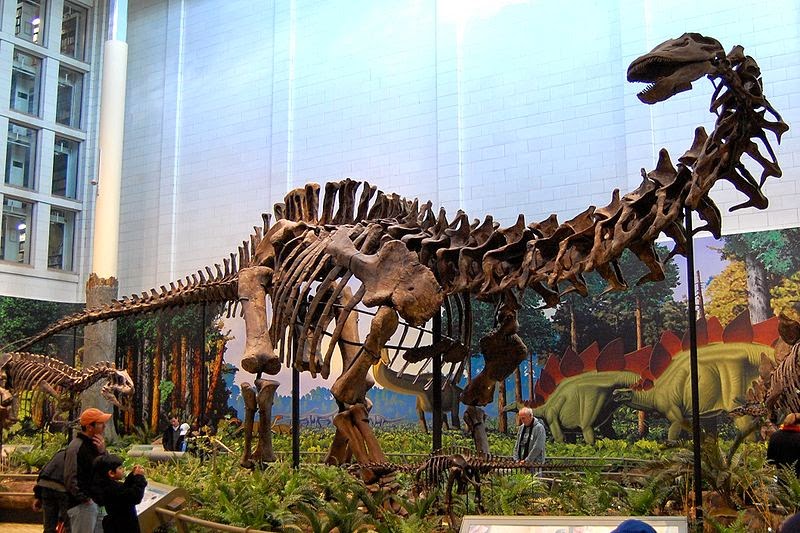
Sauropod dinosaur.
www.wallpaperswala.com
Sauropod dinosaur skeleton. Wikipedia.
The main argument here is basically the same as the one I
used in questioning the Havasupai Canyon hadrosaur. The posture of the animal
is incorrect. Observing this fifty years ago nobody would have really thought
about that because that was when dinosaurs, especially sauropods, were thought
to be slow, plodding tail draggers. Now that scientists have revised this
opinion and reconstruct dinosaurs with their tails sticking out essentially
straight behind, we can see the errors in this petroglyph. Indeed, had it
really been made by a Native American who was co-existing with dinosaurs, he
would have known that the tail should stick out straight and portrayed it that
way. This in itself brands this petroglyph as a modern hoax.
As I have said before, in interpreting rock art we are all
entitled to our own opinions and interpretations, but we are not entitled to make up our own facts.
REFERENCES:
Barnes, F. A., and M. Pendleton
1979 Canyon
Country Prehistoric Indians, Their Cultures, Ruins, Artifacts, and Rock Art,
Wasatch, Salt Lake City.
Wikipedia
Labels:
dinosaur,
Natural Bridges National Monument,
petroglyph,
rock art,
Utah
Saturday, June 28, 2014
HISTORIC INSCRIPTIONS AT EL MORRO, DON JUAN DE OÑATE – THE FIRST HISTORIC INSCRIPTION IN NORTH AMERICA:
El Morro, Cibola County, NM. Photograph: Russ Finley.
One site that has seen much history is El Morro rock in Cibola
County, in western New Mexico. This large rock outcrop has a permanent pool of
water in an arid environment, and pre-historically had a pueblo built on top of
the rock. Ancestral Puebloan rock art can be found on the cliffs and spires of
El Morro, as can the inscriptions and names of later comers.
Onate inscription over prehistoric figure, dated 1605,
El Morro, Cibola County, NM. Photograph: Russ Finley.
The earliest historic
inscription on El Morro is that of Don Juan de Oñate who annexed New Mexico to
the Spanish empire. “In 1595 he was
ordered by King Phillip II to colonize the northern
frontier of the Viceroyalty of New Spain. His stated objective
was to spread Roman Catholicism by establishing new missions in Nuevo México.
He began the expedition in 1598, fording the Rio Grande (Río del Norte) near present day El Paso in
late April.” (Wikipedia)
“In January, 1598 a
colonizing expedition moved north out of San Geronimo (located in what is now
the state of Chihuahua in northern Mexico). It was under the leadership of Juan
de Oñate, a resident of Zacatecas who was fifty years old at the time. It
included 121 Spanish soldier-colonists, some with their families, several
missionaries, and a number of persons of mixed Spanish and Indian descent –
about 400 persons in all. The colonists took wagons, tools, livestock and
everything else needed for conquest and settlement.” (Slater 1961:4)
“Late in April, 1598 the expedition crossed the Rio Grande,
in the vicinity of modern El Paso, Texas, and proceeded north. Headquarters
were made at the pueblo of Caypa, renamed San Juan, on the Rio Grande north of
modern Santa Fe.” (Slater 1961:5)
"On April 30, 1598, he claimed all of the territory across
the river crossing to the north for the Spanish Empire. That summer his party continued up the middle Rio Grande
Valley to present day northern New Mexico, where he encamped among
the Pueblo Indians. He founded the Province of Santa Fe de Nuevo México, and was its
first colonial governor.” (Wikipedia)
The first known historic inscription to be placed on El Morro "is that of Don Juan de Oñate, governor and colonizer of
New Mexico, and founder of the city of Santa Fe, who in 1605, on his return
from a trip to the head of the Gulf of California, passed by El Morro and
carved a record of his visit.” (http://www.cr.nps.gov/history/online_books/glimpses2/glimpses10.htm)
“Although his contract
authorized Oñate to bring two ships a year “free of taxes and import duty” to
New Mexico, the adelantado still had not traveled to the coast and identified a
harbor. That challenge he met at last between October 1604 and April 1605, while
the fifty or so colonists left all winter at San Gabriel told stories by the
fire, made love, and wondered if the ocean had swallowed him up. To prove that
it had not, a member of the party inscribed deeply in the sheer sandstone wall
behind the pool at El Morro: “Adelantado don Juan de Oñate passed this way on
the 16th of April 1605 returning from the discovery of the South Sea.” “I
discovered a great harbor,” he wrote apprehensively to a new viceroy, “and
clarified the reports of extraordinary riches and monstrosities never heard of
before.” (Kessell 2002:86)
The translation of this inscription, the earliest known
historic inscription at El Morro, and quite probably the earliest historic
inscription in North America reads as follows:
There passed this way the Adelantado Don Juan
De Oñate, from the discovering of the South
Sea, on the 16th of April, 1605.” (Slater 1961:7)
It is not my intention here to present the whole story of Don
Juan de Oñate (you can look that up at your local library, or online), just to present what might be the single earliest authentic
historic inscription in North America. Why historic inscriptions instead of
older Native American rock art? In many instances a historic inscription can
actually tell a story, we can research the details behind its history and know
much more of its meaning and content. That, in itself, can bring us an exciting
involvement that is harder to find with the more ambiguous Native American rock
art. In past postings I have presented inscriptions about Antoine Robidoux, the
11th Ohio Volunteer Cavalry, the 5th Cavalry, General Crook, the 2nd Colorado
Cavalry, and others. While the primary focus of RockArtBlog will remain prehistoric rock
art, I will continue periodically present historic material that I feel to be of interest.
REFERENCES:
Kessell, John L.
2002 Spain in the
Southwest, A Narrative History of Colonial New Mexico, Arizona, Texas, and
California, University of Oklahoma Press, Norman.
Slater, John M.
1961 El Morro,
Inscription Rock, New Mexico, Plantin Press, Los Angeles.
Wikipedia
Labels:
El Morro,
historic inscription,
New Mexico,
Oñate,
petroglyph,
rock art
Saturday, June 21, 2014
DINOSAURS IN ROCK ART? – THE HAVASUPAI CANYON HADROSAUR:
Havasupai Canyon panel. Picture
from www.6000years.org.
One of the first, and still most popular, examples of
dinosaurs in rock art that creationists and young-earthers point to is the
Havasupai Canyon hadrosaur (duck-billed
dinosaur). Creationists are driven to prove the position that the bible says
the earth is only 6,000 years old based upon 17th century Bishop
Usher’s calculation that “the first day of creation began at nightfall
preceding Sunday, October 23, 4004 BC” (Wikipedia).
This dinosaur petroglyph was discovered by Samuel Hubbard, Curator of Archaeology of the Oakland Museum, in the late 1800s. Hubbard led an expedition to the Havasupai Canyon area of the Grand Canyon. “On two occasions in the late 1800s,
Samuel Hubbard, Curator of Archaeology of the Oakland Museum, visited an area
of the Grand Canyon known as the Havasupai Canyon. As an evolutionist, he was
amazed to find a petroglyph (carved rock drawing) of an elephant made by Native
Americans. But another depiction was “cut into the sandstone much more deeply
than the elephant.” Its height was 11.2 inches, with a neck approximately 5.1
inches in length and a tail of 9.1 inches. What kind of animal is it? Dr.
Hubbard believed that he had found an ancient drawing of a dinosaur.” http://www.genesispark.com/exhibits/evidence/historical/ancient/dinosaur/)
Charles R. Knight painting of a hadrosaur.
Photograph from www.muttpop.fr.
I first heard of this one many years ago. When I was young
these creatures were often pictured as standing upright on the tripod formed by
their legs and tail, pretty much as this petroglyph shows. Recently, of course,
paleontologists have rethought those old assumptions and now know that these
creatures held their body and tail much more horizontally. What this means is
that, where some time back this image seemed to make some sense, we now know
that this is totally incorrect. That brands this either as an error of
identification, or a hoax. Indeed some researchers now point to the shape of
the head and suggest it might be a poorly drawn bird, but, of course, then the
tail makes no sense at all.
Grand Canyon hadrosaur petroglyph showing the
supposed "bullet hole" at the base of the tail.
Photograph from www.bible.ca.
“An example of Native American rock art carved into the
walls of Grand Canyon. It was discovered in 1879 by E. L. Doheny and documented
in 1924 by a scientific expedition which included Dr. Charles W. Gilmore, Curator
of Vertebrate Paleontology, United States National Museum. The resulting
publication reported as "fact" that "some prehistoric man made a
pictograph of a dinosaur on the walls of this canyon..." Doheny
Scientific Expedition, p.5. Recently someone used it as a target practice
and you can see a bullet hole at the base of the tail. It shows just how old
the etchings must be since the fresh bullet mark cuts through the thick
"rock varnish". (www.bible.ca)
Now I have to question the “bullet
hole” alluded to above. It shows in the photo as a white disk with not internal
textural detail or shading visible and no sign of the color of the base rock.
Even if a real hole had been heavily chalked to make it stand out it would show
differences of light and shadow with the brightest side facing the direction of
the sun and shadowing on the side facing away from the sun. This leads me to suspect
that the “bullet hole” was created in Photoshop
or Microsoft Paint and is not real.
Notice in the photo of the petroglyph with the illustration by Paul Taylor (below) there is no bullet hole.
Havasupai Canyon petroglyph and a rendering by Paul Taylor of
how the model would have been standing were it an authentic
picture of a hadrosaur. www.paleo.cc/ce/dino-art.htm.
That brings us to the pair of pictures by Paul Taylor. He
shows a photo of the petroglyph on the left and a painting of his
interpretation of the actual animal on the right, and he has concluded that it
is an Edmontosaurus. This is explained
as follows: “For example, in his creationism-promoting
book The Great Dinosaur Mystery,
which is aimed at young readers, Paul Taylor shows a petroglyph from Havasupai
Canyon in Arizona. He highlights the petroglyph with a white outline, shown
alongside a painting labeled "Edmontosaurus" (a type of two-legged
Hadrosaur dinosaur). As depicted by Taylor, the two profiles look virtually
identical. To an unsuspecting reader (especially a child) this might be
impressive, and foster the conclusion artist must have seen such a dinosaur.”
As I said above, fifty years ago
this would seem to have made sense because our picture of all dinosaurs
(including hadrosaurs) was quite
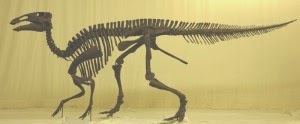
different. Compare the illustrations above with the illustration of the hadrosaur from Wikipedia, and look at
the reconstructed skeleton. Indeed, had it really been made by a Native
American who co-existed with dinosaurs and could see them in person, he would have known that the tail should stick out
straight and portrayed it that way. This in itself brands this petroglyph as a
modern hoax. Either that, or it is meant to be
something else and was done so poorly that it is totally unrecognizable. Either
way, it certainly is not a hadrosaur
dinosaur.
REFERENCES:
www. 6000years.org
Wikipedia
Subscribe to:
Posts (Atom)