According to Wikipedia right-handedness is most common. Right-handed people are more dexterous with their right hands when performing tasks. A variety of studies suggest that 70-90% of the world population is right-handed, rather than left-handed or any other form of handedness. Left-handedness is less common than right-handedness. Left-handed people are more dexterous with their left hands when performing tasks. A variety of studies suggest that 8–15% of the world population is left-handed.
Sunday, November 20, 2011
HANDEDNESS:
On August 5, 2009, I posted a column on Hand prints in Rock Art in which I discussed the fact that a viewer can sometimes determine the gender of a rock art creator by measuring the relative length of the first and third fingers in a hand print. Statistically more males have a longer third finger while more females have a longer first finger.
Hand-prints, Texas. Photo: Peter Faris, 2004.
According to Wikipedia right-handedness is most common. Right-handed people are more dexterous with their right hands when performing tasks. A variety of studies suggest that 70-90% of the world population is right-handed, rather than left-handed or any other form of handedness. Left-handedness is less common than right-handedness. Left-handed people are more dexterous with their left hands when performing tasks. A variety of studies suggest that 8–15% of the world population is left-handed.
I believe it is also possible to get a suggestion of the handedness of the creator of the rock art by examining a hand print. A human normally finds one side or the other dominant and capable of finer control and dexterity.
According to Wikipedia right-handedness is most common. Right-handed people are more dexterous with their right hands when performing tasks. A variety of studies suggest that 70-90% of the world population is right-handed, rather than left-handed or any other form of handedness. Left-handedness is less common than right-handedness. Left-handed people are more dexterous with their left hands when performing tasks. A variety of studies suggest that 8–15% of the world population is left-handed.
Now how would we apply this knowledge to the analysis of a hand print in rock art? It seems to me that if the hand print is actually a print of a hand – a hand covered in paint and applied flat to the rock face – the creator of the image would probably use their dominant hand out of force of habit. Therefore if it is a print of a right hand it was probably a right-handed person and if it is a print of a left hand it was probably a left-handed person.
If, on the other hand (pun intended), it is a tracing of a hand, whether painted or pecked, it is probably the opposite because the creator would be using their dominant hand to do the tracing around the less useful hand that they were holding flat against the rock face. When the outline was made permanent, either with paint or by pecking, it was a recording of the person’s subordinate hand, not the dominant one.
Applying this reasoning to the same panel of hand prints in Texas that I photographed in 2004 and used to illustrate the August 5, 2009 posting about hand-prints we see that these hand-prints were made with a paint covered right hand applied flat to the rock face. We have already seen that these prints indicated that their creator was probably a male, now we can see that he was probably a right-handed male. Not bad for a group of anonymous hand-prints.
Labels:
finger length ratio,
gender,
handedness,
Handprint,
pictograph,
rock art,
Texas
Saturday, November 12, 2011
ANIMALS IN ROCK ART, THE PUSH-ME-PULL-YOU:
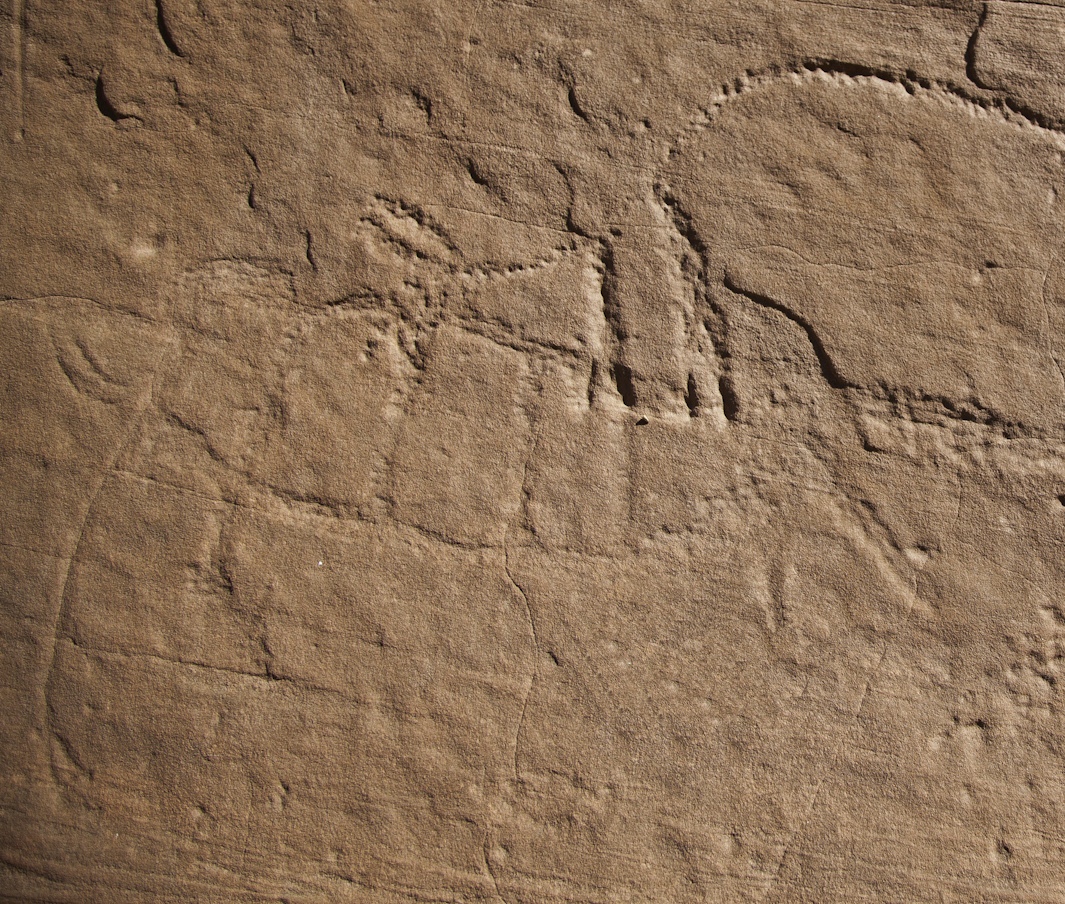
Push-me-pull-you (right center of photo), at the mouth
of Salt Arroyo, Purgatoire Canyon, Bent County,
Colorado. Photo: Peter Faris, June 1998.
Of all the many portrayals of animals (zoomorphs) in rock art some of the most fascinating are the double ended animals known lightheartedly as “Push-Me-Pull-You’s”. On May 1, 2010, I published a posting entitled Sisiutl – The 2-Headed Serpent. Sisiutl, a snake with a head at each end, represents one form of the “Push-Me-Pull-You”.
The more common form that these creatures take however is that of a quadruped, a four legged animal with a head at each end. What these Push-Me-Pull-You’s actually represented to their creators I do not know. I can show a few examples to illustrate the general form of this creature, but except for Sisiutl (mentioned above) I have no idea as to what they were intended to mean.
Push-me-pull-you, Rochester Creek,
Utah. Photo: Peter Faris, 1993.
Alex Patterson (1992:202) suggested that the two-headed animals “zoomorphs with a head at both ends” is an animal birth scene representing the “invariable head-first appearance of many animals at birth.” Can this be the meaning of these enigmatic creature? Well, it is a very clever idea and may, in fact, actually be applicable in some instances. However, many of the Push-Me-Pull-You’s are shown with what appear to be horned heads on both ends, and no animal I know of is born with a set of adult horns in place. An example is the Push-Me-Pull-You from Rochester Creek in Utah which has a set of Bighorn Sheep horns on the head at each end.
Push-me-pull-you.
So, this brings me back to the question what do they represent? I really have no idea, but I would like to hear your suggestions.
REFERENCE:
Patterson, Alex
1992 A Field Guide To Rock Art Symbols Of The Greater Southwest, Johnson Books, Boulder.
Labels:
Baca county,
Bent County,
Purgatoire,
push-me-pull-you,
Sisiutl
Sunday, November 6, 2011
THE UPPER SAND ISLAND MAMMOTH PETROGLYPH, UTAH:
Veteran readers of RockArtBlog may remember that I have published postings on the subject of mammoths in North American rock art in the past. On May 4, 2009, I posted A Possible Mastodon Petroglyph in Southeastern Colorado, and on April 16, 2011, I posted a column entitled The Earliest Art in North America, The Vero Beach Mammoth. Additionally, on November 25, 2009, I posted Elephantids in North American Rock Art – The Moab Mastodon, in which I explained my disbelief in the identification of what has been called the Moab Mastodon.
Ekkehart Malotki. Photograph used by
Petroglyph panel with images highlighted, San Juan
River, Utah,upstream from Sand Island. Photograph
used by permission of Ekkehart Malotki.
Behind all of this, however, I have always felt a strong conviction that there should be examples of mammoths and mastodons in North American rock art. We know people in North America coexisted with these Pleistocene giants, we know that they preyed on them, there should be examples of mammoths and mastodons in rock art, but, of all the candidates suggested so far only the Vero Beach mammoth has supposedly been scientifically authenticated (and I say supposedly because I do not believe that test results have been fully proven yet). Mammoth petroglyph from the right side of the panel.
The mammoth image on the left side of the picture is
partially superimposed by a large bison. Photograph
used by permission of Ekkehart Malotki.
Mammoth 1 - close up of proposed mammoth petroglyph.
Photograph used by permission of Ekkehart Malotki.
Now from the great rock art site of Sand Island on the San Juan River, near Bluff, Utah, internationally known author and rock art researcher Ekkehart Malotki, and H. D. Wallace, have put forth a new candidate (I should say candidates) in the search for elephantids in rock art. Malotki is emeritus professor of modern languages at Northern Arizona University, while Wallace is an archaeologist from Tucson, Arizona. They have described a couple of petroglyphs from that site that they have identified as representations of mammoths dating to the Pleistocene/Holocene transitional period. Malotki was originally introduced to the possible mammoth by Joe Pachak, an artist from nearby Bluff, Utah. This identification is based upon details such as the bifurcated trunk tip of the mammoth which Malotki suggests a forger would not know about, and their height (approx. 5 meters) above the present day ground level and weathered condition.
Mammoth 2 - close up of proposed mammoth petroglyph
from the left side of the panel. Photograph used by
permission of Ekkehart Malotki.
As I have not yet seen the petroglyphs in person I will refrain from cluttering up the discussion with my own speculation other than to say that I truly hope that Malotki and Wallace are correct. I want there to be petroglyphs of mammoths and mastodons in North American – there should be petroglyphs of mammoths and mastodons in North America. People were here while the great beasts were still alive, and people make marks and pictures.
Ekkehart Malotki. Photograph used by
permission of Ekkehart Malotki.
I also want to congratulate Malotki and Wallace on having the courage and dedication to stand up and say what they believe they have, especially knowing that stating this opinion may invite considerable controversy, and sometimes personal attacks. I hope that this debate can stay civilized. In any case this will be fun to watch as it plays out in the arena of scientific opinion.
See the full paper at www.stonepages.com/docs/malotki-wallace.pdf
Labels:
Bluff,
Ekkehart Malotki,
elephantids,
H. D. Wallace,
mammoth,
petroglyph,
San Juan river,
Utah
Saturday, October 29, 2011
CIMARRON RIVER MONSTER:
Petroglyph of a River Monster along the Cimarron River
in Northeastern New Mexico. Photo: Bill McGlone.
This remarkable photo was taken by Bill McGlone a couple of decades ago along the Cimarron River in northeastern New Mexico. It appears to be a portrayal of the head and foreparts of a large creature and incorporates considerable work as well as an example of incorporating a natural projection of the cliff face for the head. My first reaction upon seeing this image was that it is a portrayal of the Mesoamerican Quetzalcoatl, the feathered serpent. It certainly bears what appears to be a ruff of feathers on top of the head. What might represent a fin can be seen projecting downward from behind the head.
Drawing of the river monster petroglyph, Cimarron
River, New Mexico. Drawn by Peter Faris.
Virtually all of the peoples of the American Great Plains believed in underwater monsters living in the lakes and rivers. I have written elsewhere that I assume that such beliefs were originally inspired by the erosion of the large bones of prehistoric mammals (mammoths, mastodons, etc.) out of the river banks during the spring runoff. Given the location of this large, complex petroglyph near the Cimarron River in northeastern New Mexico I believe we are justified in assuming that it represents one of these great underwater monsters.
Of the people who occupied that area during prehistoric and protohistoric times, we can identify the Southern Cheyenne, the Comanche, and the Kiowa. The area that the Kiowa claimed as their homeland lay in the southwestern plains adjacent to the Arkansas River in southeastern Colorado and western Kansas and the Red River drainage of the Texas Panhandle and western Oklahoma.
Zemoguani, painted lodge, collected by James Mooney,
1891-1904. National Anthropological Archives.
The Kiowa version of the great underwater monster was the zemoguani. Portrayals of zemoguani were collected by the anthropologist James Mooney in 1904 from the Kiowa. These include a painted model tipi with zemoguani on its side and a hide painting of a Kiowa camp circle showing the painted zemoguani tipi erected in its place in the camp circle.
Kiowa Model Painted Tipi with Zemoguani, National Cowboy
& Western Heritage Museum, Oklahoma City, OK.
As I said above the first reaction of many viewers to this remarkable petroglyph is that it is Quetzalcoatl, but given the location of the image on the cliff in the area claimed by the Kiowa, and given its resemblance to zemoguani, I personally feel that this identification is more reasonable.
Labels:
Cimarron River,
Kiowa,
New Mexico,
underwater monsters,
zemoguani
Sunday, October 23, 2011
NOT REALLY ROCK ART - TOOL GROOVES:
Tool sharpening grooves in a boulder.
Freezeout Canyon, Baca County,
Colorado. Photo: Peter Faris, 1996.
There are certain types of rock markings that really should not be called rock art. One of these is the tool sharpening groove. These are created by the act of sharpening a bone or antler-tine awl on the rock surface. As the tool is sharpened it also wears away the surface of the rock. As the point becomes sharper the groove it wears is also narrower, eventually becoming a “v-shaped” groove abraded into the rock. Another type of tool mark on the surface of the rock is a wider, shallow smoothed area that is created by sharpening the edge of a stone tool such as an axe. Many examples of these can be seen in the illustration of the site from the Picketwire Canyonlands. Another example often lumped in with rock art (or at least recorded with the rock art at a site) is the bedrock metate, a shallow hollow in a horizontal rock surface that was used for grinding plant materials with a hand held stone called a mano.
Tool sharpening grooves in cliff,
Picketwire Canyon, Bent County,
CO. Photo: Peter Faris, 1997.
Linea Sundstrom has pointed out that tool grooves can be helpful in roughly estimating dates. Tool sharpening grooves essentially ceased being made when trade with Anglos, whether European or American, began to trade goods for furs, because among early essential items for such trade were metal awls and needles. This suggests that any rock markings that can be identified as tool grooves were basically prehistoric. The presence of tool grooves also suggests either a habitation site or, at least, a site where preparations for domestic chores were conducted. I believe we got into the habit of including these indications of industrial practices in with rock art because when rock art is being recorded it is considered important to record all features on the surface of the rock, including tool grooves, axe sharpening hollows, and bedrock mutates.
Some examples can be found where tool-sharpening grooves have been incorporated into rock art images. I have seen tool sharpening grooves that had been turned into lizards by the addition of four legs paired on both sides of the groove by pecking or abrasion.
If the tool groove is somehow incorporated into a rock art image as in the lizards mentioned above, then I would classify the modified tool groove as rock art. If the tool groove, however, is not modified, or demonstrably incorporated into rock art elements, I will have to classify it as another element of the rock surface that needs to be recorded, but not as rock art.
Labels:
Baca county,
Colorado.,
Picketwire,
Tool grooves
Saturday, October 15, 2011
MESA PRIETA PETROGLYPH PROJECT EDUCATION PROGRAMS:
Katherine Wells with rock art panel.
Photo: Peter Faris, September 2011.
In addition to recording the rock art and working for its preservation the Mesa Prieta Petroglyph Project has a major focus on educational programming. One facet of this is providing docent-led tours of rock art, including tours for a 4th grade level curriculum they have developed for local public and Pueblo schools as a adjunct to the study of New Mexico history in the 4th grade social studies curriculum. These classes complete at least six classroom activities before visiting the Wells Petroglyph Preserve on Mesa Prieta for a field work day. In the field these students participate with adult volunteer docents in discovery hikes and identify petroglyph themes and elements and compare relative patina or rock varnish to estimate relative age. Such field trips give the students a real sense of the history and cultural significance of the rock art. Many of these students are descendants of the people who created the images centuries ago and they can experience a personal identification with the imagery and what they have learned about its creators.
In addition to helping these children develop a sense of identity with the creators of the rock art it is very hard to imagine that any of these students in later years will participate in vandalism against rock art sites. Such a program seems like a win-win situation for all concerned and could serve as a model for other rock art sites. It certainly deserves support and encouragement.
Donations may be mailed to: Mesa Prieta Petroglyph Project, P.O. Box 407, Velarde, NM, 87582.
mesaprieta@cybermesa.com
Friday, October 7, 2011
KWAHU, THE EAGLE KACHINA:
Eagle head, Three Rivers, New Mexico. Photo
November 1988, John and Esther Faris.
One category of images commonly seen in rock art in almost all areas of North America represents sky themes. This is especially true in the American Southwest where climatic conditions are generally dry and desert-like, and people relied upon regular rain for their food supplies. In the southwest numerous petroglyphs and pictographs of birds (especially eagles who are the beast deities of above) can be found, and one is a kachina figure seen in Puebloan Kachina dance rituals representing Kwahu, the eagle kachina. The eagle ruled the sky, and was thus in charge of the source of the rain needed for crops. Eagle petroglyphs are particularly common in areas near the region of the upper Rio Grande where dense populations of Pueblo peoples relied heavily on agriculture for subsistence.
The first illustration (above) is a grand naturalistic eagle head from the large petroglyph site at Three Rivers, New Mexico. Eagle, star, and lightning. Galisteo dike,
New Mexico. Photo: Peter Faris.
The petroglyph of the eagle with a star and lightning is from Galisteo dike. This combination of sky themes in one composition covers all the bases toward the source of rain. The mixture of eagle and star themes is very common in Galisteo, and also at Petroglyph Park west of Albuquerque. Adding the lightning in this example reinforces the water connection as lightning usually occurs in conjunction with rain.
As a kachina, Kwahu wears a case mask painted blue-green although older examples were sometimes brown. It possesses an eagle-shaped beak with a black inverted “V” or chevron above it. Occasionally, in one of the night ceremonies in March or during the Powamu, one may have the satisfaction of seeing a performance of the Eagle Kachina. Usually the performer imitates the step or motion and cry of the eagle to absolute perfection. Eagle Kachinas will sometimes appear with Mudheads at night ceremonies in March.Eagle (Kwahu) kachina mask, Three Rivers,
New Mexico. Photo: Peter Faris.
This petroglyph from Three Rivers, New Mexico, appears to represent an eagle mask seen from the side. It shows the hooked beak of the eagle pointing to the left, with a large eye, and a double diagonal line beneath the eye like the common tear motif which can be related to the inverted “V” or chevron seen above the beak of the eagle kachina illustrated. Given the location of Three Rivers there are basically three birds that have this natural marking and that this petroglyph might represent. The three are Prairie Falcon, Peregrine Falcon, and the American Kestral, all of which can be seen in the area and which have the natural “tear marking” below their eye as seen in the petroglyph. This feature is, however, also an attribute of the mask representing Kwahu, and has probably become a generic symbol for the raptors in general, thus its use on the Eagle kachina.
Labels:
eagle,
Galisteo,
kachina,
Kwahu,
New Mexico,
Three Rivers
Subscribe to:
Posts (Atom)